


JEE Advanced · Mathematics · 25. AOD
Let \(f(x)=(1-x)^{2} \sin ^{2} x+x^{2}\) for all \(x \in I R\) and let \(g(x)=\int_{1}^{x}\left(\frac{2(t-1)}{t+1}-\ln t\right) f(t) d t\) for all \(x \in(1, \infty)\).
Question: Which of the following is true?
- A \(g\) is increasing on \((1, \infty)\)
- B \(g\) is decreasing on \((1, \infty)\)
- C \(g\) is increasing on \((1,2)\) and decreasing on \((2, \infty)\)
- D \(g\) is decreasing on \((1,2)\) and increasing on \((2, \infty)\)
Answer & Solution
Correct Answer
(B) \(g\) is decreasing on \((1, \infty)\)
Step-by-step Solution
Detailed explanation
\(g(x)=\int_{1}^{x}\left(\frac{2(t-1)}{t+1}-\ln t\right) f(t) d t\), \(\therefore \quad g^{\prime}(x)=\left[\frac{2(x-1)}{x+1}-\ln x\right] f(x)\)
Here \(f(x)>0, \forall x \in(1, \infty)\)
Let \(h(x)=\frac{2(x-1)}{x+1}-\ln x\)
\(\therefore \quad h^{\prime}(x)=\frac{4}{(x+1)^{2}}-\frac{1}{x}=\frac{-(x-1)^{2}}{(x+1)^{2} x} < 0, x \in(1, \infty)\)
\(\Rightarrow h(x)\) is decreasing function.
Hence, for \(x>1, h(x) < h(1) \Rightarrow h(x) < 0 \forall x>1\)
\(\Rightarrow g^{\prime}(x) < 0 \forall x \in(1, \infty)\)
Therefore, \(g(x)\) is decreasing on \((1, \infty)\).
Here \(f(x)>0, \forall x \in(1, \infty)\)
Let \(h(x)=\frac{2(x-1)}{x+1}-\ln x\)
\(\therefore \quad h^{\prime}(x)=\frac{4}{(x+1)^{2}}-\frac{1}{x}=\frac{-(x-1)^{2}}{(x+1)^{2} x} < 0, x \in(1, \infty)\)
\(\Rightarrow h(x)\) is decreasing function.
Hence, for \(x>1, h(x) < h(1) \Rightarrow h(x) < 0 \forall x>1\)
\(\Rightarrow g^{\prime}(x) < 0 \forall x \in(1, \infty)\)
Therefore, \(g(x)\) is decreasing on \((1, \infty)\).
See the Complete Solution
Get step-by-step explanations for this and 2.5 Lakh+ more JEE, NEET & CET questions.
- Unlock all solutions
- Practice the full chapter
- Track accuracy across PYQs
4.8 rated on Google Play · 14,000+ reviews
More questions from Mathematics
- Paragraph:
Let \(A, B, C\) be three sets of complex numbers as defined below.
\(A=\{z ; \operatorname{lm} z \geq 1\} ; B=\{z:|z-2-i|=3\} ;\) \(C=\{z: \operatorname{Re}((1-i) z)=\sqrt{2}\}\).
Question:
Let \(z\) be any point in \(A \cap B \cap C\) and let \(w\) be any point satisfying \(|w-2-i| < 3\). Then, \(|z|-|w|+3\) lies betweenJEE Advanced 2008 Medium - Let \(f(x)\) be a continuously differentiable function on the interval \((0, \infty)\) such that \(f(1)=2\) and \(\underset{t \rightarrow x}{\lim} \frac{t^{10} f(x)-x^{10} f(t)}{t^9-x^9}=1\) for each \(x>0\). Then, for all \(x>0, f(x)\) is equal toJEE Advanced 2024 Medium
- Let \(f: R \rightarrow R\) be a continuous function, which satisfies \(f(x)=\int_0^x f(t) d t\). Then, the value of \(f(\ln 5)\) isJEE Advanced 2009 Easy
- Let denote the complex conjugate of a complex number . If is a non-zero complex number for which both real and imaginary parts of are integers, then which of the following is/are possible value(s) of ?JEE Advanced 2022 Hard
- If \(\lim _{x \rightarrow \infty}\left(\frac{x^{2}+x+1}{x+1}-a x-b\right)=4\), thenJEE Advanced 2012 Hard
- Four persons independently solve a certain problem correctly with probabilities . Then the probability that the problem is solved correctly by at least one of them isJEE Advanced 2013 Medium
More PYQs from JEE Advanced
- In a high school, a committee has to be formed from a group of boys
and girls .
(i) Let be the total number of ways in which the committee can be formed such that the committee has members, having exactly boys and girls.
(ii) Let be the total number of ways in which the committee can be formed such that the committee has at least members, and having an equal number of boys and girls.
(iii) Let be the total number of ways in which the committee can be formed such that the committee has members, at least of them being girls.
(iv) Let be the total number of ways in which the committee can be formed such that the committee has members, having at least girls and such that both and are NOT in the committee together.
The correct option is:LIST-I LIST-II A. The value of is P. B. The value of is Q. C. The value of is R. D. The value of is S. T. U. JEE Advanced 2018 Medium - List I describes thermodynamic processes in four different systems. List II gives the magnitudes (either exactly or as a close approximation) of possible changes in the internal energy of the system due to the process.
Which one of the following options is correct?List-I List-II (I) of water is converted to steam at the same temperature, at a pressure of . The volume of the system changes from to in the process. Latent heat of water (P) (II) moles of a rigid diatomic ideal gas with volume at temperature undergoes an isobaric expansion to volume . Assume (Q) (III) One mole of a monoatomic ideal gas is compressed adiabatically from volume and pressure to volume . (R) (IV) Three moles of a diatomic ideal gas whose molecules can vibrate, is given of heat and undergoes isobaric expansion. (S) (T) JEE Advanced 2022 Medium - Paragraph:
Let \(p, q\) be integers and let \(\alpha, \beta\) be the roots of the equation, \(x^{2}-x-1=0\), where \(\alpha \neq \beta\). For \(n=0,1,2, \ldots\), let \(a_{n}=p \alpha^{n}+q \beta^{n}\)
FACT: If \(a\) and \(b\) are rational numbers and \(a+b \sqrt{5}=0\), then \(a=0=b\).
Question:
If \(a_{4}=28\), then \(p+2 q=\)JEE Advanced 2017 Medium - If \(z\) is any complex number satisfying \(|z-3-2 i| \leq 2\), then the maximum value of \(|2 z-6+5 i|\) isJEE Advanced 2011 Hard
- Let \(A_n=\left(\frac{3}{4}\right)-\left(\frac{3}{4}\right)^2+\left(\frac{3}{4}\right)^3+\ldots+(-1)^{n-1}\)\(\left(\frac{3}{4}\right)^n\) and \(B_n=1-A_n\). Find a least odd natural number \(n_0\), so that \(B_n>A_n, \forall n \geq n_0\).JEE Advanced 2006 Medium
- For the reaction, \(\mathbf{X}(s) \rightleftharpoons \mathbf{Y}(s)+\mathbf{Z}(g)\), the plot of \(\ln \frac{p_{\mathbf{Z}}}{p^{\theta}}\) versus \(\frac{10^{4}}{T}\) is given below (in solid line), where \(p_{\mathbf{Z}}\) is the pressure (in bar) of the gas \(\mathbf{Z}\) at temperature \(T\) and \(p^{\theta}=1\) bar.
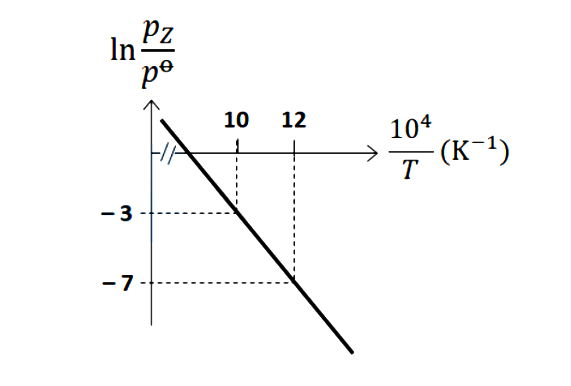
(Given, \(\frac{\mathrm{d}(\ln K)}{\mathrm{d}\left(\frac{1}{T}\right)}=-\frac{\Delta H^{\theta}}{R}\), where the equilibrium constant, \(K=\frac{p_{z}}{p^{\theta}}\) and the gas constant, \(\mathrm{R}=8.314 \mathrm{~J} \mathrm{~K}^{-1} \mathrm{~mol}^{-1}\) )
The value of (in ) for the given reaction, at is ___.JEE Advanced 2021 Hard