


JEE Advanced · Mathematics · 31. 3D Geometry
Let \(L_1\) be the line of intersection of the planes given by the equation- \(2 x+3 y+z=4 \text { and } x+2 y+z=5 .\)
Let \(L_2\) be the line passing through the point \(P(2,-1,3)\) and parallel to \(L_1\). Let \(M\) denote the plane given by the equation- \(2 x+y-2 z=6\)
Suppose that the line \(L_2\) meets the plane \(M\) at the point \(Q\). Let \(R\) be the foot of the perpendicular drawn from \(P\) to the plane \(M\).
Then which of the following statements is (are) TRUE?
- A The length of the line segment \(P Q\) is \(9 \sqrt{3}\)
- B The length of the line segment \(Q R\) is 15
- C The area of \(\triangle P Q R\) is \(\frac{3}{2} \sqrt{234}\)
- D The acute angle between the line segments \(P Q\) and \(P R\) is \(\cos ^{-1}\left(\frac{1}{2 \sqrt{3}}\right)\)
Answer & Solution
Correct Answer
(C) The area of \(\triangle P Q R\) is \(\frac{3}{2} \sqrt{234}\)
Step-by-step Solution
Detailed explanation
Let \(L_1: \vec{r}=\vec{a}+t \vec{b}\)
\(\overrightarrow{\mathrm{b}}=\left|\begin{array}{ccc}\hat{\mathrm{i}} & \hat{\mathrm{j}} & \hat{\mathrm{k}} \\ 2 & 3 & 1 \\ 1 & 2 & 1\end{array}\right|=\hat{\mathrm{i}}(1)-\hat{\mathrm{j}}(1)+\hat{\mathrm{k}}(1)\)
Dr's of \(L_1: <1,-1,1>\)
\(\begin{aligned}
& L_1: \frac{x+1}{1}=\frac{y-0}{-1}=\frac{z-6}{1} \\
& \& L_2: \frac{x-2}{1}=\frac{y+1}{-1}=\frac{z-3}{1}=\lambda \\
& M: 2 x+y-2 z-6=0
\end{aligned}\)
Let point on \(\mathrm{L}_2(\lambda+2,-\lambda-1, \lambda+3)\)
\(\begin{aligned}
& 2(\lambda+2)-\lambda-1-2 \lambda-6-6=0 \\
& 2 \lambda+4-3 \lambda-13=0 \\
& \lambda=-9 \\
& \therefore Q(-7,8,-6)
\end{aligned}\)
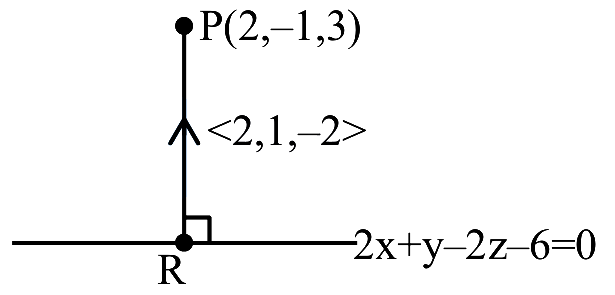
Line PR: \(\frac{x-2}{2}=\frac{y+1}{1}=\frac{z-3}{-2}=\mu\)
\(\mathrm{R}(2 \mu+2, \mu-1,-2 \mu+3)\)
Put in plane
\(\begin{aligned}
& 2(2 \mu+2)+\mu-1-2(-2 \mu+3)-6=0 \\
& 4 \mu+4+\mu-1+4 \mu-6-6=0 \\
& 9 \mu-9=0 \Rightarrow \mu=1 \\
& \mathrm{R}(4,0,1) \\
& \mathrm{P}(2,-1,3) \& \mathrm{Q}(-7,8,-6) \\
& \mathrm{PQ}=\sqrt{81+81+81}=9 \sqrt{3} \\
& \mathrm{Q}(-7,8,-6) \& \mathrm{R}(4,0,1)
\end{aligned}\)
\(\mathrm{QR}=\sqrt{121+64+49}=\sqrt{234}\)
Area ( \(\triangle \mathrm{PQR}\) )
\(\begin{aligned}
& =\frac{1}{2}|\overrightarrow{\mathrm{QP}} \times \overrightarrow{\mathrm{QR}}| \\
& =\frac{1}{2}\left|\begin{array}{ccc}
\hat{\mathrm{i}} & \hat{\mathrm{j}} & \hat{\mathrm{k}} \\
9 & -9 & 9 \\
11 & -8 & 7
\end{array}\right| \\
& =\frac{3}{2} \sqrt{234} \\
& \overrightarrow{\mathrm{PQ}}=-9 \hat{\mathrm{i}}+9 \hat{\mathrm{j}}-9 \hat{\mathrm{k}}=-9(\hat{\mathrm{i}}-\hat{\mathrm{j}}+\hat{\mathrm{k}}) \\
& \overrightarrow{\mathrm{PR}}=2 \hat{\mathrm{i}}+\hat{\mathrm{j}}-2 \hat{\mathrm{k}}
\end{aligned}\)
\(\begin{aligned} & \cos \theta=\left|\frac{\overrightarrow{\mathrm{PQ}} \cdot \overrightarrow{\mathrm{PR}}}{\mathrm{PQ} \cdot \mathrm{PR}}\right| \\ & =\frac{9}{9 \sqrt{3} \times 3}=\frac{1}{3 \sqrt{3}} \\ & \theta=\cos ^{-1}\left(\frac{1}{3 \sqrt{3}}\right)\end{aligned}\)
\(\overrightarrow{\mathrm{b}}=\left|\begin{array}{ccc}\hat{\mathrm{i}} & \hat{\mathrm{j}} & \hat{\mathrm{k}} \\ 2 & 3 & 1 \\ 1 & 2 & 1\end{array}\right|=\hat{\mathrm{i}}(1)-\hat{\mathrm{j}}(1)+\hat{\mathrm{k}}(1)\)
Dr's of \(L_1: <1,-1,1>\)
\(\begin{aligned}
& L_1: \frac{x+1}{1}=\frac{y-0}{-1}=\frac{z-6}{1} \\
& \& L_2: \frac{x-2}{1}=\frac{y+1}{-1}=\frac{z-3}{1}=\lambda \\
& M: 2 x+y-2 z-6=0
\end{aligned}\)
Let point on \(\mathrm{L}_2(\lambda+2,-\lambda-1, \lambda+3)\)
\(\begin{aligned}
& 2(\lambda+2)-\lambda-1-2 \lambda-6-6=0 \\
& 2 \lambda+4-3 \lambda-13=0 \\
& \lambda=-9 \\
& \therefore Q(-7,8,-6)
\end{aligned}\)
Line PR: \(\frac{x-2}{2}=\frac{y+1}{1}=\frac{z-3}{-2}=\mu\)
\(\mathrm{R}(2 \mu+2, \mu-1,-2 \mu+3)\)
Put in plane
\(\begin{aligned}
& 2(2 \mu+2)+\mu-1-2(-2 \mu+3)-6=0 \\
& 4 \mu+4+\mu-1+4 \mu-6-6=0 \\
& 9 \mu-9=0 \Rightarrow \mu=1 \\
& \mathrm{R}(4,0,1) \\
& \mathrm{P}(2,-1,3) \& \mathrm{Q}(-7,8,-6) \\
& \mathrm{PQ}=\sqrt{81+81+81}=9 \sqrt{3} \\
& \mathrm{Q}(-7,8,-6) \& \mathrm{R}(4,0,1)
\end{aligned}\)
\(\mathrm{QR}=\sqrt{121+64+49}=\sqrt{234}\)
Area ( \(\triangle \mathrm{PQR}\) )
\(\begin{aligned}
& =\frac{1}{2}|\overrightarrow{\mathrm{QP}} \times \overrightarrow{\mathrm{QR}}| \\
& =\frac{1}{2}\left|\begin{array}{ccc}
\hat{\mathrm{i}} & \hat{\mathrm{j}} & \hat{\mathrm{k}} \\
9 & -9 & 9 \\
11 & -8 & 7
\end{array}\right| \\
& =\frac{3}{2} \sqrt{234} \\
& \overrightarrow{\mathrm{PQ}}=-9 \hat{\mathrm{i}}+9 \hat{\mathrm{j}}-9 \hat{\mathrm{k}}=-9(\hat{\mathrm{i}}-\hat{\mathrm{j}}+\hat{\mathrm{k}}) \\
& \overrightarrow{\mathrm{PR}}=2 \hat{\mathrm{i}}+\hat{\mathrm{j}}-2 \hat{\mathrm{k}}
\end{aligned}\)
\(\begin{aligned} & \cos \theta=\left|\frac{\overrightarrow{\mathrm{PQ}} \cdot \overrightarrow{\mathrm{PR}}}{\mathrm{PQ} \cdot \mathrm{PR}}\right| \\ & =\frac{9}{9 \sqrt{3} \times 3}=\frac{1}{3 \sqrt{3}} \\ & \theta=\cos ^{-1}\left(\frac{1}{3 \sqrt{3}}\right)\end{aligned}\)
See the Complete Solution
Get step-by-step explanations for this and 2.5 Lakh+ more JEE, NEET & CET questions.
- Unlock all solutions
- Practice the full chapter
- Track accuracy across PYQs
4.8 rated on Google Play · 14,000+ reviews
More questions from Mathematics
- Paragraph:
Let \(A_1, G_1, H_1\) denote the arithmetic, geometric and harmonic means respectively, of two distinct positive numbers. For \(n \geq 2\), let \(A_{n-1}\) and \(H_{n-1}\) has arithmetic, geometric and harmonic means as \(A_n, G_n, H_n\), respectively.
Question:
Which one of the following statements is correct?JEE Advanced 2007 Medium - Let \(\gamma \in \mathbb{R}\) be such that the lines \(\mathrm{L}_1: \frac{x+11}{1}=\frac{\mathrm{y}+21}{2}=\frac{\mathrm{z}+29}{3}\) and \(L_2: \frac{x+16}{3}=\frac{y+11}{2}=\frac{z+4}{\gamma}\) intersect. Let \(\mathrm{R}_1\) be the point of intersection of \(\mathrm{L}_1\) and \(\mathrm{L}_2\). Let \(\mathrm{O}=(0,0,0)\), and \(\hat{\mathrm{n}}\) denote a unit normal vector to the plane containing both the lines \(\mathrm{L}_1\) and \(\mathrm{L}_2\).
Match each entry in List-I to the correct entry in List-II.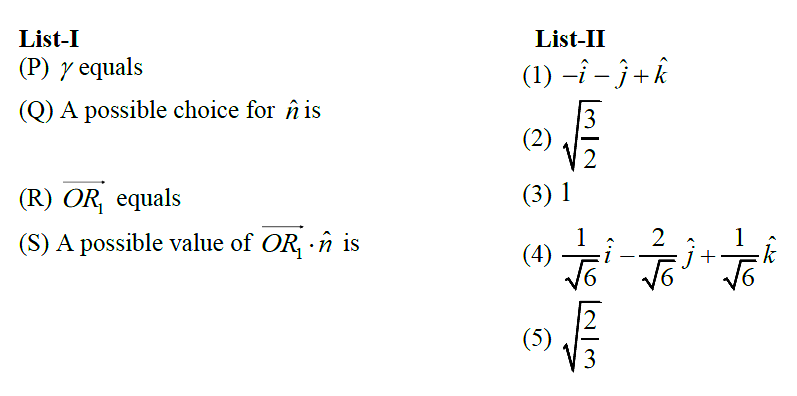
The correct option isJEE Advanced 2024 Hard - \(\frac{d^2 x}{d y^2}\) equalsJEE Advanced 2007 Medium
- Let \(L=\lim _{x \rightarrow 0} \frac{a-\sqrt{a^2-x^2}-\frac{x^2}{4}}{x^4}\), \(a>0\). If \(L\) is finite, thenJEE Advanced 2009 Medium
- If \(e_1\) is the eccentricity of the ellipse \(\frac{x^2}{16}+\frac{y^2}{25}=1\) and \(e_2\) is the eccentricity of the hyperbola passing through the focii of the ellipse and \(e_1 e_2=1\), then equation of the hyperbola isJEE Advanced 2006 Easy
- Let be the function defined as , where denotes the greatest integer less than or equal to . Then which of the following is(are) true?JEE Advanced 2023 Hard
More PYQs from JEE Advanced
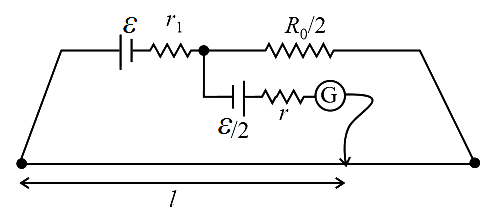
- In order to measure the internal resistance of a cell of emf a meter bridge of wire resistance , a resistance , another cell of emf (internal resistance ) and a galvanometer are used in a circuit, as shown in the figure. If the null point is found at then the value of
 JEE Advanced 2021 Easy
 - Let be a complex number with non-zero imaginary part. If is a real number, then the value of is ______.JEE Advanced 2022 Hard
- The kinetic energy of an electron in the second Bohr orbit of a hydrogen atom is \(\left[a_{0}\right.\) is Bohr radius \(]\) :JEE Advanced 2012 Medium
- Let \(A B C\) and \(A B C^{\prime}\) be two non-congruent triangles with sides \(A B=4\), \(A C=A C^{\prime}=2 \sqrt{2}\) and angle \(B=30^{\circ}\). The absolute value of the difference between the areas of these triangles isJEE Advanced 2009 Medium
- \(\mathrm{MgSO}_4\) on reaction with \(\mathrm{NH}_4 \mathrm{OH}\) and \(\mathrm{Na}_2 \mathrm{HPO}_4\) forms a white crystalline precipitate. What is its formula?JEE Advanced 2006 Medium
- Let \(f: I R \rightarrow I R\) be defined as \(f(x)=|x|+\left|x^{2}-1\right|\). The total number of points at which \(f\) attains either a local maximum or a local minimum isJEE Advanced 2012 Medium