


JEE Advanced · Chemistry · 2. Atomic Structure
Consider the Bohr's model of a one-electron atom where the electron moves around the nucleus. In the following List-I contains some quantities for the orbit of the atom and List-II contains options showing how they depend on .
| List - I | List - II |
|---|---|
| (I) Radius of the orbit | |
| (II) Angular momentum of the electron in the orbit | |
| (III) Kinetic energy of the electron in the orbit | |
| (IV) Potential energy of the electron in the orbit | |
Which of the following options has the correct combination considering List-I and List-II?
- A
- B
- C
- D
Answer & Solution
Correct Answer
(D)
Step-by-step Solution
Detailed explanation
According to Bohr’s atomic model:
Radius of orbit
Angular Momentum
Kinetic energy
Potential energy
Radius of orbit
Angular Momentum
Kinetic energy
Potential energy
See the Complete Solution
Get step-by-step explanations for this and 2.5 Lakh+ more JEE, NEET & CET questions.
- Unlock all solutions
- Practice the full chapter
- Track accuracy across PYQs
4.8 rated on Google Play · 14,000+ reviews
More questions from Chemistry
- Among the following, the correct statement(s) for electrons in an atom is(are)JEE Advanced 2024 Easy
- Paragraph:
Thermal decomposition of gaseous \(\mathrm{X}_{2}\) to gaseous \(\mathrm{X}\) at \(298 \mathrm{~K}\) takes place according to the following equation:
\(\mathrm{X}_{2}(\mathrm{~g}) \rightleftharpoons 2 \mathrm{X}(\mathrm{g})\)
The standard reaction Gibbs energy, \(\Delta_{r} G^{\circ}\), of this reaction is positive. At the start of the reaction, there is one mole of \(\mathrm{X}_{2}\) and no \(\mathrm{X}\). As the reaction proceeds, the number of moles of \(\mathrm{X}\) formed is given by \(\beta\). Thus, \(\beta_{\text {equilibrium }}\) is the number of moles of \(\mathrm{X}\) formed at equilibrium. The reaction is carried out at a constant total pressure of \(2\) bar. Consider the gases to behave ideally. (Given : \(R=0.083 \mathrm{~L}\) bar \(\mathrm{K}^{-1} \mathrm{~mol}^{-1}\) )
Question:
The equilibrium constant \(K_{P}\) for this reaction at \(298 \mathrm{~K},\) in terms of \(\beta_{equilibrium}\) isJEE Advanced 2016 Medium - With respect to the compoundschoose the correct statement(s).
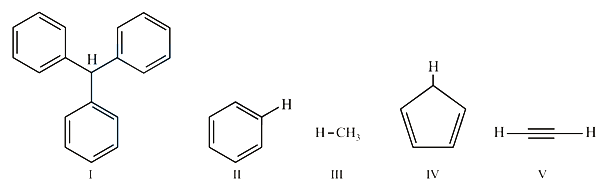 JEE Advanced 2020 Medium
 - dissociates in and ions in an aqueous solution, with a degree of dissociation of 0.5. The ratio of the observed depression of freezing point of the aqueous solution to the value of the depression of freezing point in the absence of ionic dissociation isJEE Advanced 2014 Medium
- Paragraph:
Reimer-Tiemann reaction introduces an aldehyde group, on to the aromatic ring of phenol, ortho to the hydroxyl group. This reaction involves electrophilic aromatic substitution. This is a general method for the synthesis of substituted salicylaldehydes as depicted below.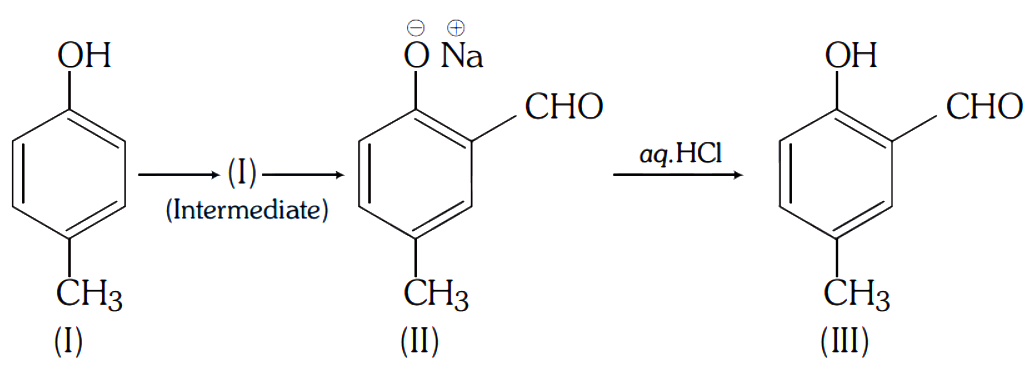
Question:
Which one of the following reagents is used the above reaction?JEE Advanced 2007 Medium - The heating of \(\mathrm{NH}_4 \mathrm{NO}_2\) at \(60-70^{\circ} \mathrm{C}\) and \(\mathrm{NH}_4 \mathrm{NO}_3\) at \(200-250^{\circ} \mathrm{C}\) is associated with the formation of nitrogen containing compounds \(\mathbf{X}\) and \(\mathbf{Y}\), respectively. \(\mathbf{X}\) and \(\mathbf{Y}\), respectively, areJEE Advanced 2025 Easy
More PYQs from JEE Advanced
- An organic compound rotates plane-polarized light. It produces pink color with neutral solution. What is the total number of all the possible isomers for this compound?JEE Advanced 2020 Hard
- The hyperconjugative stabilities of tert-butyl cation and 2-butene, respectively, due toJEE Advanced 2013 Medium
- Let denote the complex conjugate of a complex number and let . In the set of complex numbers, the number of distinct roots of the equation is _______.JEE Advanced 2022 Medium
- Let be a thrice differentiable function. Suppose that and all Let for all .
If and then the correct expression(s) is(are)JEE Advanced 2015 Medium - Let \(z_1\) and \(z_2\) be two distinct complex numbers and let \(z=(1-t) z_1+t z_2\) for some real number \(t\) with \(0 < t < 1\). If \(\arg (w)\) denotes the principal argument of a non-zero complex number \(w\), thenJEE Advanced 2010 Hard
- The compound(s) with \(\mathrm{P}-\mathrm{H}\) bond(s) is(are)JEE Advanced 2025 Easy