


JEE Advanced · Mathematics · 25. AOD
Let \(f_{1}:(0, \infty) \rightarrow \mathbb{R}\) and \(f_{2}:(0, \infty) \rightarrow \mathbb{R}\) be defined by
\[
f_{1}(x)=\int_{0}^{x} \prod_{j=1}^{21}(t-j)^{j} d t, \quad x > 0
\(
and
\]
f_{2}(x)=98(x-1)^{50}-600(x-1)^{49}+2450, \quad x > 0
\)
where, for any positive integer \(n\) and real numbers \(a_{1}, a_{2}, \ldots, a_{n}, \prod_{i=1}^{n} a_{i}\) denotes the product of \(a_{1}, a_{2}, \ldots, a_{n} .\) Let \(m_{i}\) and \(n_{i}\), respectively, denote the number of points of local minima and the number of points of local maxima of function \(f_{i}, i=1,2\), in the interval \((0, \infty)\).
The value of is ____.
- A 9
- B 4
- C 16
- D 6
Answer & Solution
Correct Answer
(D) 6
Step-by-step Solution
Detailed explanation
See the Complete Solution
Get step-by-step explanations for this and 2.5 Lakh+ more JEE, NEET & CET questions.
- Unlock all solutions
- Practice the full chapter
- Track accuracy across PYQs
4.8 rated on Google Play · 14,000+ reviews
More questions from Mathematics
- Paragraph:
Let \(O\) be the origin, and \(\overrightarrow{O X}, \overrightarrow{O Y}, \overrightarrow{O Z}\) be three unit vectors in the directions of the sides \(\overrightarrow{Q R}, \overrightarrow{R P}\), \(\overrightarrow{P Q}\), respectively, of a triangle \(P Q R\).
Question:
If the triangle \(P Q R\) varies, then the minimum value of
\(\cos (P+Q)+\cos (Q+R)+\cos (R+P)\) isJEE Advanced 2017 Easy - Paragraph:
A fair die is tossed repeatedly until a six is obtained. Let \(X\) denotes the number of tosses required.Question:
The probability that \(X=3\) equalsJEE Advanced 2009 Easy - If the distance between the plane \(A x-2 y+z=d\) and the plane containing the lines \(\frac{x-1}{2}=\frac{y-2}{3}=\frac{z-3}{4} \quad\) and \(\frac{x-2}{3}=\frac{y-3}{4}=\frac{z-4}{5}\) is \(\sqrt{6}\), then \(|d|\) isJEE Advanced 2010 Easy
- Let . Let be the function defined by . Then, which of the following statements is/are TRUE?JEE Advanced 2022 Hard
- Let and be respectively given by and Define by
Then number of points at which is not differentiable is_________JEE Advanced 2014 Hard - Consider the system of equations
where \(\quad a, b, c, d \in\{0,1\}\)
Statement 1 The probability that the system of equations has a unique solution, is \(3 / 8\).
Statement 2 The probability that the system of equations has a solution, is 1 .JEE Advanced 2008 Hard
More PYQs from JEE Advanced
- Let be a differentiable function with . If satisfies the differential equation , then the value of isJEE Advanced 2018 Easy
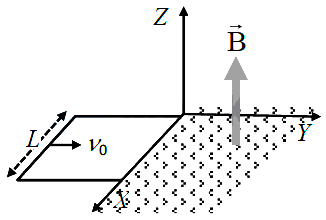
- A conducting square loop of side \(L\), mass \(M\) and resistance \(R\) is moving in the \(X Y\) plane with its edges parallel to the \(X\) and \(Y\) axes. The region \(y \geq 0\) has a uniform magnetic field, \(\vec{B}=B_0 k\). The magnetic field is zero everywhere else. At time \(t=0\), the loop starts to enter the magnetic field with an initial velocity \(v_0 \hat{\jmath} \mathrm{~m} / \mathrm{s}\), as shown in the figure. Considering the quantity \(K=\frac{B_0^2 L^2}{R M}\) in appropriate units, ignoring self-inductance of the loop and gravity, which of the following statements is/are correct:
 JEE Advanced 2025 Hard
 - Let \(A B C\) and \(A B C^{\prime}\) be two non-congruent triangles with sides \(A B=4\), \(A C=A C^{\prime}=2 \sqrt{2}\) and angle \(B=30^{\circ}\). The absolute value of the difference between the areas of these triangles isJEE Advanced 2009 Medium
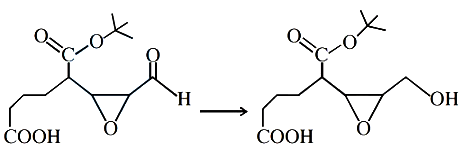
- Reagent(s) which can be used to bring about the following transformation is(are)
 JEE Advanced 2016 Medium
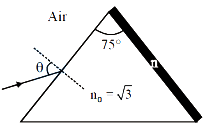
 - A monochromatic light is incident from air on a refracting surface of a prism of angle and refractive index The other refracting surface of a prism is coated by a thin film of material of refractive index as shown in figure. The light suffers total internal reflection at the coated prism surface for an incidence angle of The value of is_______.
 JEE Advanced 2019 Medium
 - Paragraph : In electromagnetic theory, the electric and magnetic phenomena are related to each other. Therefore, the dimensions of electric and magnetic quantities must also be related to each other. In the questions below, stand for dimensions of electric and magnetic fields respectively, while and stand for dimensions of the permittivity and permeability of free space respectively. are dimensions of length and time respectively. All the quantities are given in units
Question : The relation between isJEE Advanced 2018 Easy