


JEE Advanced · Mathematics · 23. C&D
Let the function be defined by and let be an arbitrary function. Let be the product function defined by . Then which of the following statements is/are TRUE?
- A If is continuous at , then is differentiable at
- B If is differentiable at , then is continuous at
- C If is differentiable at , then is differentiable at
- D If is differentiable at , then is differentiable at
Answer & Solution
Correct Answer
(C) If is differentiable at , then is differentiable at
Step-by-step Solution
Detailed explanation
Differentiability of at Left-hand derivative :
See the Complete Solution
Get step-by-step explanations for this and 2.5 Lakh+ more JEE, NEET & CET questions.
- Unlock all solutions
- Practice the full chapter
- Track accuracy across PYQs
4.8 rated on Google Play · 14,000+ reviews
More questions from Mathematics
- Consider the following lists:
List- List- has two elements has three elements has four elements has five elements has six elements
The correct option is:JEE Advanced 2022 Medium - Let and be twice differentiable functions such that and are continuous functions on . Suppose and thenJEE Advanced 2016 Medium
- Let be two arbitrary, , non - zero, skew - symmetric matrices and Z be an arbitrary , non - zero, symmetric matrix. Then which of the following matrices is (are) skew symmetric ?JEE Advanced 2015 Medium
- A tangent \(P T\) is drawn to the circle \(x^{2}+y^{2}=4\) at the point \(P(\sqrt{3}, 1)\). A straight line \(L\), perpendicular to \(P T\) is a tangent to the circle \((x-3)^{2}+y^{2}-1\).
Question: A possible equation of \(L\) isJEE Advanced 2012 Medium - If thenJEE Advanced 2017 Medium
- Let \(\alpha\) and \(\beta\) be the roots of \(x^2-6 x-2=0\) with \(\alpha>\beta\). If \(a_n=\alpha^n-\beta^n\) for \(n \geq 1\), then the value of \(\frac{a_{10}-2 a_8}{2 a_9}\) isJEE Advanced 2011 Medium
More PYQs from JEE Advanced
- On decreasing the from to , the solubility of a sparingly soluble salt of a weak acid increased from to . The of isJEE Advanced 2023 Easy
- Consider the matrix, \(P=\left(\begin{array}{lll}2 & 0 & 0 \\ 0 & 2 & 0 \\ 0 & 0 & 3\end{array}\right)\)
Let the transpose of a matrix \(X\) be denoted by \(\mathrm{X}^T\). Then the number of \(3 \times 3\) invertible matrices Q with integer entries, such that \(Q^{-1}=Q^T\) and \(P Q=Q P\) isJEE Advanced 2025 Easy - Let \(a_{1}, a_{2}, a_{3}, \ldots . .\) be in harmonic progression with \(a_{1}=5\) and \(a_{20}=25\). The least positive integer \(n\) for which \(a_{n} < 0\) isJEE Advanced 2012 Medium
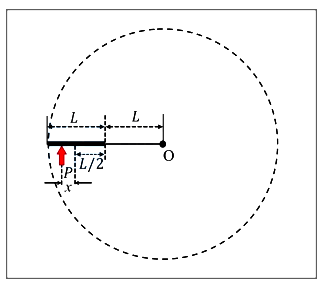
- A thin uniform rod of length \(L\) and certain mass is kept on a frictionless horizontal table with a massless string of length \(L\) fixed to one end (top view is shown in the figure). The other end of the string is pivoted to a point \(\mathrm{O}\). If a horizontal impulse \(P\) is imparted to the rod at a distance \(x=L / n\) from the mid-point of the rod (see figure), then the rod and string revolve together around the point \(\mathrm{O}\), with the rod remaining aligned with the string. In such a case, the value of \(n\) is _______ .
 JEE Advanced 2024 Hard
 - Paragraph:
In hexagonal system of crystals, a frequently encountered arrangement of atoms is described as a hexagonal prism. Here, the top and bottom of the cell are regular hexagons and three atoms are sandwiched in between them. A space-filling model of this structure, called hexagonal close-packed (HCP), is constituted of a sphere on a flat surface surrounded in the same plane by six identical spheres as closely as possible. Three spheres are then placed over the first layer so that they touch each other and represent the second layer. Each one of the three spheres touches three spheres of the bottom layer. Finally, the second layer is covered with a third layer that is identical to the bottom layer in relative position. Assume radius of every sphere to be ' \(r\) '.
Question:
The empty space in this \(\mathrm{HCP}\) unit cell isJEE Advanced 2008 Medium - Let \(f(x)=(1-x)^{2} \sin ^{2} x+x^{2}\) for all \(x \in I R\) and let \(g(x)=\int_{1}^{x}\left(\frac{2(t-1)}{t+1}-\ln t\right) f(t) d t\) for all \(x \in(1, \infty)\).
Question: Which of the following is true?JEE Advanced 2012 Hard