


JEE Advanced · Physics · 8. Rotational Motion
A thin uniform rod of length \(L\) and certain mass is kept on a frictionless horizontal table with a massless string of length \(L\) fixed to one end (top view is shown in the figure). The other end of the string is pivoted to a point \(\mathrm{O}\). If a horizontal impulse \(P\) is imparted to the rod at a distance \(x=L / n\) from the mid-point of the rod (see figure), then the rod and string revolve together around the point \(\mathrm{O}\), with the rod remaining aligned with the string. In such a case, the value of \(n\) is _______ .
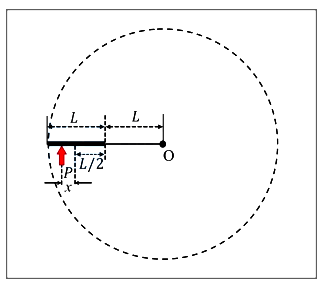
- A 6
- B 12
- C 18
- D 24
Answer & Solution
Correct Answer
(C) 18
Step-by-step Solution
Detailed explanation
Linear impulse \(\int F d t=\Delta\) momentum
\(\begin{aligned} & =\mathrm{m}\left(\mathrm{V}_{\mathrm{cm}}-0\right) \\ & \mathrm{P}=\mathrm{m}\left(\omega \mathrm{r}_{\mathrm{cm}}\right) \\ & =\mathrm{m} \omega\left(\mathrm{L}+\frac{\mathrm{L}}{2}\right)\end{aligned}\)
\(\mathrm{P}=\mathrm{m} \omega\left(\frac{3 \mathrm{~L}}{2}\right)\) ...(i)
Angular impulse \(\int \tau \mathrm{dt}=\Delta\) angular momentum
\(\begin{aligned} & \int \mathrm{r} \times \mathrm{Fdt}=\Delta \mathrm{L} \\ & \begin{aligned} & \mathrm{r} \times \int \mathrm{Fdt}=\mathrm{I}(\omega-0), \text { and } \mathrm{I} \text { is moment of inertia about axis of rotation. } \\ & \begin{aligned} &\left(\mathrm{L}+\frac{\mathrm{L}}{2}+\mathrm{x}\right) \times \mathrm{P}=\left(\mathrm{I}_{\mathrm{cm}}+\mathrm{md}^2\right) \omega \\ &=\left(\frac{\mathrm{mL}^2}{12}+\mathrm{m}\left(\mathrm{L}+\frac{\mathrm{L}}{2}\right)^2\right) \omega\end{aligned} \\ &\left(\frac{3 \mathrm{~L}}{2}+\mathrm{x}\right) \mathrm{P}=\mathrm{mL}^2\left(\frac{1}{12}+\left(\frac{3}{2}\right)^2\right) \omega\end{aligned}\end{aligned}\)
\(\left(\frac{3 L}{2}+x\right) P=\mathrm{mL}^2\left(\frac{7}{3}\right) \omega\) ...(ii)
Divide eq.-(i) & (ii)
\(\begin{aligned} & \left(\frac{3 L}{2}+x\right)=\frac{L\left(\frac{7}{3}\right)}{\left(\frac{3}{2}\right)} \\ & \frac{3 L}{2}+x=L\left(\frac{14}{9}\right) \\ & x=\frac{L}{18}\end{aligned}\)
\(\begin{aligned} & =\mathrm{m}\left(\mathrm{V}_{\mathrm{cm}}-0\right) \\ & \mathrm{P}=\mathrm{m}\left(\omega \mathrm{r}_{\mathrm{cm}}\right) \\ & =\mathrm{m} \omega\left(\mathrm{L}+\frac{\mathrm{L}}{2}\right)\end{aligned}\)
\(\mathrm{P}=\mathrm{m} \omega\left(\frac{3 \mathrm{~L}}{2}\right)\) ...(i)
Angular impulse \(\int \tau \mathrm{dt}=\Delta\) angular momentum
\(\begin{aligned} & \int \mathrm{r} \times \mathrm{Fdt}=\Delta \mathrm{L} \\ & \begin{aligned} & \mathrm{r} \times \int \mathrm{Fdt}=\mathrm{I}(\omega-0), \text { and } \mathrm{I} \text { is moment of inertia about axis of rotation. } \\ & \begin{aligned} &\left(\mathrm{L}+\frac{\mathrm{L}}{2}+\mathrm{x}\right) \times \mathrm{P}=\left(\mathrm{I}_{\mathrm{cm}}+\mathrm{md}^2\right) \omega \\ &=\left(\frac{\mathrm{mL}^2}{12}+\mathrm{m}\left(\mathrm{L}+\frac{\mathrm{L}}{2}\right)^2\right) \omega\end{aligned} \\ &\left(\frac{3 \mathrm{~L}}{2}+\mathrm{x}\right) \mathrm{P}=\mathrm{mL}^2\left(\frac{1}{12}+\left(\frac{3}{2}\right)^2\right) \omega\end{aligned}\end{aligned}\)
\(\left(\frac{3 L}{2}+x\right) P=\mathrm{mL}^2\left(\frac{7}{3}\right) \omega\) ...(ii)
Divide eq.-(i) & (ii)
\(\begin{aligned} & \left(\frac{3 L}{2}+x\right)=\frac{L\left(\frac{7}{3}\right)}{\left(\frac{3}{2}\right)} \\ & \frac{3 L}{2}+x=L\left(\frac{14}{9}\right) \\ & x=\frac{L}{18}\end{aligned}\)
See the Complete Solution
Get step-by-step explanations for this and 2.5 Lakh+ more JEE, NEET & CET questions.
- Unlock all solutions
- Practice the full chapter
- Track accuracy across PYQs
4.8 rated on Google Play · 14,000+ reviews
More questions from Physics
- Two identical moving coil galvanometer have resistance and full scale deflection at current. One of them is converted into a voltmeter of full scale reading and the other into an Ammeter of full scale current using appropriate resistors. These are then used to measure the voltage and current in the Ohm's law experiment with resistor by using an ideal cell. Which of the following statement(s) is/are correct?JEE Advanced 2019 Hard
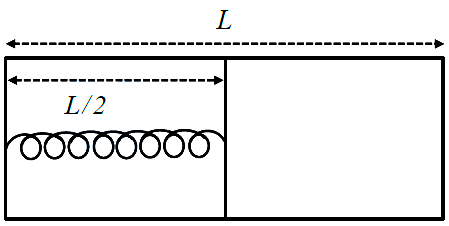
- The left and right compartments of a thermally isolated container of length \(L\) are separated by a thermally conducting, movable piston of area \(A\). The left and right compartments are filled with \(\frac{3}{2}\) and 1 moles of an ideal gas, respectively. In the left compartment the piston is attached by a spring with spring constant k and natural length \(\frac{2 L}{5}\). In thermodynamic equilibrium, the piston is at a distance \(\frac{L}{2}\) from the left and right edges of the container as shown in the figure. Under the above conditions, if the pressure in the right compartment is \(P=\frac{\mathrm{k} L}{\mathrm{~A}} \alpha\), then the value of \(\alpha\) is \(\qquad\)
 JEE Advanced 2025 Medium
 - Heater of an electric kettle is made of a wire of length L and diameter d. It takes 4 minutes to raise the temperature of 0.5 kg water by 40 K. This heater is replaced by a new heater having two wires of the same material, each of length L and diameter 2d. The way these wires are connected is given in the options. How much time in minutes will it take to raise the temperature of the same amount of water by 40K?JEE Advanced 2014 Medium
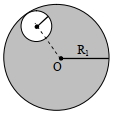
- Consider a uniform spherical charge distribution of radius centred at the origin O. In this distribution, a spherical cavity of radius , centred at with distance (see figure) is made. If the electric field inside the cavity at position is , then the correct statement(s) is (are)
 JEE Advanced 2015 Medium
 - A charged particle is introduced at the origin with a given initial velocity . A uniform electric field and a uniform magnetic field exist everywhere. The velocity , electric field and a uniform magnetic field are given in the columns below
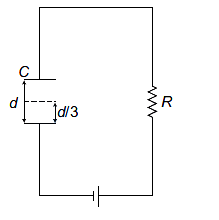
In which case will the particle describe a helical path with axis along positive z direction?Column 1 Column 2 Column 3 1. Electron with (i) (P) 2. Electron with (ii) (Q) 3.Proton with =0 (iii) (R) 4. Proton with (iv) (S) JEE Advanced 2017 Medium - A parallel plate capacitor \(C\) with plates of unit area and separation \(d\) is filled with a liquid of dielectric constant \(K=2\). The level of liquid is \(\frac{d}{3}\) initially. Suppose the liquid level decreases at a constant speed \(v\), the time constant as a function of time \(t\) is
 JEE Advanced 2008 Hard
More PYQs from JEE Advanced
- The total number of distinct for which isJEE Advanced 2016 Medium
- The isotope having a mass 12.014 u undergoes - decay to has an excited state of the nucleus at 4.041 MeV above its ground state. If decays to the maximum kinetic energy of the - particle in units of MeV is ( where c is the speed of light in vacuum).JEE Advanced 2016 Medium
- For 3 x 3 matrices M and N, which of the following statement(s) is (are) not correct?JEE Advanced 2013 Medium
- The dissociation constant of a substituted benzoic acid at \(25^{\circ} \mathrm{C}\) is \(1.0 \times 10^{-4}\). The \(\mathrm{pH}\) of \(0.01 \mathrm{M}\) solution of its sodium salt isJEE Advanced 2009 Medium
- In a conductometric titration, small volume of titrant of higher concentration is added stepwise to a larger volume of titrate of much lower concentration, and the conductance is measured after each addition.
The limiting ionic conductivity \(\left(\Lambda_0\right)\) values (in \(\mathrm{mS} \mathrm{m}^2 \mathrm{~mol}^{-1}\)) for different ions in aqueous solutions are given below:
For different combinations of titrates and titrants given in List-I, the graphs of 'conductance' versus 'volume of titrant' are given in List-II.
Match each entry in List-I with the appropriate entry in List-II and choose the correct option.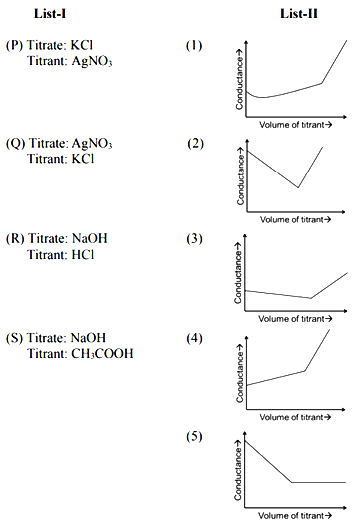 JEE Advanced 2024 Easy
 - The area of the region between the curves \(y=\sqrt{\frac{1+\sin x}{\cos x}}\) and \(y=\sqrt{\frac{1-\sin x}{\cos x}}\) bounded by the lines \(x=0\) and \(x=\frac{\pi}{4}\) isJEE Advanced 2008 Hard