


JEE Advanced · Mathematics · 32. Probability
Let \(E\) and \(F\) be two independent events. The probability that exactly one of them occurs is \(11 / 25\) and the probability of none of them occurring is \(2 / 25\). If \(P(T)\) denotes the probability of occurrence of the event \(T\), then
- A
\(P(E)=\frac{4}{5}, P(F)=\frac{3}{5}\)
- B
\(P(E)=\frac{1}{5}, P(F)=\frac{2}{5}\)
- C
\(P(E)=\frac{2}{5}, P(F)=\frac{1}{5}\)
- D
\(P(E)=\frac{3}{5}, P(F)=\frac{4}{5}\)
Answer & Solution
Correct Answer
(D)
\(P(E)=\frac{3}{5}, P(F)=\frac{4}{5}\)
Step-by-step Solution
Detailed explanation
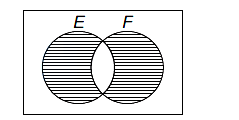
\[
P(E \cup F)-P(E \cap F)=\frac{11}{25}
\]
(i.e. only \(E\) or only \(F\) )
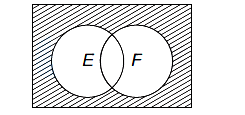
Neither of them occurs \(=\frac{2}{25}\) \(\Rightarrow \quad P(\bar{E} \cap \bar{F})=\frac{2}{25}\)
From Eq. (i), we get
\[
P(E)+P(F)-2 P(E \cap F)=\frac{11}{25}
\]
From Eq. (ii), we get
\[
\begin{gathered}
(1-P(E))(1-P(F))=\frac{2}{25} \\
\Rightarrow 1-P(E)-P(F)+P(E) \cdot P(F)=\frac{2}{25}
\end{gathered}
\]
(iv)
From Eqs. (iii) and (iv), we get
\[
\begin{aligned}
& P(E)+P(F)=\frac{7}{5} \text { and } P(E) \cdot P(F)=\frac{12}{25} \\
& \therefore \quad P(E) \cdot\left\{\frac{7}{5}-P(E)\right\}=\frac{12}{25}
\end{aligned}
\]
\[
\begin{aligned}
& \Rightarrow \quad(P(E))^2-\frac{7}{5} P(E)+\frac{12}{25}=0 \\
& \Rightarrow \quad\left(P(E)-\frac{3}{5}\right)\left(P(E)-\frac{4}{5}\right)=0 \\
& \therefore \quad P(E)=\frac{3}{4} \text { or } \frac{4}{5} \Rightarrow P(F)=\frac{4}{5} \text { or } \frac{3}{5}
\end{aligned}
\]
See the Complete Solution
Get step-by-step explanations for this and 2.5 Lakh+ more JEE, NEET & CET questions.
- Unlock all solutions
- Practice the full chapter
- Track accuracy across PYQs
4.8 rated on Google Play · 14,000+ reviews
More questions from Mathematics
- Let \(A_n=\left(\frac{3}{4}\right)-\left(\frac{3}{4}\right)^2+\left(\frac{3}{4}\right)^3+\ldots+(-1)^{n-1}\)\(\left(\frac{3}{4}\right)^n\) and \(B_n=1-A_n\). Find a least odd natural number \(n_0\), so that \(B_n>A_n, \forall n \geq n_0\).JEE Advanced 2006 Medium
- A computer producing factory has only two plants and . Plant produces and plant produces of the total computers produced. of computers produced in the factory turn out to be defective. It is known that, (computer turns out to be defective given that it is produced in plant ) (computer turns out to be defective given that it is produced in plant ). Where, denotes the probability of an event A computer produced in the factory is randomly selected and it does not turn out to be defective. Then the probability that it is produced in plant isJEE Advanced 2016 Medium
- Let and be real numbers. Consider the following system of linear equations Match each entry in List-I to the correct entries in List-II.
The correct option is:List-I List-II If and then the system has a unique solution If and , then the system has no solution If where and , then the system has infinitely many solutions If where and , then the system has and as a solution and as a solution JEE Advanced 2023 Medium - The number of digit numbers which are divisible by , with digits from the set and the repetition of digits is allowed, is _____.JEE Advanced 2018 Easy
- Paragraph:
Let \(a, r, s, t\) be nonzero real numbers. Let \(P\left(a t^{2}, 2 a t\right), Q, R\left(a r^{2}, 2 a r\right)\) and \(S\left(a s^{2}, 2 a s\right)\) be distinct points on the parabola \(y^{2}=4 a x\). Suppose that \(P Q\) is the focal chord and lines \(Q R\) and \(P K\) are parallel, where \(K\) is the point \((2 a, 0)\).
Question:
The value of \(r\) isJEE Advanced 2014 Medium - Let be a natural number and be the function defined by
If is such that the area of the region bounded by the curves and is , then the maximum value of the function isJEE Advanced 2023 Medium
More PYQs from JEE Advanced
- The number of points in , for which , is:JEE Advanced 2013 Hard
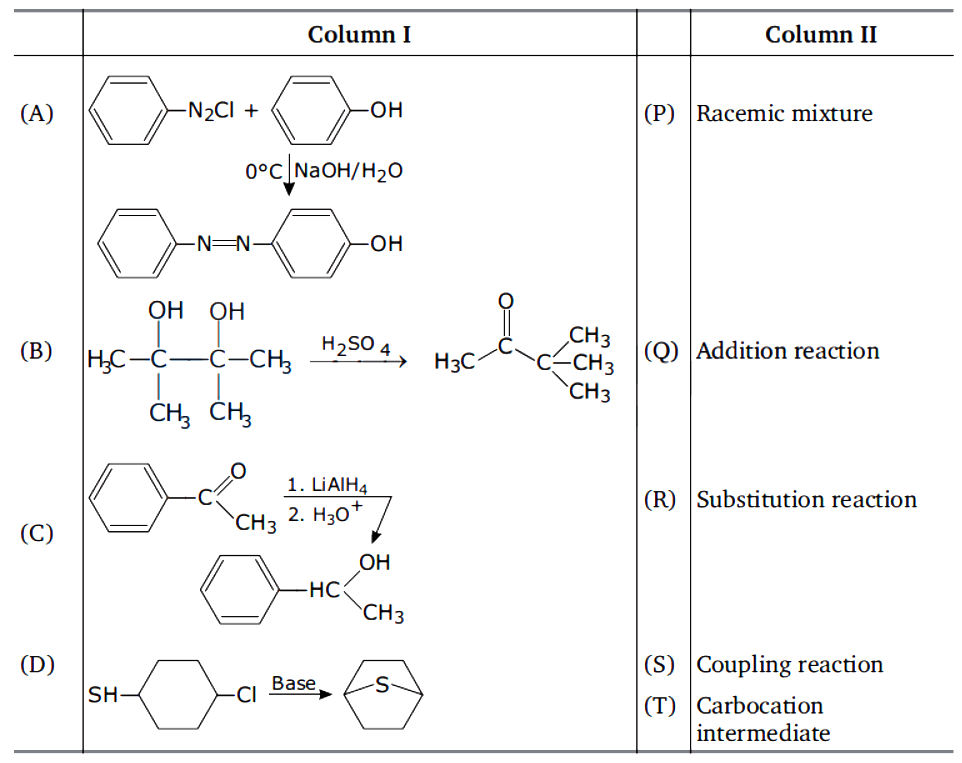
- Match the reaction in Column I with appropriate options in Column II
 JEE Advanced 2010 Hard
 - Let \(\mathbb{R}\) denote the set of all real numbers. Define the function \(f: \mathbb{R \rightarrow \mathbb { R }}\) by
\(f(\mathrm{x})=\left\{\begin{array}{cc}2-2 x^2-x^2 \sin \frac{1}{x} & \text { if } x \neq 0 \\ 2 & \text { if } x=0\end{array}\right.\)
Then which one of the following statements is TRUE ?JEE Advanced 2025 Hard - Three moles of are completely reacted with methanol. The number of moles of boron containing product formed isJEE Advanced 2015 Medium
- Paragraph:
p-amino-N, N-dimethylaniline is added to a strongly acidic solution of \(X\). The resulting solution is treated with a few drops of aqueous solution of \(Y\) to yield blue colouration due to the formation of methylene blue. Treatment of the aqueous solution of \(Y\) with the reagent potassium hexacyanoferrate(II) leads to the formation of an intense blue precipitate. The precipitate dissolves an excess addition of the reagent. Similarly, treatment of the solution of \(Y\) with the solution of potassium hexacyanoferrate(III) leads to a brown colouration due to the formation of \(Z\).
Question:
The compound \(Y\), isJEE Advanced 2009 Medium - Let be a real number. Consider the matrix . If is a singular matrix, then the value of is _____ .JEE Advanced 2022 Medium