


JEE Advanced · Mathematics · 25. AOD
Let \(f: I R \rightarrow I R\) be defined as \(f(x)=|x|+\left|x^{2}-1\right|\). The total number of points at which \(f\) attains either a local maximum or a local minimum is
- A 9
- B 4
- C 5
- D 3
Answer & Solution
Correct Answer
(C) 5
Step-by-step Solution
Detailed explanation
\(f(x)=|x|+\left|x^{2}-1\right|=\left\{\begin{array}{c}-x+x^{2}-1, x < -1 \\ -x-x^{2}+1,-1 \leq x \leq 0 \\ x-x^{2}+1,0 < x < 1 \\ x^{2}+x-1, \quad x \geq 1\end{array}\right.\)
\(\therefore \quad f^{\prime}(x)=\left[\begin{array}{ccc}
2 x-1 & , & x < -1 \\
-2 x-1 & , & -1 \leq x \leq 0 \\
-2 x+1 & , & 0 < x < 1 \\
2 x+1 & , & x>1
\end{array}\right.\)
Critical points are \(\frac{1}{2}, \frac{-1}{2},-1,0\) and 1 .
We observe at five points \(f^{\prime}(x)\) changes its sign \(\therefore\) There are 5 points at which either local maximum or local minimum.
\(\therefore \quad f^{\prime}(x)=\left[\begin{array}{ccc}
2 x-1 & , & x < -1 \\
-2 x-1 & , & -1 \leq x \leq 0 \\
-2 x+1 & , & 0 < x < 1 \\
2 x+1 & , & x>1
\end{array}\right.\)
Critical points are \(\frac{1}{2}, \frac{-1}{2},-1,0\) and 1 .
We observe at five points \(f^{\prime}(x)\) changes its sign \(\therefore\) There are 5 points at which either local maximum or local minimum.
See the Complete Solution
Get step-by-step explanations for this and 2.5 Lakh+ more JEE, NEET & CET questions.
- Unlock all solutions
- Practice the full chapter
- Track accuracy across PYQs
4.8 rated on Google Play · 14,000+ reviews
More questions from Mathematics
- Paragraph:
Read the following passage and answer the questions.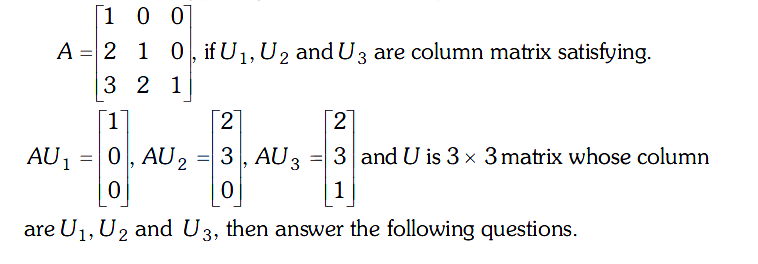
Question:
The value of the elements of \(U^{-1}\) isJEE Advanced 2006 Medium - Let \(\overrightarrow{O P}=\frac{\alpha-1}{\alpha} \hat{i}+\hat{j}+\hat{k}, \overrightarrow{O Q}=\hat{i}+\frac{\beta-1}{\beta} \hat{j}+\hat{k}\) and \(\overrightarrow{O R}=\hat{i}+\hat{j}+\frac{1}{2} \hat{k}\) be three vectors, where \(\alpha, \beta \in \mathbb{R}-\{0\}\) and \(O\) denotes the origin. If \((\overrightarrow{O P} \times \overrightarrow{O Q}) \cdot \overrightarrow{O R}=0\) and the point \((\alpha, \beta, 2)\) lies on the plane \(3 x+3 y-z+l=0\), then the value of \(l\) is ____JEE Advanced 2024 Medium
- Let and .Further and , where C is the set of all complex numbers. If and O represents the origin, thenJEE Advanced 2013 Hard
- Paragraph:
Read the following passage and answer the questions.
For every function \(f(x)\) which is twice differentiable, these will be good approximation of \(\int_a^b f(x) d x \cong\left(\frac{b-a}{2}\right)\{f(a)+f(b)\}\). Now, if we take \(c=\frac{a+b}{2}\), then using above again, we get \(\int_a^b f(x) d x=\int_a^c f(x) d x+\int_c^b f(x) d x \cong \frac{b-a}{4}\{f(a)+f(b)+2 f(c)\}\) and so on.
We get approximation for value of \(\int_a^b f(x) d x\).Question:
If \(f^{\prime \prime}(x) < 0, \forall x \in(a, b), c(c, f(c))\) is point of maxima where \(c \in(a, b)\), then \(f^{\prime}(c)\) isJEE Advanced 2006 Easy - A line L : meets at E(0,3) and the arc of the parabola at the point .The tangent to the parabola at intersects the y-axis at .The slope m of the line L is chosen such that the area of the triangle EFG has a local maximum.
Match List I with List II and select the correct answer using the code given below the lists :
List I List II A. m = P. B. Maximum area of ΔEFG is Q. 4 C. y0 = R. 2 D. y1 = S. 1 JEE Advanced 2013 Medium - For (the set of all real numbers), , Then a =JEE Advanced 2013 Hard
More PYQs from JEE Advanced
- If \(f(x)=\int_{0}^{x} e^{t^{2}}(t-2)(t-3) d t\) for all \(x \in(0, \infty)\), thenJEE Advanced 2012 Hard
- Suppose a nucleus at rest and in ground state undergoes -decay to a nucleus in its excited state. The kinetic energy of the emitted particle is found to be nucleus then goes to its ground state by -decay. The energy of the emitted -photon is _______
[Given: atomic mass of atomic mass of atomic mass of particle is speed of the light]JEE Advanced 2019 Medium - The correct statement(s) regarding defects in solids is (are)JEE Advanced 2009 Medium
- Among the following, the number of elements showing only one non-zero oxidation state is O, Cl, F, N, P, Sn, Tl, \(\mathrm{Na}, \mathrm{Ti}\)JEE Advanced 2010 Easy
- Let \(S_k, k=1,2, \ldots, 100\), denote the sum of the infinite geometric series whose first term is \(\frac{k-1}{k !}\) and the common ratio is \(\frac{1}{k}\). Then the value of \(\frac{100^2}{100 !}+\sum_{k=1}^{100}\left|\left(k^2-3 k+1\right) S_k\right|\) isJEE Advanced 2010 Hard
- If thenJEE Advanced 2017 Medium