


JEE Advanced · Mathematics · 5. Sequences & Series
Let \(\mathbb{R}\) denote the set of all real numbers. Let \(f: \mathbb{R} \rightarrow \mathbb{R}\) be a function such that \(f(x)>0\) for all \(x \in \mathbb{R}\), and \(f(x+y)=f(x) f(y)\) for all \(x, y \in \mathbb{R}\).
Let the real numbers \(\mathrm{a}_1, \mathrm{a}_2 \ldots, \mathrm{a}_{50}\) be in an arithmetic progression. If \(f\left(\mathrm{a}_{31}\right)=64 f\left(\mathrm{a}_{25}\right)\), and \(\sum_{i=1}^{50} f\left(a_i\right)=3\left(2^{25}+1\right)\) then the value of \(\sum_{i=6}^{30} f\left(a_i\right)\) is ________
- A 90
- B 92
- C 94
- D 96
Answer & Solution
Correct Answer
(D) 96
Step-by-step Solution
Detailed explanation
\(\begin{aligned} & \because f(x+y)=f(x) \cdot f(y) \\ & \Rightarrow f(x)=k^x \quad(f(x)>0 \forall x \in R) \\ & \because f\left(a_{31}\right)=64 f\left(a_{25}\right)\end{aligned}\)
\(\begin{aligned} & \Rightarrow \mathrm{k}^{(\mathrm{a}+30 \mathrm{~d})}=64 \cdot \mathrm{k}^{(\mathrm{a}+24 \mathrm{~d})} \\ & \Rightarrow \mathrm{k}^{6 \mathrm{~d}}=64 \\ & \Rightarrow \mathrm{k}^{\mathrm{d}}=2\end{aligned}\)
\(\sum_{\mathrm{i}=1}^{50} \mathrm{f}\left(\mathrm{a}_{\mathrm{i}}\right)=\mathrm{f}\left(\mathrm{a}_1\right)+\mathrm{f}\left(\mathrm{a}_2\right)+\ldots \ldots+\mathrm{f}\left(\mathrm{a}_{50}\right)\)
\(\begin{aligned} & =\mathrm{k}^{\mathrm{a}}+\mathrm{k}^{\mathrm{a}+\mathrm{d}}+\ldots+\mathrm{k}^{\mathrm{a}+49 \mathrm{~d}}=\frac{\mathrm{k}^{\mathrm{a}}\left(\mathrm{k}^{50 \mathrm{~d}}-1\right)}{\mathrm{k}^{\mathrm{d}}-1} \\ & =\mathrm{k}^{\mathrm{a}}\left(2^{50}-1\right)=3\left(2^{25}+1\right)(\text { Given }) \\ & \Rightarrow \mathrm{k}^{\mathrm{a}}=\frac{3}{2^{25}-1}\end{aligned}\)
\(\begin{aligned} & \therefore \sum_{\mathrm{i}=6}^{30} \mathrm{f}\left(\mathrm{a}_{\mathrm{i}}\right)=\mathrm{k}^{\mathrm{a}+5 \mathrm{~d}}+\mathrm{k}^{\mathrm{a}+6 \mathrm{~d}}+\ldots+\mathrm{k}^{\mathrm{a}+29 \mathrm{~d}} \\ & \quad=\mathrm{k}^{\mathrm{a}+5 \mathrm{~d}} \frac{\left(\mathrm{k}^{25 \mathrm{~d}}-1\right)}{\mathrm{k}^{\mathrm{d}}-1}=\mathrm{k}^{\mathrm{a}} \cdot\left(\mathrm{k}^{\mathrm{d}}\right)^5\left(2^{25}-1\right) \\ & \quad=\frac{3}{2^{25}-1} \cdot 2^5\left(2^{25}-1\right)=96\end{aligned}\)
\(\begin{aligned} & \Rightarrow \mathrm{k}^{(\mathrm{a}+30 \mathrm{~d})}=64 \cdot \mathrm{k}^{(\mathrm{a}+24 \mathrm{~d})} \\ & \Rightarrow \mathrm{k}^{6 \mathrm{~d}}=64 \\ & \Rightarrow \mathrm{k}^{\mathrm{d}}=2\end{aligned}\)
\(\sum_{\mathrm{i}=1}^{50} \mathrm{f}\left(\mathrm{a}_{\mathrm{i}}\right)=\mathrm{f}\left(\mathrm{a}_1\right)+\mathrm{f}\left(\mathrm{a}_2\right)+\ldots \ldots+\mathrm{f}\left(\mathrm{a}_{50}\right)\)
\(\begin{aligned} & =\mathrm{k}^{\mathrm{a}}+\mathrm{k}^{\mathrm{a}+\mathrm{d}}+\ldots+\mathrm{k}^{\mathrm{a}+49 \mathrm{~d}}=\frac{\mathrm{k}^{\mathrm{a}}\left(\mathrm{k}^{50 \mathrm{~d}}-1\right)}{\mathrm{k}^{\mathrm{d}}-1} \\ & =\mathrm{k}^{\mathrm{a}}\left(2^{50}-1\right)=3\left(2^{25}+1\right)(\text { Given }) \\ & \Rightarrow \mathrm{k}^{\mathrm{a}}=\frac{3}{2^{25}-1}\end{aligned}\)
\(\begin{aligned} & \therefore \sum_{\mathrm{i}=6}^{30} \mathrm{f}\left(\mathrm{a}_{\mathrm{i}}\right)=\mathrm{k}^{\mathrm{a}+5 \mathrm{~d}}+\mathrm{k}^{\mathrm{a}+6 \mathrm{~d}}+\ldots+\mathrm{k}^{\mathrm{a}+29 \mathrm{~d}} \\ & \quad=\mathrm{k}^{\mathrm{a}+5 \mathrm{~d}} \frac{\left(\mathrm{k}^{25 \mathrm{~d}}-1\right)}{\mathrm{k}^{\mathrm{d}}-1}=\mathrm{k}^{\mathrm{a}} \cdot\left(\mathrm{k}^{\mathrm{d}}\right)^5\left(2^{25}-1\right) \\ & \quad=\frac{3}{2^{25}-1} \cdot 2^5\left(2^{25}-1\right)=96\end{aligned}\)
See the Complete Solution
Get step-by-step explanations for this and 2.5 Lakh+ more JEE, NEET & CET questions.
- Unlock all solutions
- Practice the full chapter
- Track accuracy across PYQs
4.8 rated on Google Play · 14,000+ reviews
More questions from Mathematics
- Paragraph:
Consider the circle \(x^2+y^2=9\) and the parabola \(y^2=8 x\). They intersect at \(P\) and \(Q\) in the first and the fourth quadrants, respectively. Tangents to the circle at \(P\) and \(Q\) intersect the \(\mathrm{X}\)-axis at \(R\) and tangents to the parabola at \(P\) and \(Q\) intersect the \(\mathrm{X}\)-axis at \(S\).Question:
The radius of the circumcircle of the \(\triangle P R S\) isJEE Advanced 2007 Hard - Let be the number of red and black balls, respectively, in box I. Let be the number of red and black balls, respectively, in box II.
One of the two boxes, box I and box II, was selected at random and a ball was drawn randomly out of this box. The balls was found to be red. If the probability that this red ball was drawn from box II is , then the correct option(s) with the possible values of is(are)JEE Advanced 2015 Medium - Consider a triangle \(A B C\) and let \(a, b\) and \(c\) denote the lengths of the sides opposite to vertices \(A, B\) and \(C\) respectively. Suppose \(a=6, b=10\) and the area of the triangle is \(15 \sqrt{3}\). If \(\angle A C B\) is obtuse and if \(r\) denotes the radius of the incircle of the triangle, then \(r^2\) is equal toJEE Advanced 2010 Easy
- \[
\text { Match the statements given in Column I with the values given in Column II. }
\]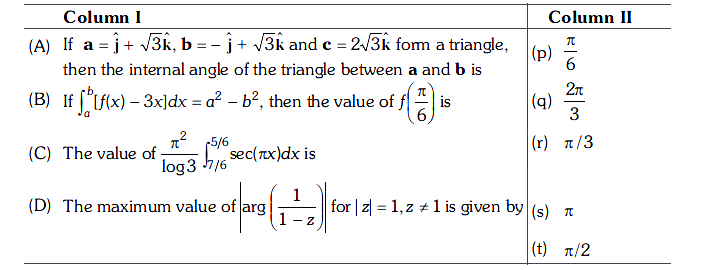 JEE Advanced 2011 Medium
 - Let be the greatest integer less than or equals to . Then, at which of the following point(s) the function is discontinuous?JEE Advanced 2017 Easy
- Consider boxes, where each box contains red balls and blue balls. Assume that all balls are distinct. In how many different ways can balls be chosen from these boxes so that from each box at least one red ball and one blue ball are chosen?JEE Advanced 2022 Hard
More PYQs from JEE Advanced
- A block of mass \(0.18 \mathrm{~kg}\) is attached to a spring of force constant \(2 \mathrm{~N} / \mathrm{m}\). The coefficient of friction between the block and the floor is 0.1. Initially, the block is at rest and the spring is unstretched. An impulse is given to the block as shown in the figure. The block slides a distance of \(0.06 \mathrm{~m}\) and comes to rest for the first time. The initial velocity of the block in \(\mathrm{m} / \mathrm{s}\) is \(v=\frac{N}{10}\). Then, \(N\) is
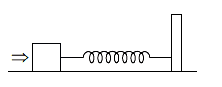 JEE Advanced 2011 Easy
 - The number of structural isomers for \(\mathrm{C}_6 \mathrm{H}_{14}\) isJEE Advanced 2007 Medium
- Atoms of metals and form face-centred cubic (fcc) unit cell of edge length , body-centred cubic (bcc) unit cell of edge length , and simple cubic unit cell of edge length , respectively. If and , then the correct statement(s) is(are)
[Given: , and are molar masses of metals , and , respectively. , and are atomic radii of metals , and , respectively.]JEE Advanced 2023 Medium - Paragraph:
Let \(p\) be an odd prime number and \(T_p\) be the following set of \(2 \times 2\) matrices
\[
T_p=\left\{A=\left[\begin{array}{ll}
a & b \\
c & a
\end{array}\right] ; a, b, c \in\{0,1,2, \ldots, p-1\}\right\}
\]Question:
The number of \(A\) in \(T_p\) such that \(A\) is either symmetric or skew-symmetric or both, and det \((A)\) is divisible by \(p\) isJEE Advanced 2010 Hard - Consider the region \(R=\left\{(x, y) \in \mathbb{R} \times \mathbb{R}: x \geq 0\right.\) and \(\left.y^{2} \leq 4-x\right\}\). Let \(\mathcal{F}\) be the family of all circles that are contained in \(R\) and have centers on the \(x\)-axis. Let \(C\) be the circle that has largest radius among the circles in \(\mathcal{F}\). Let \((\alpha, \beta)\) be a point where the circle \(C\) meets the curve \(y^{2}=4-x\).
The value of is _____.JEE Advanced 2021 Easy - Let be the plane and let
and the distance of from the plane is .
Let and be three distinct vectors in such that . Let be the volume of the parallelepiped determined by vectors and . Then the value of isJEE Advanced 2023 Hard