


JEE Advanced · Mathematics · 27. Definite Integration
\[
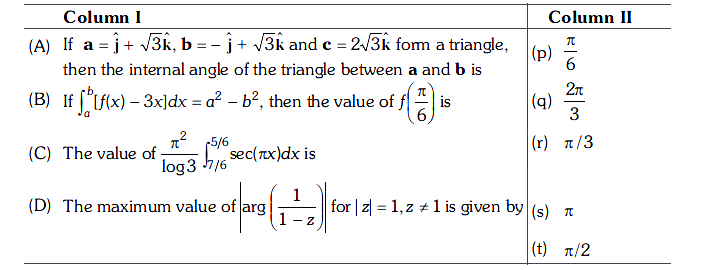
\text { Match the statements given in Column I with the values given in Column II. }
\]
- A
(A) q, (B) p, (C) s, (D) s
- B
(A) p, (B) p, (C) r, (D) q
- C
(A) q, (B) r, (C) s, (D) q
- D
(A) p, (B) s, (C) r, (D) s
Answer & Solution
Correct Answer
(A)
(A) q, (B) p, (C) s, (D) s
Step-by-step Solution
Detailed explanation
(A) \(\therefore|\mathbf{a}|=\sqrt{1+3}=2\) \(|\mathbf{b}|=\sqrt{1+3}=2\) \(|\mathbf{c}|=\sqrt{12}=2 \sqrt{3}\)
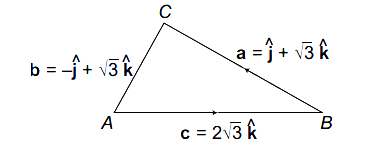
Using cosine law,
\[
\begin{aligned}
\cos C & =\frac{|\mathbf{a}|^2+|\mathbf{b}|^2-|\mathbf{c}|^2}{2|\mathbf{a}||\mathbf{b}|} \\
& =\frac{4+4-12}{2 \times 2 \times 2}=\frac{-4}{8}=\frac{-1}{2} \\
\Rightarrow \quad \angle C & =120^{\circ}=\frac{2 \pi}{3}
\end{aligned}
\]
(B)
\[
\begin{aligned}
& \int_a^b f(x) d x-3\left(\frac{x^2}{2}\right)_a^b=\left(a^2-b^2\right) \\
& \Rightarrow \int_a^b f(x) d x-\frac{3}{2}\left(b^2-a^2\right)=\left(a^2-b^2\right) \\
& \Rightarrow \int_a^b f(x) d x=\left(a^2-b^2\right)+\frac{3}{2}\left(b^2-a^2\right) \\
& =\frac{b^2-a^2}{2} \\
& \Rightarrow \int_a^b f(x) d x=\frac{b^2-a^2}{2} \\
&
\end{aligned}
\]
\[
f(x)=x \Rightarrow f\left(\frac{\pi}{6}\right)=\frac{\pi}{6}
\]
(C)
\[
\begin{aligned}
& \frac{\pi^2}{\log _e 3} \int_{7 / 6}^{5 / 6} \sec (\pi x) d x \\
& \Rightarrow \frac{\pi^2}{\log _e 3}\left\{\frac{\log |\sec \pi x+\tan \pi x|}{\pi}\right\}_{7 / 6}^{5 / 6} \\
& \Rightarrow \frac{\pi}{\log 3}\left\{\log \left|\sec \frac{5 \pi}{6}+\tan \frac{5 \pi}{6}\right|\right. \\
& \left.\quad-\log \left|\sec \frac{7 \pi}{6}+\tan \frac{7 \pi}{6}\right|\right\} \\
& \Rightarrow \frac{\pi}{\log 3}\left\{\log |\sqrt{3}|-\log \left|\frac{1}{\sqrt{3}}\right|\right\} \\
& \Rightarrow \frac{\pi}{\log 3}\{\log 3\}=\pi
\end{aligned}
\]
(D) \[
\begin{aligned}
& \left|\arg \frac{1}{(1-z)}\right|, \text { for }|z|=1 \\
& \Rightarrow\left|\arg (1-z)^{-1}\right| \\
& \Rightarrow|-\arg (1-z)| \Rightarrow|\arg (1-z)|
\end{aligned}
\]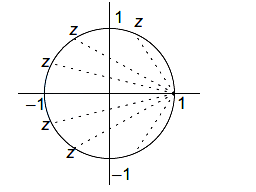
From figure, \(\arg (z-1)\) is maximum \(=\pi\).
Using cosine law,
\[
\begin{aligned}
\cos C & =\frac{|\mathbf{a}|^2+|\mathbf{b}|^2-|\mathbf{c}|^2}{2|\mathbf{a}||\mathbf{b}|} \\
& =\frac{4+4-12}{2 \times 2 \times 2}=\frac{-4}{8}=\frac{-1}{2} \\
\Rightarrow \quad \angle C & =120^{\circ}=\frac{2 \pi}{3}
\end{aligned}
\]
(B)
\[
\begin{aligned}
& \int_a^b f(x) d x-3\left(\frac{x^2}{2}\right)_a^b=\left(a^2-b^2\right) \\
& \Rightarrow \int_a^b f(x) d x-\frac{3}{2}\left(b^2-a^2\right)=\left(a^2-b^2\right) \\
& \Rightarrow \int_a^b f(x) d x=\left(a^2-b^2\right)+\frac{3}{2}\left(b^2-a^2\right) \\
& =\frac{b^2-a^2}{2} \\
& \Rightarrow \int_a^b f(x) d x=\frac{b^2-a^2}{2} \\
&
\end{aligned}
\]
\[
f(x)=x \Rightarrow f\left(\frac{\pi}{6}\right)=\frac{\pi}{6}
\]
(C)
\[
\begin{aligned}
& \frac{\pi^2}{\log _e 3} \int_{7 / 6}^{5 / 6} \sec (\pi x) d x \\
& \Rightarrow \frac{\pi^2}{\log _e 3}\left\{\frac{\log |\sec \pi x+\tan \pi x|}{\pi}\right\}_{7 / 6}^{5 / 6} \\
& \Rightarrow \frac{\pi}{\log 3}\left\{\log \left|\sec \frac{5 \pi}{6}+\tan \frac{5 \pi}{6}\right|\right. \\
& \left.\quad-\log \left|\sec \frac{7 \pi}{6}+\tan \frac{7 \pi}{6}\right|\right\} \\
& \Rightarrow \frac{\pi}{\log 3}\left\{\log |\sqrt{3}|-\log \left|\frac{1}{\sqrt{3}}\right|\right\} \\
& \Rightarrow \frac{\pi}{\log 3}\{\log 3\}=\pi
\end{aligned}
\]
(D) \[
\begin{aligned}
& \left|\arg \frac{1}{(1-z)}\right|, \text { for }|z|=1 \\
& \Rightarrow\left|\arg (1-z)^{-1}\right| \\
& \Rightarrow|-\arg (1-z)| \Rightarrow|\arg (1-z)|
\end{aligned}
\]
From figure, \(\arg (z-1)\) is maximum \(=\pi\).
See the Complete Solution
Get step-by-step explanations for this and 2.5 Lakh+ more JEE, NEET & CET questions.
- Unlock all solutions
- Practice the full chapter
- Track accuracy across PYQs
4.8 rated on Google Play · 14,000+ reviews
More questions from Mathematics
- Let determine diagonals of a parallelogram PQRS and be another vector. Then the volume of the parallelepiped determined by the vectors isJEE Advanced 2013 Medium
- Let \(a_{1}, a_{2}, a_{3}, \ldots . .\) be in harmonic progression with \(a_{1}=5\) and \(a_{20}=25\). The least positive integer \(n\) for which \(a_{n} < 0\) isJEE Advanced 2012 Medium
- Paragraph:
Consider the lines: \(L_1: \frac{x+1}{3}=\frac{y+2}{1}=\frac{z+1}{2}, L_2: \frac{x-2}{1}=\frac{y+2}{2}=\frac{z-3}{3}\)Question:
The shortest distance between \(L_1\) and \(L_2\) isJEE Advanced 2008 Easy - If is the solution of the differential equation for , and the slope of the curve is never zero, then the value of is _____ .JEE Advanced 2022 Easy
- Let \(f\) be a real-valued function defined on the interval \((0, \infty)\), by \(f(x)=\ln x+\int_0^x \sqrt{1+\sin t} d t\). Then which of the following statement(s) is (are) true ?JEE Advanced 2010 Medium
- If \(\alpha=\int_{\frac{1}{2}}^2 \frac{\tan ^{-1} x}{2 x^2-3 x+2} d x\)
then the value of \(\sqrt{7} \tan \left(\frac{2 \alpha \sqrt{7}}{\pi}\right)\) is ____________.
(Here, the inverse trigonometric function \(\tan ^{-1} x\) assumes values in \(\left(-\frac{\pi}{2}, \frac{\pi}{2}\right)\).)JEE Advanced 2025 Hard
More PYQs from JEE Advanced
- An infinitely long wire, located on the \(z\)-axis, carries a current \(I\) along the \(+z\)-direction and produces the magnetic field \(\vec{B}\). The magnitude of the line integral \(\int \vec{B} \cdot \overrightarrow{d l}\) along a straight line from the point \((-\sqrt{3} a, a, 0)\) to \((a, a, 0)\) is given by
[ \(\mu_0\) is the magnetic permeability of free space.]JEE Advanced 2024 Hard - Dissolving of white phosphorous in boiling solution in an inert atmosphere gives a gas . The amount of (in ) required to completely consume the gas is____
[Given: Atomic mass of
\(\text H =1,\text O =16, \text{Na} =23,\text P =31,\text S=32,\) \(\text{Cu} =63]\)JEE Advanced 2022 Medium - The value of is_____.JEE Advanced 2018 Easy
- Let \(a_0, a_1, \ldots, a_{23}\) be real numbers such that
\(\left(1+\frac{2}{5} x\right)^{23}=\sum_{i=0}^{23} a_i x^i\)
for every real number \(x\). let \(a_r\) be the largest among the numbers \(a_j\) for \(0 \leq j \leq 23\).
The the value of \(r\) is ______JEE Advanced 2025 Easy - For a complex number , let denote the real part of . Let be the set of all complex numbers satisfying where . Then the minimum possible value of where with and is _______JEE Advanced 2020 Medium
- Let us consider a system of units in which mass and angular momentum are dimensionless. If length has dimension of which of the following statement (s) is/are correct?JEE Advanced 2019 Easy