


JEE Advanced · Chemistry · 2. Atomic Structure
The kinetic energy of an electron in the second Bohr orbit of a hydrogen atom is \(\left[a_{0}\right.\) is Bohr radius \(]\) :
- A \(\frac{h^{2}}{4 \pi^{2} m a_{0}^{2}}\)
- B \(\frac{h^{2}}{16 \pi^{2} m a_{0}^{2}}\)
- C \(\frac{h^{2}}{32 \pi^{2} m a_{0}^{2}}\)
- D \(\frac{h^{2}}{64 \pi^{2} m a_{0}^{2}}\)
Answer & Solution
Correct Answer
(C) \(\frac{h^{2}}{32 \pi^{2} m a_{0}^{2}}\)
Step-by-step Solution
Detailed explanation
As per Bohr's postulate,
\(\begin{array}{l}
m v r=\frac{n h}{2 \pi} \quad \text { So, } v=\frac{n h}{2 \pi m r} \\
\mathrm{KE}=\frac{1}{2} m v^{2} \quad \text { So, } \mathrm{KE}=\frac{1}{2} m\left(\frac{n h}{2 \pi m r}\right)^{2}
\end{array}\)
\(\text { Since, } r=\frac{a_{\mathrm{o}} \times n^{2}}{z}\)
So, for \(2^{\text {nd }}\) Bohr orbit
\(\begin{array}{l}
r=\frac{a_{\mathrm{o}} \times 2^{2}}{1}=4 a_{\mathrm{o}} \\
\mathrm{KE}=\frac{1}{2} m\left(\frac{2^{2} h^{2}}{4 \pi^{2} m^{2} \times\left(4 a_{\mathrm{o}}\right)^{2}}\right)=\frac{h^{2}}{32 \pi^{2} m a_{\mathrm{o}}^{2}}
\end{array}\)
\(\begin{array}{l}
m v r=\frac{n h}{2 \pi} \quad \text { So, } v=\frac{n h}{2 \pi m r} \\
\mathrm{KE}=\frac{1}{2} m v^{2} \quad \text { So, } \mathrm{KE}=\frac{1}{2} m\left(\frac{n h}{2 \pi m r}\right)^{2}
\end{array}\)
\(\text { Since, } r=\frac{a_{\mathrm{o}} \times n^{2}}{z}\)
So, for \(2^{\text {nd }}\) Bohr orbit
\(\begin{array}{l}
r=\frac{a_{\mathrm{o}} \times 2^{2}}{1}=4 a_{\mathrm{o}} \\
\mathrm{KE}=\frac{1}{2} m\left(\frac{2^{2} h^{2}}{4 \pi^{2} m^{2} \times\left(4 a_{\mathrm{o}}\right)^{2}}\right)=\frac{h^{2}}{32 \pi^{2} m a_{\mathrm{o}}^{2}}
\end{array}\)
See the Complete Solution
Get step-by-step explanations for this and 2.5 Lakh+ more JEE, NEET & CET questions.
- Unlock all solutions
- Practice the full chapter
- Track accuracy across PYQs
4.8 rated on Google Play · 14,000+ reviews
More questions from Chemistry
- Tin is obtained from cassiterite by reduction with coke. Use the data given below to determine the minimum temperature (in K ) at which the reduction of cassiterite by coke would take place.
\(298 K: \Delta_{ f } H ^0\left( SnO _2(s)\right)=-581.0 kJ mol ^{-1}\), \(\Delta_{ f } H ^0\left( CO _2(g)\right)=-394.0 kJ mol ^{-1}\)
\(S ^0\left( SnO _2(s)\right)=56.0 JK ^{-1} mol^{-1}, S^0( Sn ( s ))\) \(=52.0 JK ^{-1} mol^{-1}\)
\(S ^0( C ( s ))=6.0 JK ^{-1} mol^{-1}, S^0\left( CO _2(g)\right)\) \(=210.0 JK ^{-1} mol^{-1}\)
Assume that the enthalpies and the entropies are temperature independent.JEE Advanced 2020 Medium - In a conductometric titration, small volume of titrant of higher concentration is added stepwise to a larger volume of titrate of much lower concentration, and the conductance is measured after each addition.
The limiting ionic conductivity \(\left(\Lambda_0\right)\) values (in \(\mathrm{mS} \mathrm{m}^2 \mathrm{~mol}^{-1}\)) for different ions in aqueous solutions are given below:
For different combinations of titrates and titrants given in List-I, the graphs of 'conductance' versus 'volume of titrant' are given in List-II.
Match each entry in List-I with the appropriate entry in List-II and choose the correct option.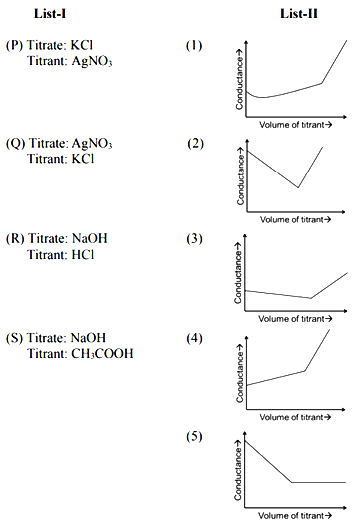 JEE Advanced 2024 Easy
 - The correct statement(s) regarding,
(i)
(ii)
(iii) and
(iv) is /areJEE Advanced 2015 Medium - Liquids and form ideal solution for all compositions of and at . Two such solutions with and mole fractions of have the total vapor pressures of and bar, respectively. What is the vapor pressure of pure liquid in bar?JEE Advanced 2020 Medium
- Aqueous solution of \(\text{Na} _2\text S_2\text O _3\) on reaction with \(\text{Cl} _2\) givesJEE Advanced 2008 Medium
- \(75.2 \mathrm{~g}\) of \(\mathrm{C}_6 \mathrm{H}_5 \mathrm{OH}\) (phenol) is dissolved in a solvent of \(K_f=14\). If the depression in freezing point is \(7 \mathrm{~K}\), then find the \(\%\) of phenol that dimerises.JEE Advanced 2006 Medium
More PYQs from JEE Advanced
- The colour of the molecules of group 17 elements changes gradually from yellow to violet down the group. This is due to -JEE Advanced 2017 Medium
- A soft plastic bottle, filled with water of density \(1 \mathrm{gm} / \mathrm{cc}\), carries an inverted glass test-tube with some air (ideal gas) trapped as shown in the figure. The test-tube has a mass of \(5 \mathrm{gm}\), and it is made of a thick glass of density \(2.5 \mathrm{gm} / \mathrm{cc}\). Initially the bottle is sealed at atmospheric pressure \(p_{0}=10^{5} \mathrm{~Pa}\) so that the volume of the trapped air is \(v_{0}=3.3 \mathrm{cc}\). When the bottle is squeezed from outside at constant temperature, the pressure inside rises and the volume of the trapped air reduces. It is found that the test tube begins to sink at pressure \(p_{0}+\Delta p\) without changing its orientation. At this pressure, the volume of the trapped air is \(v_{0}-\Delta v\).
Let \(\Delta v=X\) cc and \(\Delta p=Y \times 10^{3} \mathrm{~Pa}\).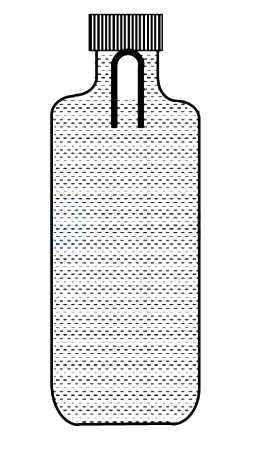
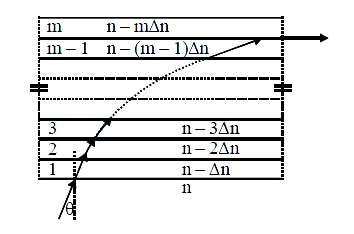
The value of is _____.JEE Advanced 2021 Hard - A monochromatic light is travelling in a medium of refractive index . It enters a stack of glass layers from the bottom side at an angle The interfaces of the glass layers are parallel to each other. The refractive indices of different glass layers are monotonically decreasing as where is the refractive index of the slab and (see the figure). The ray is refracted out parallel to the interface between the and slabs from the right side of the stack. What is the value of m?
 JEE Advanced 2017 Hard
 - An infinitely long thin non-conducting wire is parallel to the z - axis and carries a uniform line charge density . It pierces a thin non-conducting spherical shell of radius in such a way that the arc subtends an angle at the centre of the spherical shell, as shown in the figure. The permittivity of free space is . Which of the following statements is (are) true?
 JEE Advanced 2018 Medium
 - If \(f^{\prime \prime}(x)=-f(x)\), where \(f(x)\) is a continuous double differentiable function and \(g(x)=f^{\prime}(x)\). If \(F(x)=\left(f\left(\frac{x}{2}\right)\right)^2+\left(g\left(\frac{x}{2}\right)\right)^2\) and \(F(5)=5\), then \(F(10)\) isJEE Advanced 2006 Medium
- The dilution processes of different aqueous solutions with water are given in LIST-I. The effects of dilution of the solutions on are given in LIST-II.
(Note: The degree of dissociation of a weak acid and a weak base is the degree of hydrolysis of salt is represents the concentration of ions)List - I List - II A) 10 mL of \(0.1\text{ M NaOH} +20\text{ mL}\) of 0.1 M acetic acid diluted to 60 mL . P) The value of \(\left[\text H ^{+}\right]\)does not change on dilution. B) 20 mL of \(0.1\text{ M NaOH} +20\text{ mL}\) of 0.1 M acetic acid diluted to 80 mL . Q) The value of \(\left[\text H ^{+}\right]\)changes to half of its initial value on dilution. C) 20 mL of \(0.1\text{ M HCl} +20\text{ mL}\) of 0.1 M ammonia solution diluted to 80 mL . R) The value of \(\left[\text H ^{+}\right]\)changes to two times its initial value on dilution. D) 10 mL saturated solution of \(\text{Ni} (\text{OH})_2\) in equilibrium with excess of solid \(\text{Ni} (\text{OH})_2\) is diluted to 20 mL (solid \(\text{Ni} (\text{OH})_2\) is still present after dilution). S) The value of \(\left[\text H ^{+}\right]\)changes to \(\sqrt{ }\) times its initial value on dilution. T) The value of \(\left[\text H ^{+}\right]\)changes to \(\sqrt{2}\) times its initial value on dilution.
Match each process given in LIST-I with one or more effect(s) in LIST-II. The correct option isJEE Advanced 2018 Hard