


JEE Advanced · Mathematics · 31. 3D Geometry
Let \(\gamma \in \mathbb{R}\) be such that the lines \(\mathrm{L}_1: \frac{x+11}{1}=\frac{\mathrm{y}+21}{2}=\frac{\mathrm{z}+29}{3}\) and \(L_2: \frac{x+16}{3}=\frac{y+11}{2}=\frac{z+4}{\gamma}\) intersect. Let \(\mathrm{R}_1\) be the point of intersection of \(\mathrm{L}_1\) and \(\mathrm{L}_2\). Let \(\mathrm{O}=(0,0,0)\), and \(\hat{\mathrm{n}}\) denote a unit normal vector to the plane containing both the lines \(\mathrm{L}_1\) and \(\mathrm{L}_2\).
Match each entry in List-I to the correct entry in List-II.
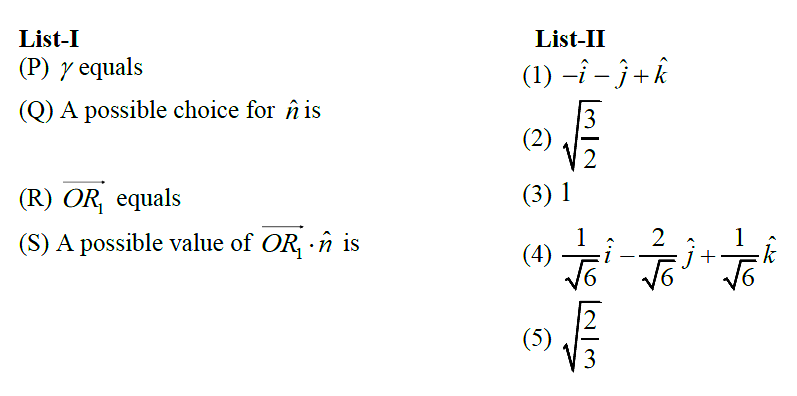
The correct option is
- A \((\mathrm{P}) \rightarrow(3) \quad(\mathrm{Q}) \rightarrow(4) \quad(\mathrm{R}) \rightarrow(1) \quad(\mathrm{S}) \rightarrow(2)\)
- B \((\mathrm{P}) \rightarrow(5) \quad(\mathrm{Q}) \rightarrow(4) \quad(\mathrm{R}) \rightarrow(1) \quad(\mathrm{S}) \rightarrow(2)\)
- C \((\mathrm{P}) \rightarrow(3) \quad(\mathrm{Q}) \rightarrow(4) \quad(\mathrm{R}) \rightarrow(1) \quad(\mathrm{S}) \rightarrow(5)\)
- D \((\mathrm{P}) \rightarrow(3) \quad(\mathrm{Q}) \rightarrow(1) \quad(\mathrm{R}) \rightarrow(4) \quad(\mathrm{S}) \rightarrow(5)\)
Answer & Solution
Correct Answer
(C) \((\mathrm{P}) \rightarrow(3) \quad(\mathrm{Q}) \rightarrow(4) \quad(\mathrm{R}) \rightarrow(1) \quad(\mathrm{S}) \rightarrow(5)\)
Step-by-step Solution
Detailed explanation
\(\begin{aligned} & \mathrm{L}_1: \frac{\mathrm{x}+11}{1}=\frac{\mathrm{y}+21}{2}=\frac{\mathrm{z}+29}{3}=\mathrm{a} \\ & \mathrm{L}_2: \frac{\mathrm{x}+16}{3}=\frac{\mathrm{y}+11}{2}=\frac{\mathrm{z}+4}{\gamma}=\mathrm{b}\end{aligned}\)
\(\begin{aligned} & x=a-11=3 b-16 \Rightarrow a-3 b=-5...(1) \\ & y=2 a-21=2 b-11 \Rightarrow 2 a-2 b=10...(2) \\ & z=3 a-29=b r-4 \Rightarrow 3 a-b \gamma=25...(3)\end{aligned}\)
from (1) & (2)
\(\mathrm{a}=10, \mathrm{~b}=5\)
Now from (3)
\(3(10)-5 \gamma=25 \quad \therefore \gamma=1\)
\(\begin{aligned} & \mathrm{R}_1 \equiv(-1,-1,1) \\ & \mathrm{OR}_1=-\hat{\mathrm{i}}-\hat{\mathrm{j}}+\hat{\mathrm{k}} \\ & \overrightarrow{\mathrm{n}}=\left|\begin{array}{lrr}\mathrm{i} & \mathrm{j} & \mathrm{k} \\ 1 & 2 & 3 \\ 3 & 2 & 1\end{array}\right|=-4 \hat{\mathrm{i}}-(-8) \hat{\mathrm{j}}-4 \hat{\mathrm{k}} \\ & \overrightarrow{\mathrm{n}}=-4 \hat{\mathrm{i}}+8 \hat{\mathrm{j}}+4 \hat{\mathrm{k}}=-4(\hat{\mathrm{i}}-2 \hat{\mathrm{j}}+\hat{\mathrm{k}}) \\ & \hat{\mathrm{n}}= \pm \frac{4(\hat{\mathrm{i}}-2 \hat{\mathrm{j}}+\hat{\mathrm{k}})}{4 \sqrt{6}}= \pm \frac{(\hat{\mathrm{i}}-2 \hat{\mathrm{j}}+\hat{\mathrm{k}})}{\sqrt{6}} \\ & \overrightarrow{\mathrm{OR}}_1 \cdot \hat{\mathrm{n}}= \pm(-\hat{\mathrm{i}}-\hat{\mathrm{j}}+\hat{\mathrm{k}})\left(\frac{\hat{\mathrm{i}}-2 \hat{\mathrm{j}}+\hat{\mathrm{k}}}{\sqrt{6}}\right)= \pm \frac{2}{\sqrt{6}}= \pm \sqrt{\frac{4}{6}}= \pm \sqrt{\frac{2}{3}}\end{aligned}\)
\(\begin{aligned} & x=a-11=3 b-16 \Rightarrow a-3 b=-5...(1) \\ & y=2 a-21=2 b-11 \Rightarrow 2 a-2 b=10...(2) \\ & z=3 a-29=b r-4 \Rightarrow 3 a-b \gamma=25...(3)\end{aligned}\)
from (1) & (2)
\(\mathrm{a}=10, \mathrm{~b}=5\)
Now from (3)
\(3(10)-5 \gamma=25 \quad \therefore \gamma=1\)
\(\begin{aligned} & \mathrm{R}_1 \equiv(-1,-1,1) \\ & \mathrm{OR}_1=-\hat{\mathrm{i}}-\hat{\mathrm{j}}+\hat{\mathrm{k}} \\ & \overrightarrow{\mathrm{n}}=\left|\begin{array}{lrr}\mathrm{i} & \mathrm{j} & \mathrm{k} \\ 1 & 2 & 3 \\ 3 & 2 & 1\end{array}\right|=-4 \hat{\mathrm{i}}-(-8) \hat{\mathrm{j}}-4 \hat{\mathrm{k}} \\ & \overrightarrow{\mathrm{n}}=-4 \hat{\mathrm{i}}+8 \hat{\mathrm{j}}+4 \hat{\mathrm{k}}=-4(\hat{\mathrm{i}}-2 \hat{\mathrm{j}}+\hat{\mathrm{k}}) \\ & \hat{\mathrm{n}}= \pm \frac{4(\hat{\mathrm{i}}-2 \hat{\mathrm{j}}+\hat{\mathrm{k}})}{4 \sqrt{6}}= \pm \frac{(\hat{\mathrm{i}}-2 \hat{\mathrm{j}}+\hat{\mathrm{k}})}{\sqrt{6}} \\ & \overrightarrow{\mathrm{OR}}_1 \cdot \hat{\mathrm{n}}= \pm(-\hat{\mathrm{i}}-\hat{\mathrm{j}}+\hat{\mathrm{k}})\left(\frac{\hat{\mathrm{i}}-2 \hat{\mathrm{j}}+\hat{\mathrm{k}}}{\sqrt{6}}\right)= \pm \frac{2}{\sqrt{6}}= \pm \sqrt{\frac{4}{6}}= \pm \sqrt{\frac{2}{3}}\end{aligned}\)
See the Complete Solution
Get step-by-step explanations for this and 2.5 Lakh+ more JEE, NEET & CET questions.
- Unlock all solutions
- Practice the full chapter
- Track accuracy across PYQs
4.8 rated on Google Play · 14,000+ reviews
More questions from Mathematics
- The positive integer value of \(n>3\) satisfying the equation
\(\frac{1}{\sin \left(\frac{\pi}{n}\right)}=\frac{1}{\sin \left(\frac{2 \pi}{n}\right)}+\frac{1}{\sin \left(\frac{3 \pi}{n}\right)} \text { is }\)JEE Advanced 2011 Hard - Paragraph:
A circle \(C\) of radius 1 is inscribed in an equilateral \(\triangle P Q R\). The points of contact of \(C\) with the sides \(P Q, Q R, R P\) are \(D, E, F\) respectively. The line \(P Q\) is given by the equation
\(\sqrt{3} x+y-6=0\) and the point \(D\) is \(\left(\frac{3 \sqrt{3}}{2}, \frac{3}{2}\right)\). Further, it is given that the origin and the centre of \(C\) are on the same side of the line \(P Q\).Question:
Points \(E\) and \(F\) are given byJEE Advanced 2008 Medium - If \(f(x)\) is cubic polynomial which has local maximum at \(x=-1\). If \(f(2)=18, f(1)=-1\) and \(f^{\prime}(x)\) has local minimum at \(x=0\), thenJEE Advanced 2006 Hard
- In a triangle , let and . If and , then the value of is _______JEE Advanced 2020 Medium
- Paragraph:
There are \(n\) urns each containing \((n+1)\) balls such that the ith urn contains \(i\) white balls and \((n+1-i)\) red balls. Let \(u_i\) be the event of selecting ith urn, \(i=1,2,3, \ldots, n\) and \(W\) denotes the event of getting a white balls.Question:
If \(n\) is even and \(E\) denotes the event of choosing even numbered urn \(\left(P\left(u_i\right)=\frac{1}{n}\right)\), then the value of \(P(W / E)\) isJEE Advanced 2006 Medium - Let \(y(x)\) be the solution of the differential equation
\(x^2 \frac{d y}{d x}+x y=x^2+y^2, x>\frac{1}{e}\)
satisfying \(y(1)=0\). Then the value of \(2 \frac{(y(e))^2}{y\left(e^2\right)}\) is _____ .JEE Advanced 2025 Easy
More PYQs from JEE Advanced
- Two players, and , play a game against each other. In every round of the game, each player rolls a fair die once, where the six faces of the die have six distinct numbers. Let and denote the readings on the die rolled by and , respectively. If , then scores points and scores point. If , then each player scores points. If , then scores point and scores points. Let and be the total scores of and , respectively, after playing the round.
The correct option is:List- List- Probability of is Probability of is Probability of is Probability of is JEE Advanced 2022 Hard - Paragraph:
The reactions of \(\mathrm{Cl}_{2}\) gas with cold-dilute and hot-concentrated \(\mathrm{NaOH}\) in water give sodium salts of two (different) oxoacids of chlorine, \(\boldsymbol{P}\) and \(\boldsymbol{Q}\), respectively. The \(\mathrm{Cl}_{2}\) gas reacts with \(\mathrm{SO}_{2}\) gas, in presence of charcoal, to give a product \(\boldsymbol{R}\). \(\boldsymbol{R}\) reacts with white phosphorus to give a compound \(\boldsymbol{S}\). On hydrolysis, \(\boldsymbol{S}\) gives an oxoacid of phosphorus, \(\boldsymbol{T}\).
Question:
\(R, S\) and \(T\), respectively, areJEE Advanced 2013 Medium - The circuit shown in the figure contains an inductor \(L\), a capacitor \(C_0\), a resistor \(R_0\) and an ideal battery. The circuit also contains two keys \(\mathrm{K}_1\) and \(\mathrm{K}_2\). Initially, both the keys are open and there is no charge on the capacitor. At an instant, key \(K_1\) is closed and immediately after this the current in \(R_0\) is found to be \(I_1\). After a long time, the current attains a steady state value \(I_2\). Thereafter, \(\mathrm{K}_2\) is closed and simultaneously \(\mathrm{K}_1\) is opened and the voltage across \(C_0\) oscillates with amplitude \(V_0\) and angular frequency \(\omega_0\).
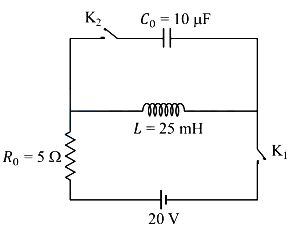
Match the quantities mentioned in List-I with their values in List-II and choose the correct option.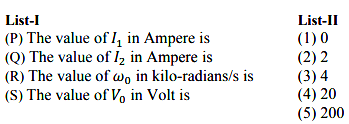 JEE Advanced 2024 Hard
 - Total number of geometrical isomers for the complex \(\left[\mathrm{RhCl}(\mathrm{CO})\left(\mathrm{PPh}_3\right)\left(\mathrm{NH}_3\right)\right]\) isJEE Advanced 2010 Easy
- Let and be respectively given by and Define by
Then number of points at which is not differentiable is_________JEE Advanced 2014 Hard - A uniformly charged thin spherical shell of radius \(R\) carries uniform surface charge density of \(\sigma\) per unit area. It is made of two hemispherical shells, held together by pressing them with force \(F\) (see figure). \(F\) is proportional to
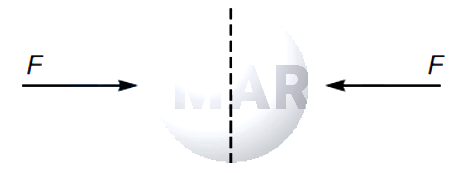 JEE Advanced 2010 Medium