


JEE Advanced · Physics · 27. Atomic Physics
The wavelength of the first spectral line in the Balmer series of hydrogen atom is \(6561 Å\). The wavelength of the second spectral line in the Balmer series of singly ionized helium atom is
- A \(1215 Å\)
- B \(1640 Å\)
- C \(2430 Å\)
- D \(4687 Å\)
Answer & Solution
Correct Answer
(A) \(1215 Å\)
Step-by-step Solution
Detailed explanation
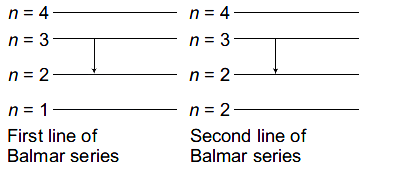
For hydrogen or hydrogen type atoms
\(\frac{1}{\lambda}=R Z^2\left(\frac{1}{n_f^2}-\frac{1}{n_i^2}\right)\)
In the transition from \(n_i \longrightarrow n_f\)
\(\therefore \lambda \propto \frac{1}{Z^2\left(\frac{1}{n_f^2}-\frac{1}{n_i^2}\right)} \)
\(\therefore \frac{\lambda_2}{\lambda_1}=\frac{Z_1^2\left(\frac{1}{n_f^2}-\frac{1}{n_i^2}\right)_1}{Z_2^2\left(\frac{1}{n_f^2}-\frac{1}{n_i^2}\right)_2}\)
\(\lambda_2=\frac{\lambda_1 Z_1^2\left(\frac{1}{n_f^2}-\frac{1}{n_i^2}\right)_1}{Z_2^2\left(\frac{1}{n_f^2}-\frac{1}{n_i^2}\right)_2}\)
Substituting the values, we have
\(=\frac{(6561 Å)(1)^2\left(\frac{1}{2^2}-\frac{1}{3^2}\right)}{(2)^2\left(\frac{1}{2^2}-\frac{1}{4^2}\right)}=1215 Å\)
\(\therefore\) Correct option is (a).
Analysis of Question
(i) Question is simple.
(ii) In modern physics, mostly questions are asked on the emission of photon by the transition of electron from some higher energy state to some lower energy state.
(iii) For hydrogen and hydrogen like atoms which have only single electron, we can use the formula
\(\frac{1}{\lambda}=R Z^2\left(\frac{1}{n_f^2}-\frac{1}{n_i^2}\right)\)
(iv) Further, the student should also remember different series, as shown in figure below.
\(\mathrm{I} \rightarrow\) Lymen series
II \(\rightarrow\) Balmer series
III \(\rightarrow\) Paschen series
IV \(\rightarrow\) Brackett series
\(\mathrm{V} \rightarrow\) Pfund series
See the Complete Solution
Get step-by-step explanations for this and 2.5 Lakh+ more JEE, NEET & CET questions.
- Unlock all solutions
- Practice the full chapter
- Track accuracy across PYQs
4.8 rated on Google Play · 14,000+ reviews
More questions from Physics
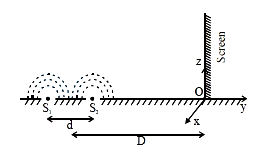
- While conducting the Young's double slit experiment, a student replaced the two slits with a large opaque plate in the x-y plane containing two small holes that act as two coherent point sources emitting light of wavelength 600 nm. The student mistakenly placed the screen parallel to the x-z plane (for z > 0) at a distance D = 3m from the mid-point of , as shown schematically in the figure. The distance between the sources d = 0.6003 mm. The origin O is at the intersection of the screen and the line joining . Which of the following is (are) true of the intensity pattern on the screen?
 JEE Advanced 2016 Medium
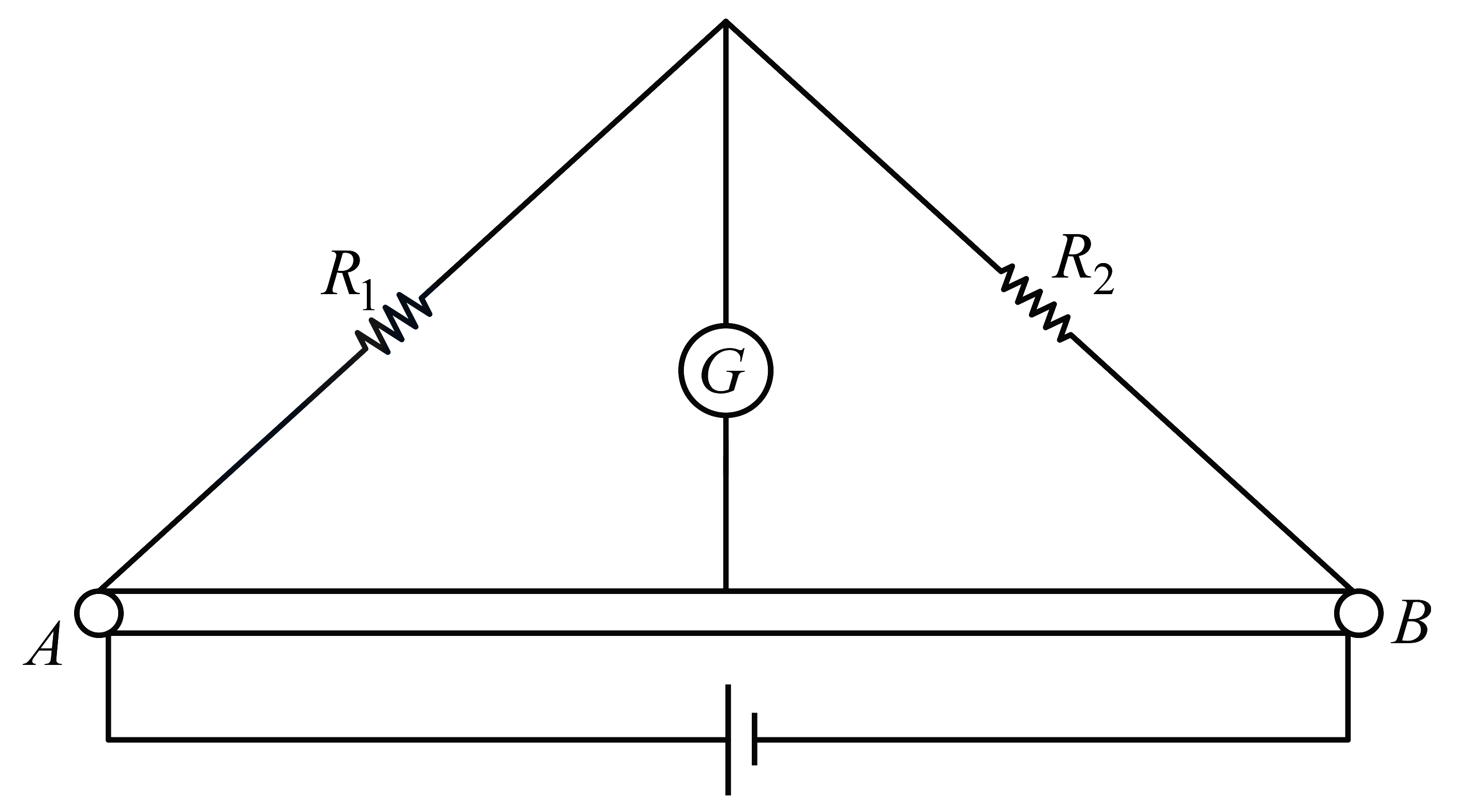
 - Two resistances and are connected to a wire of uniform resistivity, as shown in the figure. The radius of the wire varies linearly along its axis from at to at . A galvanometer connected to the center of the wire, from each end along its axis, shows zero deflection when and are connected to a battery. The value of is _______.
 JEE Advanced 2022 Medium
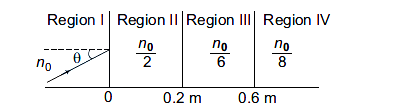
 - A light beam is travelling from Region I to Region IV (refer figure). The refractive index in Region I, II, III and IV are \(n_0, \frac{n_0}{2}, \frac{n_0}{6}\) and \(\frac{n_0}{8}\), respectively. The angle of incidence \(\theta\) for which the beam just misses entering Region IV is
 JEE Advanced 2008 Easy
 - A silver sphere of radius \(1 \mathrm{~cm}\) and work function \(4.7 \mathrm{eV}\) is suspended from an insulating thread in free-space. It is under continuous illumination of \(200 \mathrm{~nm}\) wavelength light. As photoelectrons are emitted, the sphere gets charged and acquires a potential. The maximum number of photoelectrons emitted from the sphere is \(A \times 10^Z\) (where \(1 < A < 10\) ). The value of \(Z\) isJEE Advanced 2011 Medium
- A light inextensible string that goes over a smooth fixed pulley as shown in the figure connects two blocks of masses \(0.36 \mathrm{~kg}\) and \(0.72 \mathrm{~kg}\). Taking \(g=10 \mathrm{~ms}^{-2}\), find thework done (in Joule) by string on the block of mass \(0.36 \mathrm{~kg}\) during the first second after the system is released from rest.
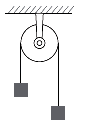 JEE Advanced 2009 Hard
 - Four solid spheres each of diameter \(\sqrt{5} \mathrm{~cm}\) and mass \(0.5 \mathrm{~kg}\) ar placed with their centres at the corners of a square of side \(4 \mathrm{~cm}\). The moment of inertia of the system about the diagonal of the square is \(N \times 10^{-4} \mathrm{~kg}-\mathrm{m}^2\), then \(N\) isJEE Advanced 2011 Medium
More PYQs from JEE Advanced
- A heavy nucleus of half-life minutes undergoes alpha-decay with probability of and beta-decay with probability of . Initially, the number of nuclei is . The number of alpha-decays of in the first one hour is:JEE Advanced 2021 Easy
- Let and be three vectors each of magnitude and the angle between each pair of them is If is a non - zero vector perpendicular to and and is a non - zero vector perpendicular to and , thenJEE Advanced 2014 Hard
- In the figure, a ladder of mass m is shown leaning against a wall. It is in static equilibrium making an angle with the horizontal floor. The coefficient of friction between the wall and the ladder is and that between the floor and the ladder is . The normal reaction of the wall on the ladder is and that of the floor is If the ladder is about to slip, then
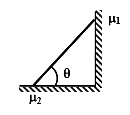 JEE Advanced 2014 Medium
 - Internal bisector of \(\angle A\) of \(\triangle A B C\) meets side \(B C\) at \(D\). A line drawn through \(D\) perpendicular to \(A D\) intersects the side \(A C\) at \(E\) and side \(A B\) at \(F\). If \(a, b\) and \(c\) represent sides of \(\triangle A B C\), thenJEE Advanced 2006 Hard
- Paragraph:
Carbon-14 is used to determine the age of organic material. The procedure is based on the formation of \({ }^{14} \mathrm{C}\) by neutron capture in the upper atmosphere.
\(
{ }_7^{14} \mathrm{~N}+{ }_0^1 n \longrightarrow{ }_6^{14} \mathrm{C}+{ }_1 n^1
\)
\({ }^{14} \mathrm{C}\) is absorbed by living organisms during photosynthesis. The \({ }^{14} \mathrm{C}\) content is constant in living organism once the plant or animal dies, the uptake of carbon dioxide by it ceases and the level of \({ }^{14} \mathrm{C}\) in the dead being, falls to the decay which \({ }^{14} \mathrm{C}\) undergoes.
\(
{ }_6^{14} \mathrm{C} \longrightarrow{ }_7^{14} \mathrm{~N}+\beta^{-}
\)
The half life period of \({ }^{14} \mathrm{C}\) is 5770 years. The decay constant \((\lambda)\) can be calculated by using the following formula \(\lambda=\frac{0.693}{t_{1 / 2}}\).
The comparison of the \(\beta^{-}\)activity of the dead matter with that of the carbon still in circulation enables measurement of the period of the isolation of the material from the living cycle. The method however, ceases to be accurate over periods longer than 30,000 years. The proportion of \({ }^{14} \mathrm{C}\) to \({ }^{12} \mathrm{C}\) in living matter is \(1: 10^{12}\).
Question:
Which of the following option is correct?JEE Advanced 2006 Medium - Paragraph:
A fair die is tossed repeatedly until a six is obtained. Let \(X\) denotes the number of tosses required.Question:
The probability that \(X \geq 3\) equalsJEE Advanced 2009 Easy