


JEE Advanced · Mathematics · 16. Limits
Let be a function. We say that has:
PROPERTY if exists and is finite, and
PROPERTY if exists and is finite.
Then which of the following options is/are correct?
- A has PROPERTY
- B has PROPERTY
- C has PROPERTY
- D has PROPERTY
Answer & Solution
Correct Answer
(D) has PROPERTY
Step-by-step Solution
Detailed explanation
Does not exist
does not exist
See the Complete Solution
Get step-by-step explanations for this and 2.5 Lakh+ more JEE, NEET & CET questions.
- Unlock all solutions
- Practice the full chapter
- Track accuracy across PYQs
4.8 rated on Google Play · 14,000+ reviews
More questions from Mathematics
- For let Then the possible value(s) of is/are:JEE Advanced 2019 Medium
- Paragraph:
Box \(1\) contains three cards bearing numbers \(1,2,3\); box \(2\) contains five cards bearing numbers \(1,2,3,4,5\); and box \(3\) contains seven cards bearing numbers \(1,2,3,4,5,6,7\). A card is drawn from each of the boxes. Let \(x_{i}\) be the number on the card drawn from the \(i^{t h}\) box, \(i=1,2,3\).
Question:
The probability that \(x_{1}+x_{2}+x_{3}\) is odd, isJEE Advanced 2014 Medium - Let be two planes. Then, which of the following statement(s) is (are) TRUE?JEE Advanced 2018 Medium
- If \(0 < x < 1\), then \(\sqrt{1+x^2}\left[\left\{x \cos \left(\cot ^{-1} x\right)+\sin \left(\cot ^{-1} x\right)\right\}^2-1\right]^{\frac{1}{2}}\) is equal toJEE Advanced 2008 Medium
- Considering only the principal values of the inverse trigonometric functions, the value of \(\tan \left(\sin ^{-1}\left(\frac{3}{5}\right)-2 \cos ^{-1}\left(\frac{2}{\sqrt{5}}\right)\right)\) isJEE Advanced 2024 Easy
- Let \(\omega=e^{i \pi / 3}\) and \(a, b, c, x, y, z\) be non-zero complex numbers such that \(a+b+c=x, a+b \omega+c \omega^2=y, a+b \omega^2+c \omega=z\).
Then, the value of \(\frac{|x|^2+|y|^2+|z|^2}{|a|^2+|b|^2+|c|^2}\) isJEE Advanced 2011 Hard
More PYQs from JEE Advanced
- Paragraph:
A circle \(C\) of radius 1 is inscribed in an equilateral \(\triangle P Q R\). The points of contact of \(C\) with the sides \(P Q, Q R, R P\) are \(D, E, F\) respectively. The line \(P Q\) is given by the equation
\(\sqrt{3} x+y-6=0\) and the point \(D\) is \(\left(\frac{3 \sqrt{3}}{2}, \frac{3}{2}\right)\). Further, it is given that the origin and the centre of \(C\) are on the same side of the line \(P Q\).Question:
The equation of circle \(C\) isJEE Advanced 2008 Easy - Paragraph:
The reaction of \(\mathrm{K}_{3}\left[\mathrm{Fe}(\mathrm{CN})_{6}\right]\) with freshly prepared \(\mathrm{FeSO}_{4}\) solution produces a dark blue precipitate called Turnbull's blue. Reaction of \(\mathrm{K}_{4}\left[\mathrm{Fe}(\mathrm{CN})_{6}\right]\) with the \(\mathrm{FeSO}_{4}\) solution in complete absence of air produces a white precipitate \(\mathbf{X}\), which turns blue in air. Mixing the \(\mathrm{FeSO}_{4}\) solution with \(\mathrm{NaNO}_{3}\), followed by a slow addition of concentrated \(\mathrm{H}_{2} \mathrm{SO}_{4}\) through the side of the test tube produces a brown ring.
Question:
Precipitate \(\mathbf{X}\) isJEE Advanced 2021 Medium - A vertical line passing through the point intersects the ellipse at the points and . Let the tangents to the ellipse at and meet at the point . If area of triangle and , thenJEE Advanced 2013 Hard
- Let \(\left(x_0, y_0\right)\) be the solution of the following equations \((2 x)^{\log 2}=(3 y)^{\log 3}\), \(3^{\log x}=2^{\log y}\), then \(x_0\) is equal toJEE Advanced 2011 Medium
- Paragraph:
A small block of mass \(M\) moves on a frictionless surface of an inclined plane, as shown in figure. The angle of the incline suddenly changes from \(60^{\circ}\) to \(30^{\circ}\) at point \(B\). The block is initially at rest at \(A\). Assume that collisions between the block and the incline are totally inelastic \(\left(g=10 \mathrm{~m} / \mathrm{s}^2\right)\)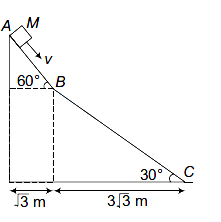
Question:
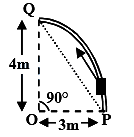
If collision between the block and the incline is completely elastic, then the vertical (upward) component of the velocity of the block at point \(B\), immediately after it strikes the second incline isJEE Advanced 2008 Medium - Consider an elliptically shaped rail PQ in the vertical plane with and . A block of mass 1 kg is pulled along the rail from P to Q with a force of 18 N, which is always parallel to line PQ (see the figure given). Assuming no frictional losses, the kinetic energy of the block when it reaches Q is Joules. The value of n is (take acceleration due to gravity = )
 JEE Advanced 2014 Hard