


JEE Advanced · Mathematics · 19. Determinants
Paragraph:
Let \(A\) be the set of all \(3 \times 3\) symmetric matrices all of whose entries are either 0 or 1 . Five of these entries are 1 and four of them are 0 .Question:
The number of matrices \(A\) in \(A\) for which the system of linear equations \(A\left[\begin{array}{l}x \\ y \\ z\end{array}\right]=\left[\begin{array}{l}1 \\ 0 \\ 0\end{array}\right]\) is is inconsistent, is
- A
0
- B
more than 2
- C
2
- D
1
Answer & Solution
Correct Answer
(B)
more than 2
Step-by-step Solution
Detailed explanation
Given, \(A\left[\begin{array}{l}x \\ y \\ z\end{array}\right]=\left[\begin{array}{l}1 \\ 0 \\ 0\end{array}\right]\)
Case I \(\left[\begin{array}{lll}1 & a & b \\ a & 1 & c \\ b & c & 1\end{array}\right]\left[\begin{array}{l}x \\ y \\ z\end{array}\right]=\left[\begin{array}{l}1 \\ 0 \\ 0\end{array}\right]\)
\(a, b, c\) are selected from \(1,0,0\).
\(\Rightarrow x+a y+b z=1 \Rightarrow a x+y+c z=0\) \(b x+c y+z=0\)
(i) If \(a=1, b=c=0\), then \(x+y=1\) Inconsistent system of equation \(x+y=0\)
(ii) If \(a=0=c, b=1\), then \(x+z=1\), \(y=0\)
Inconsistent system of equation
\[
x+z=0
\]
(iii) If \(c=1, a=b=0\), then \(x=1, z=0\), \(y=0\)
Case II
(i) \(\left[\begin{array}{lll}1 & a & b \\ a & 0 & c \\ b & c & 0\end{array}\right]\left[\begin{array}{l}x \\ y \\ z\end{array}\right]=\left[\begin{array}{l}1 \\ 0 \\ 0\end{array}\right]\)
\(a, b, c\) are selected from \(1,1,0\).
\[
\begin{aligned}
\Rightarrow x+a y+b z & =1 \Rightarrow a x+c z=0 \\
b x+c y & =0
\end{aligned}
\]
Clearly, in all three cases, solutions are possible, so system is consistent.
\[
\begin{gathered}
\text { (ii) }\left[\begin{array}{lll}
0 & a & b \\
a & 1 & c \\
b & c & 0
\end{array}\right]\left[\begin{array}{l}
x \\
y \\
z
\end{array}\right]=\left[\begin{array}{l}
1 \\
0 \\
0
\end{array}\right] \\
\Rightarrow a y+b z=1 \Rightarrow a x+y+c z=0 \\
b x+c y=0
\end{gathered}
\]
Clearly, \(b=0, a=c=1\) gives
\[
y=1 ; x+y+z=0
\]
Inconsistent system \(y=0\)
More than 2 matrices are possible.
Hence, option (b) is correct.
Case I \(\left[\begin{array}{lll}1 & a & b \\ a & 1 & c \\ b & c & 1\end{array}\right]\left[\begin{array}{l}x \\ y \\ z\end{array}\right]=\left[\begin{array}{l}1 \\ 0 \\ 0\end{array}\right]\)
\(a, b, c\) are selected from \(1,0,0\).
\(\Rightarrow x+a y+b z=1 \Rightarrow a x+y+c z=0\) \(b x+c y+z=0\)
(i) If \(a=1, b=c=0\), then \(x+y=1\) Inconsistent system of equation \(x+y=0\)
(ii) If \(a=0=c, b=1\), then \(x+z=1\), \(y=0\)
Inconsistent system of equation
\[
x+z=0
\]
(iii) If \(c=1, a=b=0\), then \(x=1, z=0\), \(y=0\)
Case II
(i) \(\left[\begin{array}{lll}1 & a & b \\ a & 0 & c \\ b & c & 0\end{array}\right]\left[\begin{array}{l}x \\ y \\ z\end{array}\right]=\left[\begin{array}{l}1 \\ 0 \\ 0\end{array}\right]\)
\(a, b, c\) are selected from \(1,1,0\).
\[
\begin{aligned}
\Rightarrow x+a y+b z & =1 \Rightarrow a x+c z=0 \\
b x+c y & =0
\end{aligned}
\]
Clearly, in all three cases, solutions are possible, so system is consistent.
\[
\begin{gathered}
\text { (ii) }\left[\begin{array}{lll}
0 & a & b \\
a & 1 & c \\
b & c & 0
\end{array}\right]\left[\begin{array}{l}
x \\
y \\
z
\end{array}\right]=\left[\begin{array}{l}
1 \\
0 \\
0
\end{array}\right] \\
\Rightarrow a y+b z=1 \Rightarrow a x+y+c z=0 \\
b x+c y=0
\end{gathered}
\]
Clearly, \(b=0, a=c=1\) gives
\[
y=1 ; x+y+z=0
\]
Inconsistent system \(y=0\)
More than 2 matrices are possible.
Hence, option (b) is correct.
See the Complete Solution
Get step-by-step explanations for this and 2.5 Lakh+ more JEE, NEET & CET questions.
- Unlock all solutions
- Practice the full chapter
- Track accuracy across PYQs
4.8 rated on Google Play · 14,000+ reviews
More questions from Mathematics
- If \(\lim _{x \rightarrow \infty}\left(\frac{x^{2}+x+1}{x+1}-a x-b\right)=4\), thenJEE Advanced 2012 Hard
- For a real number if the system of linear equations, has infinitely many solutions, thenJEE Advanced 2017 Medium
- Let { and } and { is a real number} (Here the inverse trigonometric function assumes values in .)
Let be the function defined by
And be the function defined by .
The correct option is:LIST-I LIST-II A. The range of is P. B. The range of contains Q. (0, 1) C. The domain of contains R. D. The domain of is S. T. U. JEE Advanced 2018 Hard - \[
\text { Match the statements/expressions in Column I with the open intervals in Column II. }
\]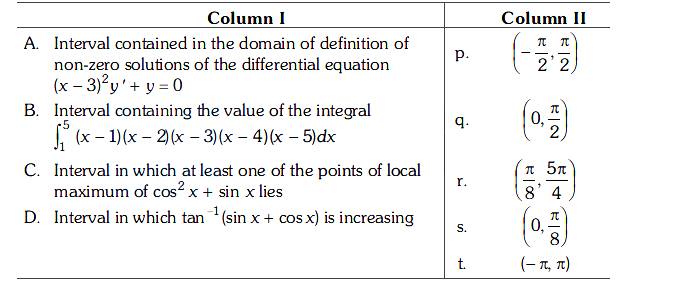 JEE Advanced 2009 Hard
 - Let \(P Q R\) be a triangle of area \(\Delta\) with \(a=2, b=\frac{7}{2}\) and \(c=\frac{5}{2} ;\) where \(a, b\), and \(c\) are the lengths of the sides of the triangle opposite to the angles at \(P, Q\) and \(R\) respectively. Then \(\frac{2 \sin P-\sin 2 P}{2 \sin P+\sin 2 P}\) equals.JEE Advanced 2012 Medium
- If \(\vec{a}\) and \(\vec{b}\) are vectors such that \(|\vec{a}+\vec{b}|=\sqrt{29}\) and \(\vec{a} \times(2 \hat{i}+3 \hat{j}+4 \hat{k})=(2 \hat{i}+3 \hat{j}+4 \hat{k}) \times \vec{b}\), then a possible value of \((\vec{a}+\vec{b}) \cdot(-7 \hat{i}+2 \hat{j}+3 \hat{k})\) isJEE Advanced 2012 Easy
More PYQs from JEE Advanced
- Paragraph:
Properties such as boiling point, freezing point and vapour pressure of a pure solvent change when solute molecules are added to get homogeneous solution. These are called colligative properties. Applications of colligative properties are very useful in day-to-day life. One of its examples is the use of ethylene glycol and water mixture as anti-freezing liquid in the radiator automobiles.
A solution \(M\) is prepared by mixing ethanol and water. The mole fraction of ethanol in the mixtrue is \(0.9\)
Given Freezing point depression constant of water \(\left(k^{\text {water }}\right)=1.86 \mathrm{~K} \mathrm{~kg} \mathrm{~mol}^{-1}\)
Freezing point depression constant of ethanol \(\left(k_f^{\text {ethanol }}\right)=2.0 \mathrm{Kkg} \mathrm{mol}^{-1}\)
Boiling point elevation constant of water \(\left(k_b^{\text {water }}\right)=0.52 \mathrm{Kkg} \mathrm{mol}^{-1}\)
Boiling point elevation constant of ethanol \(\left(k_b^{\text {ethanol }}\right)=1.2 \mathrm{Kkg} \mathrm{mol}^{-1}\)
Standard freezing point of water \(=273 \mathrm{~K}\)
Standard freezing point of ethanol \(=155.7 \mathrm{~K}\)
Standard boiling point of water \(=373 \mathrm{~K}\)
Standard boiling point of ethanol \(=351.5 \mathrm{~K}\)
Vapour pressure of pure water \(=328 \mathrm{~mm}\) of \(\mathrm{Hg}\)
Vapour pressure of pure ethanol \(=40 \mathrm{~mm}\) of \(\mathrm{Hg}\)
Molecular weight of water \(=18 \mathrm{~g} \mathrm{~mol}^{-1}\)
Molecular weight of ethanol \(=46 \mathrm{~g} \mathrm{~mol}^{-1}\)
In answering the following questions, consider the solutions to be ideal dilute solutions and solutes to be non-volatile and non-dissociative.
Question:
The vapour pressure of the solution \(M\) isJEE Advanced 2008 Medium - Paragraph:
There are \(n\) urns each containing \((n+1)\) balls such that the ith urn contains \(i\) white balls and \((n+1-i)\) red balls. Let \(u_i\) be the event of selecting ith urn, \(i=1,2,3, \ldots, n\) and \(W\) denotes the event of getting a white balls.Question:
If \(P\left(u_i\right)=c\), where \(c\) is a constant, then \(P\left(u_i / W\right)\) is equal toJEE Advanced 2006 Medium - The number of real solutions of the equation lying in the interval is____.
(Here, the inverse trigonometric functions assume values in
respectively.)JEE Advanced 2018 Hard - The total number of lone pairs of electrons in isJEE Advanced 2015 Easy
- A parallel beam of light is incident from air at an angle on the side PQ of a right angled triangular prism of refractive index . Light undergoes total internal reflection in the prism at the face PR when has a minimum value of The angle of the prism is:
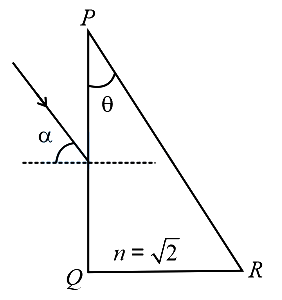 JEE Advanced 2016 Easy
 - The species formed on fluorination of phosphorus pentachloride in a polar organic solvent are :JEE Advanced 2024 Easy