


JEE Advanced · Mathematics · 30. Vector Algebra
Let \(\mathbf{a}=\hat{\mathbf{i}}+2 \hat{\mathbf{j}}+\hat{\mathbf{k}}, \mathbf{b}=\hat{\mathbf{i}}-\hat{\mathbf{j}}+\hat{\mathbf{k}}, \mathbf{c}=\hat{\mathbf{i}}+\hat{\mathbf{j}}-\hat{\mathbf{k}}\). A vector coplanar to \(\mathbf{a}\) and \(\mathbf{b}\) has a projection along c of magnitude \(\frac{1}{\sqrt{3}}\), then the vector is
- A
\(4 \hat{\mathbf{i}}-\hat{\mathbf{j}}+4 \hat{\mathbf{k}}\)
- B
\(4 \hat{\mathbf{i}}+\hat{\mathbf{j}}-4 \hat{\mathbf{k}}\)
- C
\(2 \hat{\mathbf{i}}+\hat{\mathbf{j}}+\hat{\mathbf{k}}\)
- D
None of these
Answer & Solution
Correct Answer
(A)
\(4 \hat{\mathbf{i}}-\hat{\mathbf{j}}+4 \hat{\mathbf{k}}\)
Step-by-step Solution
Detailed explanation
Let vector \(\mathbf{r}\) be coplanar to \(\mathbf{a}\) and \(\mathbf{b}\).
\[
\begin{array}{ll}
\therefore & \mathbf{r}=\mathbf{a}+t \mathbf{b} \\
\Rightarrow & \mathbf{r}=(\hat{\mathbf{i}}+2 \hat{\mathbf{j}}+\hat{\mathbf{k}})+t(\hat{\mathbf{i}}-\hat{\mathbf{j}}+\hat{\mathbf{k}})=\hat{\mathbf{i}}(1+t)+\hat{\mathbf{j}}(2-t)+\hat{\mathbf{k}}(1+t)
\end{array}
\]
The projection of \(\mathbf{r}\) on \(\mathbf{c}=\frac{1}{\sqrt{3}} \Rightarrow \frac{\mathbf{r} \cdot \mathbf{c}}{|\mathbf{c}|}=\frac{1}{\sqrt{3}}\) \(\Rightarrow \frac{|1 \cdot(1+t)+1 \cdot(2-t)-1 \cdot(1+t)|}{\sqrt{3}}=\frac{1}{\sqrt{3}}\) \(\Rightarrow|2-t|=\pm 1 \Rightarrow t=1\) or 3
When, \(t=1\) we have \(\mathbf{r}=2 \hat{\mathbf{i}}+\hat{\mathbf{j}}+2 \hat{\mathbf{k}}\)
When, \(t=3\) we have \(\mathbf{r}=4 \hat{\mathbf{i}}-\hat{\mathbf{j}}+4 \hat{\mathbf{k}}\)
\[
\begin{array}{ll}
\therefore & \mathbf{r}=\mathbf{a}+t \mathbf{b} \\
\Rightarrow & \mathbf{r}=(\hat{\mathbf{i}}+2 \hat{\mathbf{j}}+\hat{\mathbf{k}})+t(\hat{\mathbf{i}}-\hat{\mathbf{j}}+\hat{\mathbf{k}})=\hat{\mathbf{i}}(1+t)+\hat{\mathbf{j}}(2-t)+\hat{\mathbf{k}}(1+t)
\end{array}
\]
The projection of \(\mathbf{r}\) on \(\mathbf{c}=\frac{1}{\sqrt{3}} \Rightarrow \frac{\mathbf{r} \cdot \mathbf{c}}{|\mathbf{c}|}=\frac{1}{\sqrt{3}}\) \(\Rightarrow \frac{|1 \cdot(1+t)+1 \cdot(2-t)-1 \cdot(1+t)|}{\sqrt{3}}=\frac{1}{\sqrt{3}}\) \(\Rightarrow|2-t|=\pm 1 \Rightarrow t=1\) or 3
When, \(t=1\) we have \(\mathbf{r}=2 \hat{\mathbf{i}}+\hat{\mathbf{j}}+2 \hat{\mathbf{k}}\)
When, \(t=3\) we have \(\mathbf{r}=4 \hat{\mathbf{i}}-\hat{\mathbf{j}}+4 \hat{\mathbf{k}}\)
See the Complete Solution
Get step-by-step explanations for this and 2.5 Lakh+ more JEE, NEET & CET questions.
- Unlock all solutions
- Practice the full chapter
- Track accuracy across PYQs
4.8 rated on Google Play · 14,000+ reviews
More questions from Mathematics
- Let be consecutive terms of an arithmetic progression with common difference , and let , be consecutive terms of another arithmetic progression with common difference , where . For each , let be a rectangle with length , width and area .If , then the value of is _______.JEE Advanced 2022 Medium
- If the function \(f(x)=x^3+e^{\frac{x}{2}}\) and \(g(x)=f^{-1}(x)\), then the value of \(g^{\prime}(1)\) isJEE Advanced 2009 Easy
- Let determine diagonals of a parallelogram PQRS and be another vector. Then the volume of the parallelepiped determined by the vectors isJEE Advanced 2013 Medium
- An experiment has 10 equally likely outcomes. Let \(A\) and \(B\) be two non-empty events of the experiment. If \(A\) consists of 4 outcomes, the number of outcomes that \(B\) must have so that \(A\) and \(B\) are independent, isJEE Advanced 2008 Hard
- The set of values of \(\theta\) satisfying the inequation \(2 \sin ^2 \theta-5 \sin \theta+2>0\), where \(0 < \theta < 2 \pi\), isJEE Advanced 2006 Easy
- Consider three points \(P=(-\sin (\beta-\alpha),-\cos \beta), Q=(\cos (\beta-\alpha), \sin \beta)\) and \(R=(\cos (\beta-\alpha+\theta), \sin (\beta-\theta)\), where \(0 < \alpha, \beta, \theta < \frac{\pi}{4}\). Then,JEE Advanced 2008 Easy
More PYQs from JEE Advanced
- If thenJEE Advanced 2017 Medium
- A liquid at is poured very slowly into a Calorimeter that is at temperature of The boiling temperature of the liquid is It is found that the first of the liquid completely evaporates. After pouring another of the liquid the equilibrium temperature is found to be The ratio of the Latent heat of the liquid to its specific heat will be ______
[Neglect the heat exchange with surrounding]JEE Advanced 2019 Medium - Isomers of hexane, based on their branching, can be divided into three distinct classes as shown in the figure.

The correct order of their boiling point isJEE Advanced 2014 Medium - For the given aqueous reactions, which of the statement (s) is (are) true?
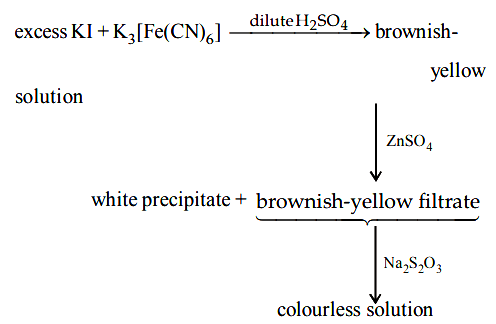 JEE Advanced 2012 Medium
 - Consider the following linear equations
\[
a x+b y+c z=0, b x+c y+a z=0, c x+a y+b z=0
\]
Match the conditions/expressions in Column I with statements in Column II.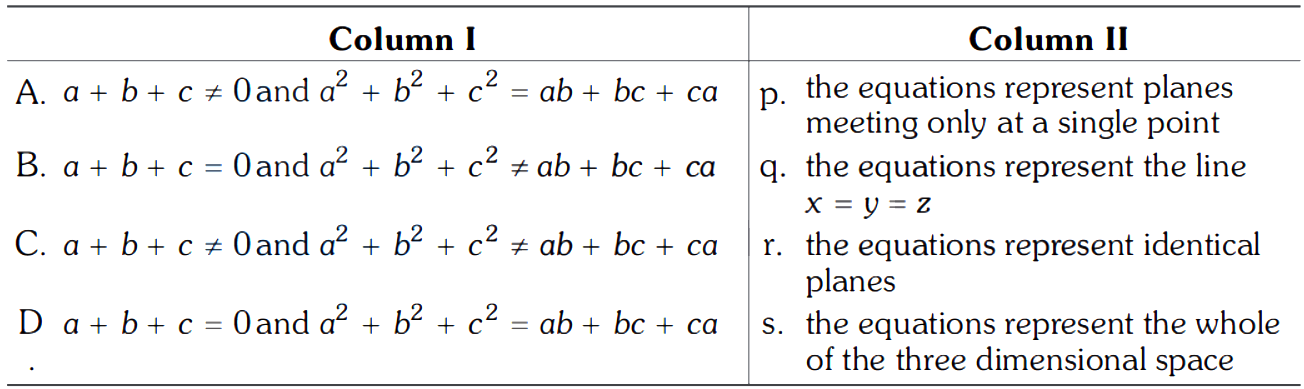 JEE Advanced 2007 Medium
 - Consider a triangle \(A B C\) and let \(a, b\) and \(c\) denote the lengths of the sides opposite to vertices \(A, B\) and \(C\) respectively. Suppose \(a=6, b=10\) and the area of the triangle is \(15 \sqrt{3}\). If \(\angle A C B\) is obtuse and if \(r\) denotes the radius of the incircle of the triangle, then \(r^2\) is equal toJEE Advanced 2010 Easy