


JEE Advanced · Mathematics · 19. Determinants
Consider the following linear equations
\[
a x+b y+c z=0, b x+c y+a z=0, c x+a y+b z=0
\]
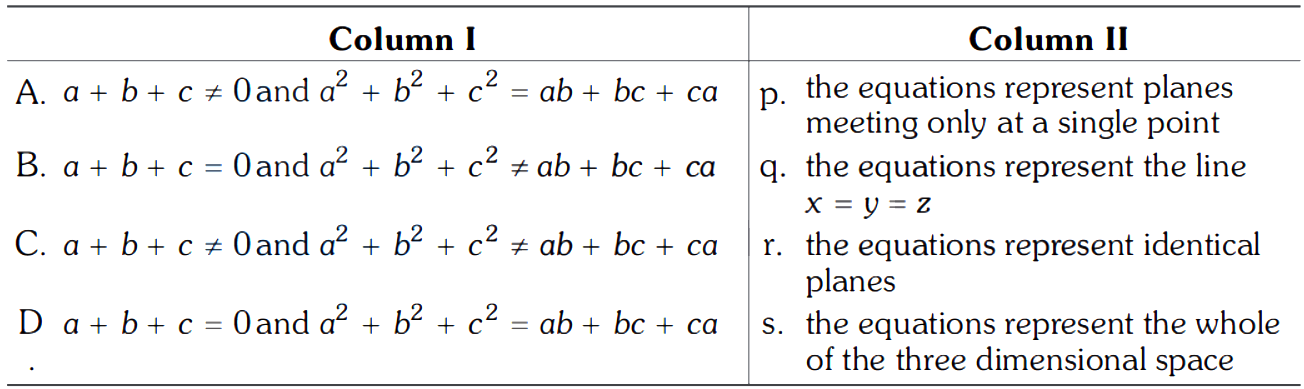
Match the conditions/expressions in Column I with statements in Column II.
- A
A-p; B-p, s; C-p; D-q
- B
A-r, q; B-r, s; C-r, s; D-r, s
- C
A-s; B-p; C-q; D-s
- D
A-r; B-q; C-p; D-s
Answer & Solution
Correct Answer
(D)
A-r; B-q; C-p; D-s
Step-by-step Solution
Detailed explanation
Let \(\Delta=\left|\begin{array}{lll}a & b & c \\ b & c & a \\ c & a & b\end{array}\right|=-\frac{1}{2}(a+b+c)\left[(a-b)^2+(b-c)^2+(c-a)^2\right]\)
(A) If \(a+b+c \neq 0\) and \(a^2+b^2+c^2=a b+b c+c a\)
\[
\Rightarrow \quad \Delta=0 \text { and } a=b=c \neq 0
\]
The equations represents identical planes.
(B) \(a+b+c=0\) and \(a^2+b^2+c^2 \neq a b+b c+c a\)
\[
\Rightarrow \quad \Delta=0
\]
The equations have infinitely many solutions.
\[
\begin{array}{rlrl}
& & a x+b y & =(a+b) z \\
\Rightarrow & b x+c y & =(b+c) z \\
\Rightarrow & & \left(b^2-a c\right) y & =\left(b^2-a c\right) z \Rightarrow y=z \\
\Rightarrow & a x+b y+c y & =0 \\
& a x & =a y \Rightarrow x=y=z
\end{array}
\]
(C) \(a+b+c \neq 0\) and \(a^2+b^2+c^2 \neq a b+b c+c a\)
\[
\Rightarrow \quad \Delta \neq 0
\]
The equation represent planes meeting at only one point.
(D) \(a+b+c=0\) and \(a^2+b^2+c^2=a b+b c+c a\)
\[
\Rightarrow \quad a=b=c=0
\]
The equations represent whole of the three dimensional space.
(A) If \(a+b+c \neq 0\) and \(a^2+b^2+c^2=a b+b c+c a\)
\[
\Rightarrow \quad \Delta=0 \text { and } a=b=c \neq 0
\]
The equations represents identical planes.
(B) \(a+b+c=0\) and \(a^2+b^2+c^2 \neq a b+b c+c a\)
\[
\Rightarrow \quad \Delta=0
\]
The equations have infinitely many solutions.
\[
\begin{array}{rlrl}
& & a x+b y & =(a+b) z \\
\Rightarrow & b x+c y & =(b+c) z \\
\Rightarrow & & \left(b^2-a c\right) y & =\left(b^2-a c\right) z \Rightarrow y=z \\
\Rightarrow & a x+b y+c y & =0 \\
& a x & =a y \Rightarrow x=y=z
\end{array}
\]
(C) \(a+b+c \neq 0\) and \(a^2+b^2+c^2 \neq a b+b c+c a\)
\[
\Rightarrow \quad \Delta \neq 0
\]
The equation represent planes meeting at only one point.
(D) \(a+b+c=0\) and \(a^2+b^2+c^2=a b+b c+c a\)
\[
\Rightarrow \quad a=b=c=0
\]
The equations represent whole of the three dimensional space.
See the Complete Solution
Get step-by-step explanations for this and 2.5 Lakh+ more JEE, NEET & CET questions.
- Unlock all solutions
- Practice the full chapter
- Track accuracy across PYQs
4.8 rated on Google Play · 14,000+ reviews
More questions from Mathematics
- Let for Suppose are in Arithmetic Progression (A.P.) with the common difference Suppose are in A.P. such that and If and thenJEE Advanced 2016 Hard
- The following integral is equal toJEE Advanced 2014 Hard
- \[
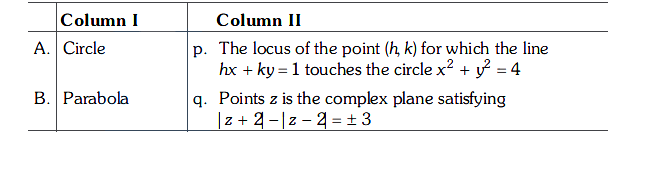
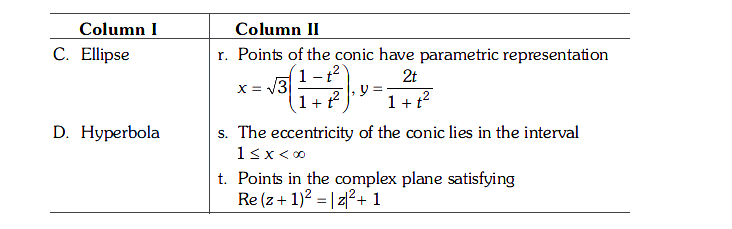
\text { Match the conics in Column I with the statements/expressions in Column II. }
\]
 JEE Advanced 2009 Easy
 - For any real number , let denotes the largest integer less than or equal to . If , then the value of is ____.JEE Advanced 2021 Hard
- Consider the functions defined by and
If is the area of the region , then the value of is _____ .JEE Advanced 2022 Hard - The value of the integral isJEE Advanced 2018 Easy
More PYQs from JEE Advanced
- Consider the following volume-temperature \((\mathrm{V}-\mathrm{T})\) diagram for the expansion of 5 moles of an ideal monoatomic gas.
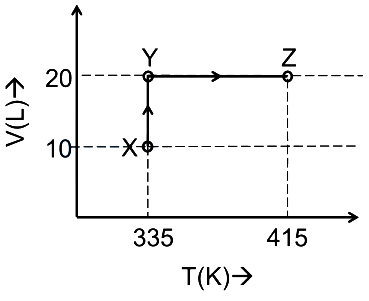
Considering only P-V work is involved, the total change in enthalpy (in Joule) for the transformation of state in the sequence \(\mathbf{X} \rightarrow \mathbf{Y} \rightarrow \mathbf{Z}\) is ________.
[Use the given data: Molar heat capacity of the gas for the given temperature range, \(\mathrm{C}_{\mathrm{V}, \mathrm{m}}=12 \mathrm{~J} \mathrm{~K}^{-1}\) \(\mathrm{mol}^{-1}\) and gas constant, \(\left.\mathrm{R}=8.3 \mathrm{~J} \mathrm{~K}^{-1} \mathrm{~mol}^{-1}\right]\)JEE Advanced 2024 Medium - The entropy versus temperature plot for phases and at bar pressure is given. and are entropies of the phases at temperatures and , respectively.
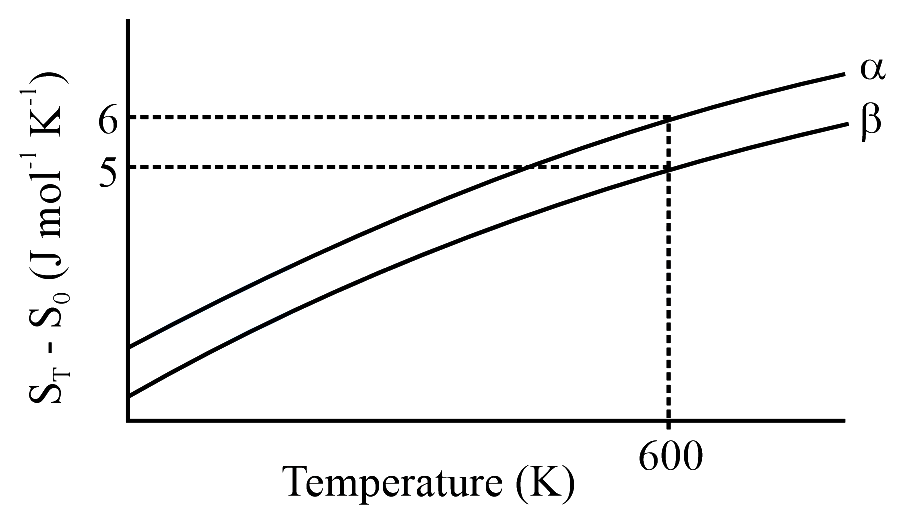 The transition temperature for to phase change is and . Assume is independent of temperature in the range of to and are heat capacities of and phases, respectively. The value of enthalpy change, (in ), at isJEE Advanced 2023 Medium
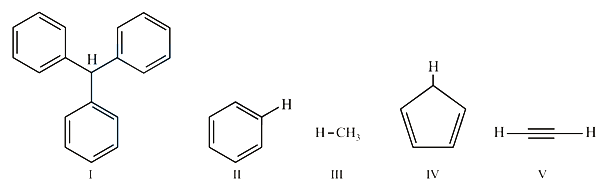
 - With respect to the compoundschoose the correct statement(s).
 JEE Advanced 2020 Medium
 - Let \(g_{i}:\left[\frac{\pi}{8}, \frac{3 \pi}{8}\right] \rightarrow \mathbb{R}, i=1,2\), and \(f:\left[\frac{\pi}{8}, \frac{3 \pi}{8}\right] \rightarrow \mathbb{R}\) be functions such that \(g_{1}(x)=1, g_{2}(x)=|4 x-\pi|\) and \(f(x)=\sin ^{2} x\), for all \(x \in\left[\frac{\pi}{8}, \frac{3 \pi}{8}\right]\)
Define
\(
S_{i}=\int_{\frac{\pi}{8}}^{\frac{3 \pi}{8}} f(x) \cdot g_{i}(x) d x, \quad i=1,2
\)
The value of is ____.JEE Advanced 2021 Medium - Using the expression , one calculates the values of by measuring the corresponding angle in the range to . The wavelength is exactly known and the error in is constant for all the values of . As increases from ,JEE Advanced 2013 Easy
- Among PbS, CuS, HgS, MnS, , NiS, CoS, and , the total number of black coloured sulphides isJEE Advanced 2014 Easy