


JEE Advanced · Mathematics · 32. Probability
An experiment has 10 equally likely outcomes. Let \(A\) and \(B\) be two non-empty events of the experiment. If \(A\) consists of 4 outcomes, the number of outcomes that \(B\) must have so that \(A\) and \(B\) are independent, is
- A
2,4 or 8
- B
3,6 or 9
- C
4 or 8
- D
5 or 10
Answer & Solution
Correct Answer
(D)
5 or 10
Step-by-step Solution
Detailed explanation
\(P(A)=\frac{2}{5}\)
For independent events,
\[
\begin{aligned}
& P(A \cap B)=P(A) P(B) \Rightarrow P(A \cap B) \leq \frac{2}{5} \\
& \Rightarrow P(A \cap B)=\frac{1}{10}, \frac{2}{10}, \frac{3}{10}, \frac{4}{10} \\
& \text { (i) } P(A \cap B)=\frac{1}{10} \\
& \Rightarrow P(A) \cdot P(B)=\frac{1}{10} \\
& \Rightarrow \quad P(B)=\frac{1}{10} \times \frac{5}{2}=\frac{1}{4}, \text { not possible. } \\
& \text { (ii) } P(A \cap B)=\frac{2}{10} \Rightarrow \frac{2}{5} \times P(B)=\frac{2}{10} \\
& \Rightarrow \quad P(B)=\frac{5}{10}, \text { outcomes of } B=5
\end{aligned}
\]
\[
\text { (iii) } \begin{aligned}
& P(A \cap B)=\frac{3}{10} \Rightarrow P(A) \cdot P(B)=\frac{3}{10} \\
& \Rightarrow \quad \frac{2}{5} \times P(B)=\frac{3}{10} \\
& P(B)=\frac{3}{4}, \text { not possible }
\end{aligned}
\]
\[
\text { (iv) } \begin{aligned}
& P(A \cap B)=\frac{4}{10} \\
\Rightarrow & P(A) \cdot P(B)=\frac{4}{10} \\
\Rightarrow & P(B)=1, \text { outcomes of } B=10 .
\end{aligned}
\]
For independent events,
\[
\begin{aligned}
& P(A \cap B)=P(A) P(B) \Rightarrow P(A \cap B) \leq \frac{2}{5} \\
& \Rightarrow P(A \cap B)=\frac{1}{10}, \frac{2}{10}, \frac{3}{10}, \frac{4}{10} \\
& \text { (i) } P(A \cap B)=\frac{1}{10} \\
& \Rightarrow P(A) \cdot P(B)=\frac{1}{10} \\
& \Rightarrow \quad P(B)=\frac{1}{10} \times \frac{5}{2}=\frac{1}{4}, \text { not possible. } \\
& \text { (ii) } P(A \cap B)=\frac{2}{10} \Rightarrow \frac{2}{5} \times P(B)=\frac{2}{10} \\
& \Rightarrow \quad P(B)=\frac{5}{10}, \text { outcomes of } B=5
\end{aligned}
\]
\[
\text { (iii) } \begin{aligned}
& P(A \cap B)=\frac{3}{10} \Rightarrow P(A) \cdot P(B)=\frac{3}{10} \\
& \Rightarrow \quad \frac{2}{5} \times P(B)=\frac{3}{10} \\
& P(B)=\frac{3}{4}, \text { not possible }
\end{aligned}
\]
\[
\text { (iv) } \begin{aligned}
& P(A \cap B)=\frac{4}{10} \\
\Rightarrow & P(A) \cdot P(B)=\frac{4}{10} \\
\Rightarrow & P(B)=1, \text { outcomes of } B=10 .
\end{aligned}
\]
See the Complete Solution
Get step-by-step explanations for this and 2.5 Lakh+ more JEE, NEET & CET questions.
- Unlock all solutions
- Practice the full chapter
- Track accuracy across PYQs
4.8 rated on Google Play · 14,000+ reviews
More questions from Mathematics
- Let be a differentiable function such that and If , for thenJEE Advanced 2017 Medium
- Paragraph:
Consider the lines: \(L_1: \frac{x+1}{3}=\frac{y+2}{1}=\frac{z+1}{2}, L_2: \frac{x-2}{1}=\frac{y+2}{2}=\frac{z-3}{3}\)Question:
The distance of the point \((1,1,1)\) from the plane passing through the point \((-1,-2,-1)\) and whose normal is perpendicular to both the lines \(L_1\) and \(L_2\), isJEE Advanced 2008 Easy - Let and be distinct points on the parabola such that a circle with as diameter passes through the vertex of the parabola. If lies in the first quadrant and the area of the triangle is then which of the following is (are) the coordinates of ?JEE Advanced 2015 Medium
- Let \(\mathbf{A}\) be vector parallel to line of intersection of planes \(P_1\) and \(P_2\) through origin. \(P_1\) is parallel to the vectors \(2 \hat{\mathbf{j}}+3 \hat{\mathbf{k}}\) and \(4 \hat{\mathbf{j}}-3 \hat{\mathbf{k}}\) and \(P_2\) is parallel to \(\hat{\mathbf{j}}-\hat{\mathbf{k}}\) and \(3 \hat{\mathbf{i}}+3 \hat{\mathbf{j}}\), then the angle between vector \(\mathbf{A}\) and \(2 \hat{\mathbf{i}}+\hat{\mathbf{j}}-2 \hat{\mathbf{k}}\) isJEE Advanced 2006 Easy
- Paragraph:
If a continuous \(f\) defined on the real line \(R\), assume positive and negative values in \(R\), then the equation \(f(x)=0\) has a root in \(R\). For example, if it is known that a continuous function \(f\) on \(R\) is positive at some point and its minimum values is negative, then the equation \(f(x)=0\) has a root in \(R\).
Consider \(f(x)=k e^x-x\) for all real \(x\), where \(k\) is real constant.Question:
The positive value of \(k\) for which \(k e^x-x=0\) has only one root isJEE Advanced 2007 Hard - Let
Column 1 contains information about zeros of and
Column 2 contains information about the limiting behaviour of and at infinity.
Column 3 contains information about increasing-decreasing nature of and
Which of the following options is the only Incorrect combination?Column 1 Column 2 Column 3 (I) for some (i) (P) is increasing in (0, 1) (II) for some (ii) (Q) is decreasing in (III) for some (iii) (R) is increasing in (0, 1) (IV) for some (iv) (S) is decreasing in JEE Advanced 2017 Hard
More PYQs from JEE Advanced
- Consider a helium atom that absorbs a photon of wavelength . The change in the velocity (in ) of atom after the photon absorption is ______ .
(Assume: Momentum is conserved when photon is absorbed.
Use: Planck constant , Avocados number , Molar mass of )JEE Advanced 2021 Medium - Paragraph:
The hydrogen-like species \(\mathrm{Li}^{2+}\) is in a spherically symmetric state \(S_1\) with one radial node. Upon absorbing light the ion undergoes transition to a state \(S_2\). The state \(S_2\) has one radial node and its energy is equal to the ground state energy of the hydrogen atom.
Question:
The orbtial angular momentum quantum number of the state \(S_2\) isJEE Advanced 2010 Medium - Column I showns four systems, each of the same length \(L\), for producing standing waves. The lowest possible natural frequency of a system is called its fundamental frequency, whose wavelength is denoted as \(\lambda_f\). Match each system with statements given in Column II describing the nature and wave length of the standing waves.
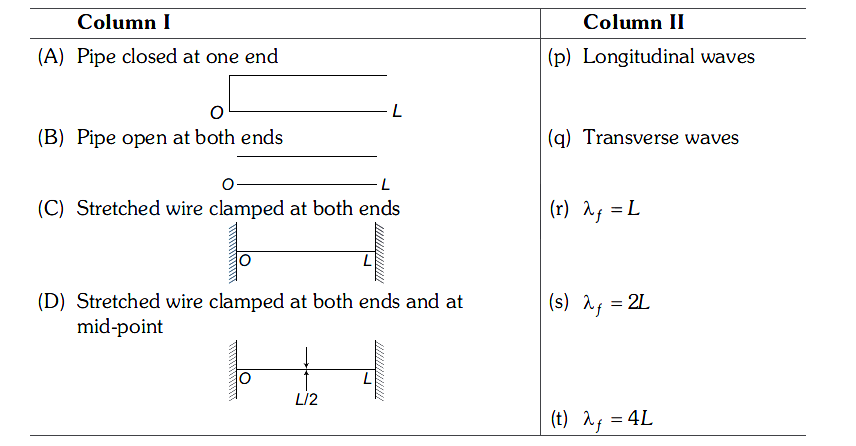 JEE Advanced 2011 Hard
 - A thin and uniform rod of mass and length is held vertical on a floor with large friction. The rod is released from rest so that it falls by rotating about its contact-point with the floor without slipping. Which of the following statement(s) is/are correct, when the rod makes an angle with vertical?
[ is the acceleration due to gravity]JEE Advanced 2019 Medium - The maximum value of the expression \(\frac{1}{\sin ^2 \theta+3 \sin \theta \cos \theta+5 \cos ^2 \theta}\) isJEE Advanced 2010 Easy
- If is a twice differentiable function such that for all and thenJEE Advanced 2017 Easy