


JEE Advanced · Mathematics · 2. Quadratic Equations
Let \(a, b, c, p, q\) be real numbers.
Suppose, \(\alpha, \beta\) are the roots of the equation \(x^2+2 p x+q=0\) and \(\alpha, \frac{1}{\beta}\) are the roots of the equation \(a x^2+2 b x+c=0\), where \(\beta^2 \notin\{-1,0,1\}\).
Statement \(1\left(p^2-q\right)\left(b^2-a c\right) \geq 0\).
Statement \(2 b \neq p a\) or \(c \neq q a\).
- A Statement 1 is true, Statement 2 is true, Statement 2 is a correct explanation for Statement 1.
- B Statement 1 is true, Statement 2 is true, Statement 2 is not a correct explanation for Statement 1.
- C Statement 1 is true, Statement 2 is false.
- D Statement 1 is false, Statement 2 is true
Answer & Solution
Correct Answer
(B) Statement 1 is true, Statement 2 is true, Statement 2 is not a correct explanation for Statement 1.
Step-by-step Solution
Detailed explanation
Given, \(\alpha\) and \(\beta\) are the roots of \(x^2+2 p x+q=0\).
\(\therefore \alpha+\beta =-2 p \)
\( \text {and } \alpha \beta =q\)
\(\alpha\) and \(\frac{1}{\beta}\) are the roots of \(a x^2+2 b x+c=0\)
and
\(
\alpha+\frac{1}{\beta}=\frac{-2 b}{a}
\)
and
\(
\frac{\alpha}{\beta}=\frac{c}{a}
\)
\( \text {Now, } \left(p^2-q\right)\left(b^2-a c\right) =\left[\left(\frac{\alpha+\beta}{-2}\right)^2-\alpha \beta\right]\)\(\left[\left(\frac{\alpha+\frac{1}{\beta}}{2}\right)^2-\frac{\alpha}{\beta}\right] a^2 \)
\( =\frac{(\alpha-\beta)^2}{16}\left(\alpha-\frac{1}{\beta}\right)^2 \cdot a^2 \geq 0\)
Statement 1 is true.
\(\text {Again now, } p a=-\left(\frac{\alpha+\beta}{2}\right) a=-\frac{a}{2}(\alpha+\beta) \)
\( \text {and } b=-\frac{a}{2}\left(\alpha+\frac{1}{\beta}\right) \)
\( p a \neq b \Rightarrow \alpha+\frac{1}{\beta} \neq \alpha+\beta \)
\( \Rightarrow \beta \neq 1 \)
\( \because \beta^2 \neq\{-1,0,1\}, \text {correct. } \)
\( \text {Similarly, if } c \neq q x \)
\( \Rightarrow a \frac{\alpha}{\beta} \neq a \alpha \beta \Rightarrow \alpha\left(\beta-\frac{1}{\beta}\right) \neq 0\)
\(\Rightarrow \alpha \neq 0 \text { and } \beta-\frac{1}{\beta} \neq 0 \)
\( \Rightarrow \beta \neq\{-1,0,1\}\)
Statement 2 is true.
Both Statement 1 and Statement 2 are true. But Statement 2 does not explain Statement 1.
\(\therefore \alpha+\beta =-2 p \)
\( \text {and } \alpha \beta =q\)
\(\alpha\) and \(\frac{1}{\beta}\) are the roots of \(a x^2+2 b x+c=0\)
and
\(
\alpha+\frac{1}{\beta}=\frac{-2 b}{a}
\)
and
\(
\frac{\alpha}{\beta}=\frac{c}{a}
\)
\( \text {Now, } \left(p^2-q\right)\left(b^2-a c\right) =\left[\left(\frac{\alpha+\beta}{-2}\right)^2-\alpha \beta\right]\)\(\left[\left(\frac{\alpha+\frac{1}{\beta}}{2}\right)^2-\frac{\alpha}{\beta}\right] a^2 \)
\( =\frac{(\alpha-\beta)^2}{16}\left(\alpha-\frac{1}{\beta}\right)^2 \cdot a^2 \geq 0\)
Statement 1 is true.
\(\text {Again now, } p a=-\left(\frac{\alpha+\beta}{2}\right) a=-\frac{a}{2}(\alpha+\beta) \)
\( \text {and } b=-\frac{a}{2}\left(\alpha+\frac{1}{\beta}\right) \)
\( p a \neq b \Rightarrow \alpha+\frac{1}{\beta} \neq \alpha+\beta \)
\( \Rightarrow \beta \neq 1 \)
\( \because \beta^2 \neq\{-1,0,1\}, \text {correct. } \)
\( \text {Similarly, if } c \neq q x \)
\( \Rightarrow a \frac{\alpha}{\beta} \neq a \alpha \beta \Rightarrow \alpha\left(\beta-\frac{1}{\beta}\right) \neq 0\)
\(\Rightarrow \alpha \neq 0 \text { and } \beta-\frac{1}{\beta} \neq 0 \)
\( \Rightarrow \beta \neq\{-1,0,1\}\)
Statement 2 is true.
Both Statement 1 and Statement 2 are true. But Statement 2 does not explain Statement 1.
See the Complete Solution
Get step-by-step explanations for this and 2.5 Lakh+ more JEE, NEET & CET questions.
- Unlock all solutions
- Practice the full chapter
- Track accuracy across PYQs
4.8 rated on Google Play · 14,000+ reviews
More questions from Mathematics
- Let and be the roots of with For all positive integers define
and
Then which of the following options is/are correct?JEE Advanced 2019 Hard - Consider the parabola . Let be the focus of the parabola. A pair of tangents drawn to the parabola from the point meet the parabola at and . Let and be points on the lines and respectively such that is perpendicular to and is perpendicular to . Then, which of the following is/are TRUE?JEE Advanced 2022 Medium
- Let and be functions defined by
(i)
(ii) , where the inverse trigonometric function assumes values in
(iii) , where, for denotes the greatest integer less than or equal to ,
(iv)
The correct option is :LIST-I LIST-II A. the function is P. NOT continuous at B. The function is Q. continuous at and NOT differentiable at C. The function is R. differentiable at and its derivative is NOT continuous at D. The function is S. differentiable at and its derivative is continuous at JEE Advanced 2018 Medium - Consider a pyramid located in the first octant with, as origin, and and, along the and the , respectively. The base of the pyramid is a square with. The point S is directly above the mid-point T of diagonal, , such that, . ThenJEE Advanced 2016 Medium
- Let be an arithmetic progression with and common difference . Let be such that and fo . Then, which of the following is/are TRUE?JEE Advanced 2022 Hard
- Let be given by
Then which of the following options is/are correct?JEE Advanced 2019 Medium
More PYQs from JEE Advanced
- Paragraph:
In a mixture of \(\mathrm{H}-\mathrm{H}^{+}\)gas \(\left(\mathrm{He}^{+}\right.\)is singly ionised \(\mathrm{He}\) atom), \(\mathrm{H}\) atoms and \(\mathrm{He}^{+}\)ions are excited to their respective first excited states. Subsequently, \(\mathrm{H}\) atoms transfer their total excitation energy to \(\mathrm{He}^{+}\)ions (by collisions). Assume that the Bohr model of atom is exactly valid.
Question:
The wavelength of light emitted in the visible region by \(\mathrm{He}^{+}\)ions after collisions with \(\mathrm{H}\) atoms isJEE Advanced 2008 Medium - A series \(R\) - \(C\) circuit is connected to \(A C\) voltage source. Consider two cases; \((A)\) when \(C\) is without a dielectric medium and \((B)\) when \(C\) is filled with dielectric of constant 4. The current \(I_R\) through the resistor and voltage \(V_C\) across the capacitor are compared in the two cases. Which of the following is/are true?JEE Advanced 2011 Easy
- Five persons and are seated in a circular arrangement. If each of them is given a hat of one of the three colours red, blue and green, then the number of ways of distributing the hats such that the persons seated in adjacent seats get different coloured hats isJEE Advanced 2019 Easy
- Paragraph:
In a mixture of \(\mathrm{H}-\mathrm{H}^{+}\)gas \(\left(\mathrm{He}^{+}\right.\)is singly ionised \(\mathrm{He}\) atom), \(\mathrm{H}\) atoms and \(\mathrm{He}^{+}\)ions are excited to their respective first excited states. Subsequently, \(\mathrm{H}\) atoms transfer their total excitation energy to \(\mathrm{He}^{+}\)ions (by collisions). Assume that the Bohr model of atom is exactly valid.
Question:
The ratio of the kinetic energy of the \(n=2\) electron for the \(\mathrm{H}\) atom to that of \(\mathrm{He}^{+}\) ion isJEE Advanced 2008 Easy - Let \(f(x)=\frac{x^2-6 x+5}{x^2-5 x+6}\).
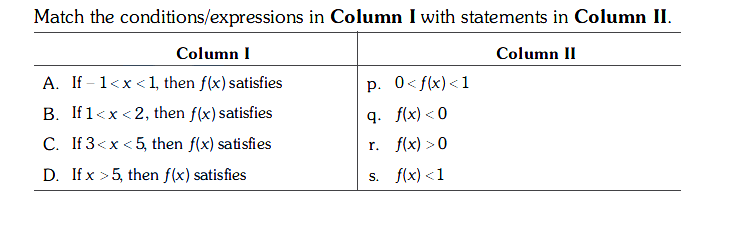 JEE Advanced 2007 Hard
 - The total number of local maxima and local minima of the function \(f(x)=\left\{\begin{array}{lc}(2+x)^3 ; & -3 < x \leq-1 \\ x^{\frac{2}{3}} ; & -1 < x < 2\end{array}\right.\) isJEE Advanced 2008 Hard