


JEE Advanced · Mathematics · 30. Vector Algebra
If \(\mathbf{a}, \mathbf{b}, \mathbf{c}\) and \(\mathbf{d}\) are the unit vectors such that \((\mathbf{a} \times \mathbf{b}) \cdot(\mathbf{c} \times \mathbf{d})=1\) and \(\mathbf{a} \cdot \mathbf{c}=\frac{1}{2}\), then
- A
\(\mathbf{a}, \mathbf{b}, \mathbf{c}\) are non-coplanar
- B
\(\mathbf{b}, \mathbf{d}\) are non-parallel
- C
\(\mathbf{a}, \mathbf{b}, \mathbf{d}\) are non-coplanar
- D
a, d are parallel and \(\mathbf{b}, \mathbf{c}\) are parallel
Answer & Solution
Correct Answer
(C)
\(\mathbf{a}, \mathbf{b}, \mathbf{d}\) are non-coplanar
Step-by-step Solution
Detailed explanation
Let angle between \(\mathbf{a}\) and \(\mathbf{b}\) be \(\theta_1, \mathbf{c}\) and \(\mathbf{d}\) be \(\theta_2\) and \(\mathbf{a} \times \mathbf{b}\) and \(\mathbf{c} \times \mathbf{d}\) be \(\theta\).
Since, \((\mathbf{a} \times \mathbf{b}) \cdot(\mathbf{c} \times \mathbf{d})=1\)
\(\Rightarrow \quad \sin \theta_1 \cdot \sin \theta_2 \cdot \cos \theta=1\)
\(\Rightarrow \theta_1=90^{\circ}, \theta_2=90^{\circ}, \theta=0^{\circ}\)
\(\Rightarrow \mathbf{a} \perp \mathbf{b}, \mathbf{c} \perp \mathbf{d},(\mathbf{a} \times \mathbf{b}) \|(\mathbf{c} \times \mathbf{d})\)
So, \(\mathbf{a} \times \mathbf{b}=k(\mathbf{c} \times \mathbf{d})\)
and \(\mathbf{a} \times \mathbf{b}=k(\mathbf{c} \times \mathbf{d})\)
\(\Rightarrow \quad(\mathbf{a} \times \mathbf{b}) \cdot \mathbf{c}=k(\mathbf{c} \times \mathbf{d}) \cdot \mathbf{c}\)
and \((\mathbf{a} \times \mathbf{b}) \cdot \mathbf{d}=k(\mathbf{c} \times \mathbf{d}) \cdot \mathbf{d}\)
\(\Rightarrow\left[\begin{array}{lll}\mathbf{a} & \mathbf{b} & \mathbf{c}\end{array}\right]=0\) and \(\left[\begin{array}{lll}\mathbf{a} & \mathbf{b} & \mathbf{d}\end{array}\right]=0\)
\(\Rightarrow \mathbf{a}, \mathbf{b}, \mathbf{c}\) and \(\mathbf{a}, \mathbf{b}, \mathbf{d}\) are coplanar vectors, so options (a) and (b) are incorrect.
Let \(\quad \mathbf{b} \| \mathbf{d} \Rightarrow \mathbf{b}=\pm \mathbf{d}\)
As \(\quad(\mathbf{a} \times \mathbf{b}) \cdot(\mathbf{c} \times \mathbf{d})=1\)
\((\mathbf{a} \times \mathbf{b}) \cdot(\mathbf{c} \times \mathbf{b})=\pm 1\)
\(\Rightarrow \quad[\mathbf{a} \times \mathbf{b} \mathbf{c} \mathbf{b}]=\pm 1\)
\(\Rightarrow \quad[\mathbf{c} \mathbf{b} \mathbf{a} \times \mathbf{b}]=\pm 1\)
\(\Rightarrow \quad \mathbf{c} \cdot[\mathbf{b} \times(\mathbf{a} \times \mathbf{b})]=\pm 1\)
\(\Rightarrow \quad \mathbf{c} \cdot[\mathbf{a}-(\mathbf{b} \cdot \mathbf{a}) \mathbf{b}]=\pm 1\)
\(\Rightarrow \quad \mathbf{c} \cdot \mathbf{a}=\pm 1 \quad[\because \mathbf{a} \cdot \mathbf{b}=0]\)
which is a contradiction, so option (c) is correct.
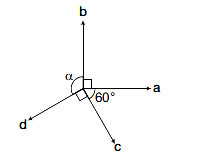
Let option (d) be correct.
\[
\begin{array}{ll}
\Rightarrow & \mathbf{d}=\pm \mathbf{a} \text { and } \mathbf{c}=\pm \mathbf{b} \\
\text { As } & (\mathbf{a} \times \mathbf{b}) \cdot(\mathbf{c} \times \mathbf{d})=1 \\
\Rightarrow & (\mathbf{a} \times \mathbf{b}) \cdot(\mathbf{b} \times \mathbf{a})=\pm 1
\end{array}
\]
which is a contradiction, so option (d) is incorrect.
Alternatively option (c) and (d) may be observed from the given figure.
Since, \((\mathbf{a} \times \mathbf{b}) \cdot(\mathbf{c} \times \mathbf{d})=1\)
\(\Rightarrow \quad \sin \theta_1 \cdot \sin \theta_2 \cdot \cos \theta=1\)
\(\Rightarrow \theta_1=90^{\circ}, \theta_2=90^{\circ}, \theta=0^{\circ}\)
\(\Rightarrow \mathbf{a} \perp \mathbf{b}, \mathbf{c} \perp \mathbf{d},(\mathbf{a} \times \mathbf{b}) \|(\mathbf{c} \times \mathbf{d})\)
So, \(\mathbf{a} \times \mathbf{b}=k(\mathbf{c} \times \mathbf{d})\)
and \(\mathbf{a} \times \mathbf{b}=k(\mathbf{c} \times \mathbf{d})\)
\(\Rightarrow \quad(\mathbf{a} \times \mathbf{b}) \cdot \mathbf{c}=k(\mathbf{c} \times \mathbf{d}) \cdot \mathbf{c}\)
and \((\mathbf{a} \times \mathbf{b}) \cdot \mathbf{d}=k(\mathbf{c} \times \mathbf{d}) \cdot \mathbf{d}\)
\(\Rightarrow\left[\begin{array}{lll}\mathbf{a} & \mathbf{b} & \mathbf{c}\end{array}\right]=0\) and \(\left[\begin{array}{lll}\mathbf{a} & \mathbf{b} & \mathbf{d}\end{array}\right]=0\)
\(\Rightarrow \mathbf{a}, \mathbf{b}, \mathbf{c}\) and \(\mathbf{a}, \mathbf{b}, \mathbf{d}\) are coplanar vectors, so options (a) and (b) are incorrect.
Let \(\quad \mathbf{b} \| \mathbf{d} \Rightarrow \mathbf{b}=\pm \mathbf{d}\)
As \(\quad(\mathbf{a} \times \mathbf{b}) \cdot(\mathbf{c} \times \mathbf{d})=1\)
\((\mathbf{a} \times \mathbf{b}) \cdot(\mathbf{c} \times \mathbf{b})=\pm 1\)
\(\Rightarrow \quad[\mathbf{a} \times \mathbf{b} \mathbf{c} \mathbf{b}]=\pm 1\)
\(\Rightarrow \quad[\mathbf{c} \mathbf{b} \mathbf{a} \times \mathbf{b}]=\pm 1\)
\(\Rightarrow \quad \mathbf{c} \cdot[\mathbf{b} \times(\mathbf{a} \times \mathbf{b})]=\pm 1\)
\(\Rightarrow \quad \mathbf{c} \cdot[\mathbf{a}-(\mathbf{b} \cdot \mathbf{a}) \mathbf{b}]=\pm 1\)
\(\Rightarrow \quad \mathbf{c} \cdot \mathbf{a}=\pm 1 \quad[\because \mathbf{a} \cdot \mathbf{b}=0]\)
which is a contradiction, so option (c) is correct.
Let option (d) be correct.
\[
\begin{array}{ll}
\Rightarrow & \mathbf{d}=\pm \mathbf{a} \text { and } \mathbf{c}=\pm \mathbf{b} \\
\text { As } & (\mathbf{a} \times \mathbf{b}) \cdot(\mathbf{c} \times \mathbf{d})=1 \\
\Rightarrow & (\mathbf{a} \times \mathbf{b}) \cdot(\mathbf{b} \times \mathbf{a})=\pm 1
\end{array}
\]
which is a contradiction, so option (d) is incorrect.
Alternatively option (c) and (d) may be observed from the given figure.
See the Complete Solution
Get step-by-step explanations for this and 2.5 Lakh+ more JEE, NEET & CET questions.
- Unlock all solutions
- Practice the full chapter
- Track accuracy across PYQs
4.8 rated on Google Play · 14,000+ reviews
More questions from Mathematics
- Let be positive integers such that . Then the number of such distinct arrangements is _________JEE Advanced 2014 Hard
- A line passing through the origin is perpendicular to the lines
Then, the coordinate(s) of the point(s) on at a distance of from the point of intersection of and is (are)JEE Advanced 2013 Medium - Paragraph:
Let \(A_1, G_1, H_1\) denote the arithmetic, geometric and harmonic means respectively, of two distinct positive numbers. For \(n \geq 2\), let \(A_{n-1}\) and \(H_{n-1}\) has arithmetic, geometric and harmonic means as \(A_n, G_n, H_n\), respectively.
Question:
Which of the following statements is correct?JEE Advanced 2007 Hard - Paragraph:
Read the following passage and answer the questions.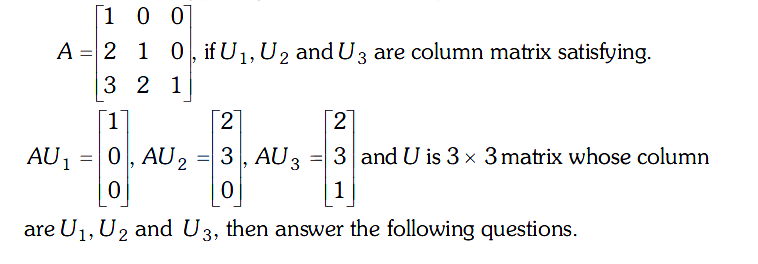
Question:
The value of the elements of \(U^{-1}\) isJEE Advanced 2006 Medium - Let be the sample space of all matrices with entries from the set Let the events and be given by
and
sum of entries of is
If a matrix is chosen at random from then the conditional probability equals____JEE Advanced 2019 Medium - \[
\text { Match the statements/expressions in Column I with the open intervals in Column II. }
\]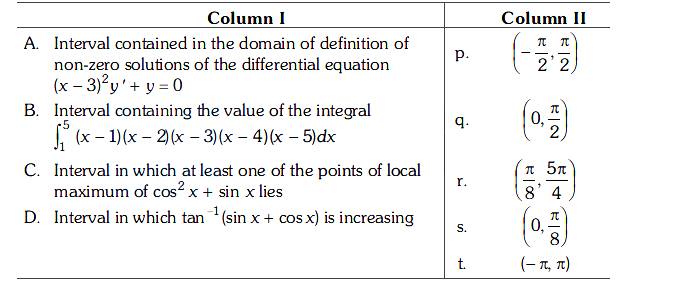 JEE Advanced 2009 Hard
More PYQs from JEE Advanced
- The heating of \(\mathrm{NH}_4 \mathrm{NO}_2\) at \(60-70^{\circ} \mathrm{C}\) and \(\mathrm{NH}_4 \mathrm{NO}_3\) at \(200-250^{\circ} \mathrm{C}\) is associated with the formation of nitrogen containing compounds \(\mathbf{X}\) and \(\mathbf{Y}\), respectively. \(\mathbf{X}\) and \(\mathbf{Y}\), respectively, areJEE Advanced 2025 Easy
- Let be the of all column matrices such that and the system of equations (in real variables)
has at least one solution. Then, which of the following system(s) (in real variables) has (have) at least one solution of each ?JEE Advanced 2018 Hard - At room temperature, disproportionation of an aqueous solution of in situ generated nitrous acid \(\left(\mathrm{HNO}_2\right)\) gives the speciesJEE Advanced 2024 Easy
- Consider an ionic solid , with structure. Construct a new structure , whose unit cell is constructed from the unit cell of , following the sequential instructions given below. Neglect the charge balance.
Remove all the anions , except the central one.
Replace all the face centered cations , by anions .
Remove all the corner cations .
Replace the central anion , with cation .
The value of in is _____.JEE Advanced 2018 Hard - A circle S passes through the point (0, 1) and is orthogonal to the circles and . ThenJEE Advanced 2014 Easy
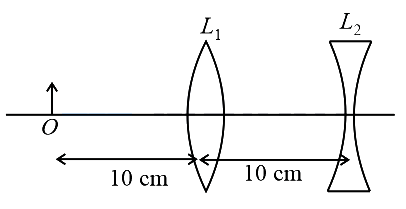
- An extended object is placed at point , in front of a convex lens and a concave lens is placed behind it, as shown in the figure. The radii of curvature of all the curved surfaces in both the lenses are . The refractive index of both the lenses is . The total magnification of this lens system is:
 JEE Advanced 2021 Medium