


JEE Advanced · Mathematics · 2. Quadratic Equations
Let \(\alpha, \beta\) be the roots of the equation \(x^2-p x+r=0\) and \(\frac{\alpha}{2}, 2 \beta\) be the roots of the equation \(x^2-q x+r=0\). Then, the value of \(r\) is
- A \(\frac{2}{9}(p-q)(2 q-p)\)
- B \(\frac{2}{9}(q-p)(2 p-q)\)
- C \(\frac{2}{9}(q-2 p)(2 q-p)\)
- D \(\frac{2}{9}(2 p-q)(2 q-p)\)
Answer & Solution
Correct Answer
(D) \(\frac{2}{9}(2 p-q)(2 q-p)\)
Step-by-step Solution
Detailed explanation
The equation \(x^2-p x+r=0\) has roots \((\alpha, \beta)\) and the equation \(x^2-q x+r=0\) has roots
\(\left(\frac{\alpha}{2}, 2 \beta\right) . \)
\( \Rightarrow r=\alpha \beta \text { and } \alpha+\beta=p \text { and }\)\(\frac{\alpha}{2}+2 \beta=q \)
\( \Rightarrow \beta=\frac{2 q-p}{3} \text { and } \alpha=\frac{2(2 p-q)}{3} \)
\( \Rightarrow \alpha \beta=r=\frac{2}{9}(2 q-p)(2 p-q)\)
\(\left(\frac{\alpha}{2}, 2 \beta\right) . \)
\( \Rightarrow r=\alpha \beta \text { and } \alpha+\beta=p \text { and }\)\(\frac{\alpha}{2}+2 \beta=q \)
\( \Rightarrow \beta=\frac{2 q-p}{3} \text { and } \alpha=\frac{2(2 p-q)}{3} \)
\( \Rightarrow \alpha \beta=r=\frac{2}{9}(2 q-p)(2 p-q)\)
See the Complete Solution
Get step-by-step explanations for this and 2.5 Lakh+ more JEE, NEET & CET questions.
- Unlock all solutions
- Practice the full chapter
- Track accuracy across PYQs
4.8 rated on Google Play · 14,000+ reviews
More questions from Mathematics
- Let . Three distinct point and are randomly chosen from . Then the probability that and form a triangle whose area is a positive integer, isJEE Advanced 2023 Medium
- Let and . Then which of the following statements is(are) true?JEE Advanced 2023 Hard
- Let \(I=\int \frac{e^x}{e^{4 x}+e^{2 x}+1} d x, J=\int \frac{e^{-x}}{e^{-4 x}+e^{-2 x}+1} d x\).
Then, for an arbitrary constant \(C\), the value of \(J-I\) equalsJEE Advanced 2008 Easy - Let the function be defined by . Suppose the function has a local minimum at precisely when where Then the value of is_______JEE Advanced 2020 Easy
- The value of is equal toJEE Advanced 2016 Hard
- Let . If contains exactly one positive integer , then the value of isJEE Advanced 2023 Easy
More PYQs from JEE Advanced
- If the normal of the parabola drawn at the end points of its latus rectum are tangents to the circle then the value of isJEE Advanced 2015 Easy
- Let be the function defined as if where . Let be a function such that for all . ThenJEE Advanced 2023 Hard
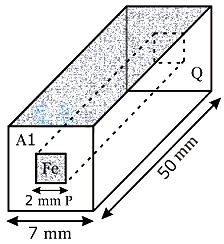
- In an aluminum (Al) bar of square cross section, a square hole is drilled and is filled with iron (Fe) as shown in the figure. The electrical resistivities of Al and Fe are and , respectively. The electrical resistance between the two faces P and Q of the composite bar is
 JEE Advanced 2015 Medium
 - For a first order reaction, \(A \rightarrow P\), the temperature \((T)\) dependent rate constant \((k)\) was found to follow the equation, \(\log k=-(2000) / T+6.0\)
The pre-exponential factor \(A\) and the activation energy \(\left(E_a\right)\), respectively, areJEE Advanced 2009 Easy - Ozonolysis of produces an oxide of chlorine. The average oxidation state of chlorine in this oxide is ______ .JEE Advanced 2021 Medium
- Paragraph :
A special metal \(S\) conducts electricity without any resistance. A closed wire loop, made of \(S\), does not allow any change in flux through itself by inducing a suitable current to generate a compensating flux. The induced current in the loop cannot decay due to its zero resistance. This current gives rise to a magnetic moment which in turn repels the source of magnetic field or flux. Consider such a loop, of radius \(a\), with its center at the origin. A magnetic dipole of moment \(m\) is brought along the axis of this loop from infinity to a point at distance \(r(\gg a)\) from the center of the loop with its north pole always facing the loop, as shown in the figure below.
The magnitude of magnetic field of a dipole \(m\), at a point on its axis at distance \(r\), is \(\frac{\mu_{0}}{2 \pi} \frac{m}{r^{3}}\), where \(\mu_{0}\) is the permeability of free space. The magnitude of the force between two magnetic dipoles with moments, \(m_{1}\) and \(m_{2}\), separated by a distance \(r\) on the common axis, with their north poles facing each other, is \(\frac{k m_{1} m_{2}}{r^{4}}\), where \(k\) is a constant of appropriate dimensions. The direction of this force is along the line joining the two dipoles.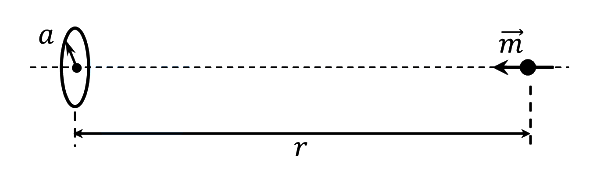
Question :
When the dipole m is placed at a distance r from the centre of the loop (as shown in the figure), the current induced in the loop will be proportional to:JEE Advanced 2021 Medium