


JEE Advanced · Mathematics · 29. Differential Eqns
For any real numbers and , let , be the solution of the differential equation Let . Then which of the following functions belong(s) to the set ?
- A
- B
- C
- D
Answer & Solution
Correct Answer
(C)
Step-by-step Solution
Detailed explanation
\(\frac{d y}{d x}+a y=x e^{\beta x}\)
Integrating factor (I.F.) \(=\mathrm{e}^{\mathrm{adx}}=\mathrm{e}^{\mathrm{ax}}\)
So, the solution is \(y \cdot e^{a x}=\int x e^{\beta x} \cdot e^{a x} d x\)
\(\Rightarrow y e^{a x}=\int x e^{(\alpha+\beta) x} d x\)
If \(\alpha+\beta \neq 0\)
\(\Rightarrow y e^{a x}=x \frac{e^{(\alpha+\beta) x}}{(\alpha+\beta)}-\frac{e^{(\alpha+\beta) x}}{(\alpha+\beta)^2}+C\)
\(\Rightarrow y=\frac{x e^{\beta x}}{(\alpha+\beta)}-\frac{e^{\beta x}}{(\alpha+\beta)^2}+C e^{-a x}\)
\(\Rightarrow y=\frac{e^{\beta x}}{(\alpha+\beta)}\left(x-\frac{1}{a+\beta}\right)+C e^{-\alpha x}\)
Put \(\alpha=\beta=1\) in (1)
\(y=\frac{e^x}{2}\left(x-\frac{1}{2}\right)+C e^{-x}\)
\(y(1)=1\)
\(1=\frac{e}{2} \times \frac{1}{2}+\frac{C}{e} \Rightarrow c=e-\frac{e^2}{4}\)
So, \(y=\frac{e^x}{2}\left(x-\frac{1}{2}\right)+\left(e-\frac{e^2}{4}\right) e^{-x}\)
If \(\alpha+\beta=0 \& \alpha=1\)
\(\begin{aligned}
&\frac{d y}{d x}+y=x e^{-x} \\
&\text { I.F. }=e^x
\end{aligned}\)
Solution is \(y e^x=\int x d x\)
\(\Rightarrow y e^x=\frac{x^2}{2}+C\)
\(y=\frac{x^2}{2} e^{-x}+C e^{-x}\)
\(y(1)=1\)
\(1=\frac{1}{2 e}+\frac{C}{e} \Rightarrow C=e-\frac{1}{2}\)
\(y=\frac{x^2}{2} e^{-x}+\left(e-\frac{1}{2}\right) e^{-x}\)
Integrating factor (I.F.) \(=\mathrm{e}^{\mathrm{adx}}=\mathrm{e}^{\mathrm{ax}}\)
So, the solution is \(y \cdot e^{a x}=\int x e^{\beta x} \cdot e^{a x} d x\)
\(\Rightarrow y e^{a x}=\int x e^{(\alpha+\beta) x} d x\)
If \(\alpha+\beta \neq 0\)
\(\Rightarrow y e^{a x}=x \frac{e^{(\alpha+\beta) x}}{(\alpha+\beta)}-\frac{e^{(\alpha+\beta) x}}{(\alpha+\beta)^2}+C\)
\(\Rightarrow y=\frac{x e^{\beta x}}{(\alpha+\beta)}-\frac{e^{\beta x}}{(\alpha+\beta)^2}+C e^{-a x}\)
\(\Rightarrow y=\frac{e^{\beta x}}{(\alpha+\beta)}\left(x-\frac{1}{a+\beta}\right)+C e^{-\alpha x}\)
Put \(\alpha=\beta=1\) in (1)
\(y=\frac{e^x}{2}\left(x-\frac{1}{2}\right)+C e^{-x}\)
\(y(1)=1\)
\(1=\frac{e}{2} \times \frac{1}{2}+\frac{C}{e} \Rightarrow c=e-\frac{e^2}{4}\)
So, \(y=\frac{e^x}{2}\left(x-\frac{1}{2}\right)+\left(e-\frac{e^2}{4}\right) e^{-x}\)
If \(\alpha+\beta=0 \& \alpha=1\)
\(\begin{aligned}
&\frac{d y}{d x}+y=x e^{-x} \\
&\text { I.F. }=e^x
\end{aligned}\)
Solution is \(y e^x=\int x d x\)
\(\Rightarrow y e^x=\frac{x^2}{2}+C\)
\(y=\frac{x^2}{2} e^{-x}+C e^{-x}\)
\(y(1)=1\)
\(1=\frac{1}{2 e}+\frac{C}{e} \Rightarrow C=e-\frac{1}{2}\)
\(y=\frac{x^2}{2} e^{-x}+\left(e-\frac{1}{2}\right) e^{-x}\)
See the Complete Solution
Get step-by-step explanations for this and 2.5 Lakh+ more JEE, NEET & CET questions.
- Unlock all solutions
- Practice the full chapter
- Track accuracy across PYQs
4.8 rated on Google Play · 14,000+ reviews
More questions from Mathematics
- The total number of ways in which 5 balls of different colours can be distributed among 3 persons so that each person gets at least one ball isJEE Advanced 2012 Hard
- Let , for all . ThenJEE Advanced 2016 Hard
- The number of values of \(\theta\) in the interval \(\left(-\frac{\pi}{2}, \frac{\pi}{2}\right)\) such that \(\theta \neq \frac{n \pi}{5}\) for \(n=0, \pm 1, \pm 2\) and \(\tan \theta=\cot 5 \theta\) as well as \(\sin 2 \theta=\cos 4 \theta\) isJEE Advanced 2010 Easy
- If \(f(x)=\int_{0}^{x} e^{t^{2}}(t-2)(t-3) d t\) for all \(x \in(0, \infty)\), thenJEE Advanced 2012 Hard
- The function has a local minimum or a local maximum atJEE Advanced 2013 Hard
- Let \(z\) be a complex number such that the imaginary part of \(z\) is non-zero and \(a=z^{2}+z+1\) is real. Then a cannot take the valueJEE Advanced 2012 Hard
More PYQs from JEE Advanced
- A straight line \(L\) through the point \((3,-2)\) is inclined at an angle \(60^{\circ}\) to the line \(\sqrt{3} x+y=1\). If \(L\) also intersects the \(X\)-axis, then the equation of \(L\) isJEE Advanced 2011 Easy
- Let \(\theta, \varphi \in[0,2 \pi]\) be such that \(2 \cos \theta(1-\sin \varphi)\) \(=\sin ^{2} \theta ~\times\) \(\left(\tan \frac{\theta}{2}+\cot \frac{\theta}{2}\right) \cos \varphi-1, \tan\) \((2 \pi-\theta)>0\) and \(-1 < \sin \theta < -\frac{\sqrt{3}}{2}\), then \(\varphi\) cannot satisfyJEE Advanced 2012 Medium
- If the reaction sequence given below is carried out with moles of acetylene, the amount of the product formed (in ) is
 The yields of and are given in parentheses. [Given: Atomic mass of ]JEE Advanced 2022 Medium
 - A cylindrical cavity of diameter a exists inside a cylinder of diameter \(2 a\) as shown in the figure. Both the cylinder and the cavity are infinity long. A uniform current density \(J\) flows along the length. If the magnitude of the magnetic field at the point \(P\) is given by \(\frac{N}{12} \mu_{0} a J\), then the value of \(N\) is
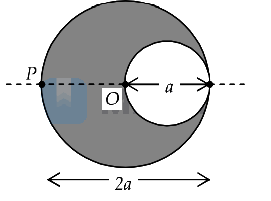 JEE Advanced 2012 Medium
 - Among the following, the number of elements showing only one non-zero oxidation state is O, Cl, F, N, P, Sn, Tl, \(\mathrm{Na}, \mathrm{Ti}\)JEE Advanced 2010 Easy
- In a Young's double slit experiment, a combination of two glass wedges \(A\) and \(B\), having refractive indices 1.7 and 1.5, respectively, are placed in front of the slits, as shown in the figure. The separation between the slits is \(d=2 \mathrm{~mm}\) and the shortest distance between the slits and the screen is \(D=2 \mathrm{~m}\). Thickness of the combination of the wedges is \(t=12 \mu \mathrm{~m}\). The value of \(l\) as shown in the figure is 1 mm . Neglect any refraction effect at the slanted interface of the wedges. Due to the combination of the wedges, the central maximum shifts (in mm ) with respect to O by ______
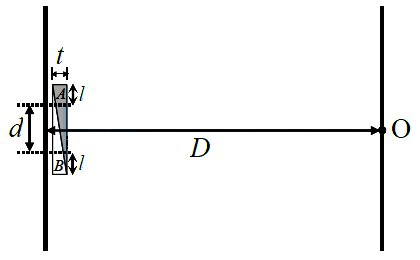 JEE Advanced 2025 Hard