


JEE Advanced · Mathematics · 3. Complex Numbers
Let \(z\) be a complex number such that the imaginary part of \(z\) is non-zero and \(a=z^{2}+z+1\) is real. Then a cannot take the value
- A \(-1\)
- B \(\frac{1}{3}\)
- C \(\frac{1}{2}\)
- D \(\frac{3}{4}\)
Answer & Solution
Correct Answer
(D) \(\frac{3}{4}\)
Step-by-step Solution
Detailed explanation
\(\because \operatorname{Im}(z) \neq 0\) \(\Rightarrow \quad z\) is non-real and equation \(z^{2}+z+(1-a)=0\) will have non-real roots, if \(D < 0\)
\(\Rightarrow 1-4(1-a) < 0\) \(\Rightarrow \quad 4 a < 3 \Rightarrow a < \frac{3}{4}\)
\(\therefore a\) can not take the value \(\frac{3}{4}\).
\(\Rightarrow 1-4(1-a) < 0\) \(\Rightarrow \quad 4 a < 3 \Rightarrow a < \frac{3}{4}\)
\(\therefore a\) can not take the value \(\frac{3}{4}\).
See the Complete Solution
Get step-by-step explanations for this and 2.5 Lakh+ more JEE, NEET & CET questions.
- Unlock all solutions
- Practice the full chapter
- Track accuracy across PYQs
4.8 rated on Google Play · 14,000+ reviews
More questions from Mathematics
- Let \(f\) be a function defined on \(R\) (the set of all real numbers) such that \(f^{\prime}(x)=2010(x-2009)\) \((x-2010)^2(x-2011)^3(x-2012)^4\), for all \(x \in R\). If \(g\) is a function defined on \(R\) with values in the interval \((0, \infty)\) such that \(f(x)=\ln (g(x))\), for all \(x \in R\), then the number of points in \(R\) at which \(g\) has a local maximum isJEE Advanced 2010 Hard
- If \(r, s, t\) are prime numbers and \(p, q\) are the positive integers such that LCM of \(p, q\) is \(r^2 s^4 t^2\), then the number of ordered pairs \((p, q)\) isJEE Advanced 2006 Hard
- Suppose that the foci of the ellipse are where Let be two parabolas with a common vertex at (0, 0) and with foci at and respectively. Let be a tangent to which passes through and be a tangent to which passes through . If is the slope of and is the slope of then the value of isJEE Advanced 2015 Medium
- Paragraph:
The circle \(x^2+y^2-8 x=0\) and hyperbola \(\frac{x^2}{9}-\frac{y^2}{4}=1\) intersect at the points \(A\) and \(B\).Question:
Equation of the circle with \(A B\) as its diameter isJEE Advanced 2010 Easy - If the distance between the plane \(A x-2 y+z=d\) and the plane containing the lines \(\frac{x-1}{2}=\frac{y-2}{3}=\frac{z-3}{4} \quad\) and \(\frac{x-2}{3}=\frac{y-3}{4}=\frac{z-4}{5}\) is \(\sqrt{6}\), then \(|d|\) isJEE Advanced 2010 Easy
- Let \(z_1\) and \(z_2\) be two distinct complex numbers and let \(z=(1-t) z_1+t z_2\) for some real number \(t\) with \(0 < t < 1\). If \(\arg (w)\) denotes the principal argument of a non-zero complex number \(w\), thenJEE Advanced 2010 Hard
More PYQs from JEE Advanced
- Let \(\omega=e^{i \pi / 3}\) and \(a, b, c, x, y, z\) be non-zero complex numbers such that \(a+b+c=x, a+b \omega+c \omega^2=y, a+b \omega^2+c \omega=z\).
Then, the value of \(\frac{|x|^2+|y|^2+|z|^2}{|a|^2+|b|^2+|c|^2}\) isJEE Advanced 2011 Hard - Let S be the set of all twice differentiable functions f from to such that for all . For , let be the number of points for which . Then which of the following statements is(are) true?JEE Advanced 2023 Medium
- Consider the lines \(L_{1}\) and \(L_{2}\) defined by
\[
L_{1}: x \sqrt{2}+y-1=0 \text { and } L_{2}: x \sqrt{2}-y+1=0
\]
For a fixed constant \(\lambda\), let \(C\) be the locus of a point \(P\) such that the product of the distance of \(P\) from \(L_{1}\) and the distance of \(P\) from \(L_{2}\) is \(\lambda^{2}\). The line \(y=2 x+1\) meets \(C\) at two points \(R\) and \(S\), where the distance between \(R\) and \(S\) is \(\sqrt{270}\).
Let the perpendicular bisector of \(R S\) meet \(C\) at two distinct points \(R^{\prime}\) and \(S^{\prime}\). Let \(D\) be the square of the distance between \(R^{\prime}\) and \(S^{\prime}\).
The value of isJEE Advanced 2021 Hard - and are two identical sound sources of frequency . The source is located at and moves anti-clockwise with a uniform speed on a circular path around , as shown in the figure. There are three points and on this path such that and are diametrically opposite while is equidistant from them. A sound detector is placed at point . The source can move along direction .
[Given: The speed of sound in air is ]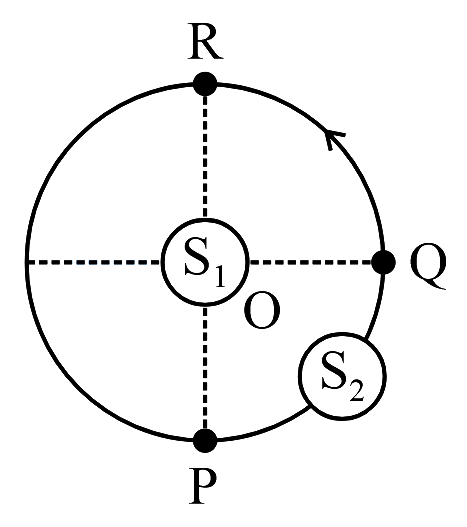
Consider both sources emitting sound. When is at and approaches the detector with a speed , the beat frequency measured by the detector is _____ .JEE Advanced 2023 Easy - The \(\beta\)-decay process, discovered around 1900 , is basically the decay of a neutron \((n)\). In the laboratory, a proton \((p)\) and an electron \(\left(e^{-}\right)\)are observed as the decay products of the neutron. Therefore, considering the decay of a neutron as a two-body decay process, it was predicted theoretically that the kinetic energy of the electron should be a constant. But experimentally, it was observed that the electron kinetic energy has continuous spectrum. Considering a three-body decay process, i.e.
\(n \rightarrow p+e^{-}+\bar{v}_{e}\), around 1930, Pauli explained the observed electron energy spectrum. Assuming the anti-neutrino \(\left(\bar{v}_{e}\right)\) to be massless and possessing negligible energy, and the neutron to be at rest, momentum and energy conservation principles are applied. From this calculation, the maximum kinetic energy of the electron is \(0.8 \times 10^{6} \mathrm{eV}\). The kinetic energy carried by the proton is only the recoil energy.
Question:
If the anti-neutrino had a mass of \(3 \mathrm{eV} / \mathrm{c}^{2}\) (where \(\mathrm{c}\) is the speed of light) instead of zero mass, what should be the range of the kinetic energy, \(K\), of the electron?JEE Advanced 2012 Hard - For the reduction of \(\mathrm{NO}_3^{-}\)ion in an aqueous solution \(E^{\circ}\) is \(+0.96 \mathrm{~V}\). Values of \(E^{\circ}\) for some metal ions are given below.
\(
\begin{aligned}
& \mathrm{V}^{2+}(a q)+2 e^{-} \longrightarrow \mathrm{V} ; E^{\circ}=-1.19 \mathrm{~V} \\
& \mathrm{Fe}^{3+}(a q)+3 e^{-} \longrightarrow \mathrm{Fe} ; \mathrm{E}^{\circ}=-0.04 \mathrm{~V} \\
& \mathrm{Au}^{3+}(a q)+3 e^{-} \longrightarrow \mathrm{Au} ; E^{\circ}=+1.40 \mathrm{~V}
\end{aligned}
\)
\(
\mathrm{Hg}^{2+}(a q)+2 e^{-} \longrightarrow \mathrm{Hg} ; E^{\circ}=+0.86 \mathrm{~V}
\)
The pair(s) of metals that is (are) oxidised by \(\mathrm{NO}_3^{-}\)in aqueous solution is (are)JEE Advanced 2009 Medium