


JEE Advanced · Mathematics · 25. AOD
If \(f(x)=\int_{0}^{x} e^{t^{2}}(t-2)(t-3) d t\) for all \(x \in(0, \infty)\), then
- A \(f\) has a local maximum at \(x=2\)
- B \(f\) is decreasing on \((2,3)\)
- C there exists some \(c \in(0, \infty)\), such that \(f^{\prime \prime}(c)=0\)
- D \(f\) has a local minimum at \(x=3\)
Answer & Solution
Correct Answer
(A) \(f\) has a local maximum at \(x=2\)
Step-by-step Solution
Detailed explanation
\(f(x)=\int_{0}^{x} e^{t^{2}}(t-2)(t-3) d t\)
\(\Rightarrow f^{\prime}(x)=e^{x^{2}} \cdot(x-2)(x-3)\)
Put \(f^{\prime}(x)=0 \Rightarrow x=2,3\)
\(f^{\prime \prime}(x)=e^{x^{2}} \cdot 2 x\left(x^{2}-5 x+6\right)+e^{x^{2}}(2 x-5)\)
\(f^{\prime \prime}(2)=-\) ve and \(f^{\prime \prime}(3)=+\) ve
\(\therefore \quad x=2\) is a point of local maxima.
and \(x=3\) is a point of local minima.
Also for \(x \in(2,3), f^{\prime}(x) < 0\)
\(\Rightarrow \quad f\) is decreasing on \((2,3)\).
Also we observe \(f^{\prime \prime}(0) < 0\) and \(f^{\prime \prime}(1)>0\)
\(\therefore \quad\) There exists some \(C \in(0,1)\) such that \(f^{\prime \prime}(C)=0\)
Hence all the options are correct.
\(\Rightarrow f^{\prime}(x)=e^{x^{2}} \cdot(x-2)(x-3)\)
Put \(f^{\prime}(x)=0 \Rightarrow x=2,3\)
\(f^{\prime \prime}(x)=e^{x^{2}} \cdot 2 x\left(x^{2}-5 x+6\right)+e^{x^{2}}(2 x-5)\)
\(f^{\prime \prime}(2)=-\) ve and \(f^{\prime \prime}(3)=+\) ve
\(\therefore \quad x=2\) is a point of local maxima.
and \(x=3\) is a point of local minima.
Also for \(x \in(2,3), f^{\prime}(x) < 0\)
\(\Rightarrow \quad f\) is decreasing on \((2,3)\).
Also we observe \(f^{\prime \prime}(0) < 0\) and \(f^{\prime \prime}(1)>0\)
\(\therefore \quad\) There exists some \(C \in(0,1)\) such that \(f^{\prime \prime}(C)=0\)
Hence all the options are correct.
See the Complete Solution
Get step-by-step explanations for this and 2.5 Lakh+ more JEE, NEET & CET questions.
- Unlock all solutions
- Practice the full chapter
- Track accuracy across PYQs
4.8 rated on Google Play · 14,000+ reviews
More questions from Mathematics
- Match the following
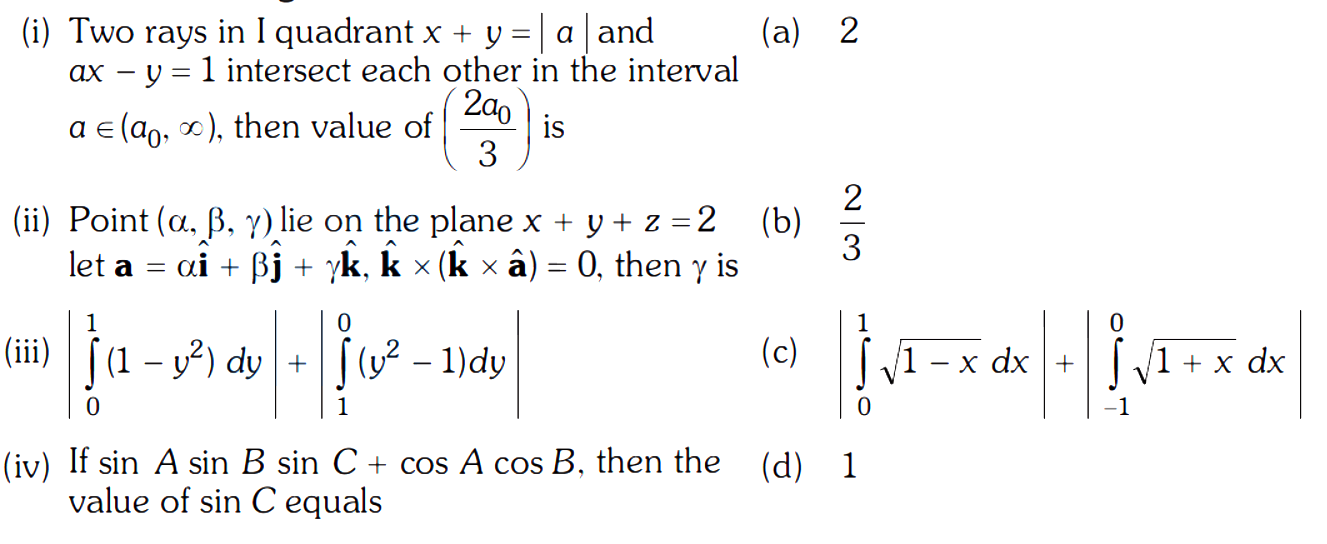 JEE Advanced 2006 Medium
 - Let \(f(x)\) be a non-constant twice differentiable function defined on \((-\infty, \infty)\), such that \(f(x)=f(1-x)\) and \(f^{\prime}\left(\frac{1}{4}\right)=0\). Then,JEE Advanced 2008 Hard
- Let and be positive real numbers such that and Let be a point in the first quadrant that lies on the hyperbola Suppose the tangent to the hyperbola at passes through the point and suppose the normal to the hyperbola at cuts off equal intercepts on the coordinate axes. Let denote the area of the triangle formed by the tangent at , the normal at and the -axis. If denotes the eccentricity of the hyperbola, then which of the following statements is/are TRUE?JEE Advanced 2020 Medium
- In a \(\triangle A B C\) with fixed base \(B C\), the vertex \(A\) moves such that \(\cos B+\cos C=4 \sin ^2 \frac{A}{2}\). If \(a, b\) and \(c\) denote the lengths of the sides of the triangle opposite to the angles \(A, B\) and \(C\) respectively, thenJEE Advanced 2009 Medium
- Match the following.
List – I List – II (A) Let Then equals (P) 1 (B) Let be the vertices of a regular polygon of n sides with its centre at the origin. Let be the position vector of the point If , then the minimum value of n is (Q) 2 (C) If the normal from the point on the ellipse is perpendicular to the line then the value of h is (R) 8 (D) Number of positive solutions satisfying the equation is (S) 9 JEE Advanced 2014 Hard - Let \(\mathbf{a}, \mathbf{b}, \mathbf{c}\) be unit vectors such that \(\mathbf{a}+\mathbf{b}+\mathbf{c}=\mathbf{0}\). Which one of the following is correct?JEE Advanced 2007 Easy
More PYQs from JEE Advanced
- Two conducting cylinders of equal length but different radii are connected in series between two heat baths kept at temperatures as shown in the figure. The radius of the bigger cylinder is twice that of the smaller one and the thermal conductivities of the materials of the smaller and the larger cylinders are , respectively. If the temperature at the junction of the two cylinders in the steady state is , then is
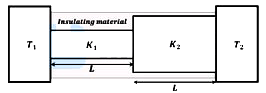 JEE Advanced 2018 Easy
 - In the following monobromination reaction, the number of possible chiral products is
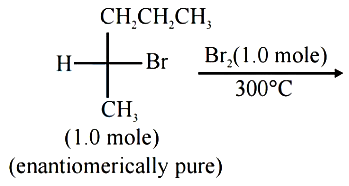 JEE Advanced 2016 Medium
 - An extended object is placed at point , in front of a convex lens and a concave lens is placed behind it, as shown in the figure. The radii of curvature of all the curved surfaces in both the lenses are . The refractive index of both the lenses is . The total magnification of this lens system is:
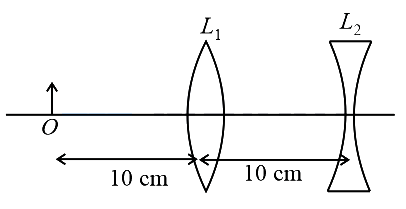 JEE Advanced 2021 Medium
 - Let be the plane and let
and the distance of from the plane is .
Let and be three distinct vectors in such that . Let be the volume of the parallelepiped determined by vectors and . Then the value of isJEE Advanced 2023 Hard - A man walks a distance of 3 units from the origin towards the North-East \(\left(\mathrm{N} 45^{\circ} \mathrm{E}\right)\) direction. From there, he walks a distance of 4 units towards the North-West ( \(\mathrm{N} 45^{\circ} \mathrm{W}\) ) direction to reach a point \(P\). Then, the position of \(P\) in the Argand plane isJEE Advanced 2007 Easy
- Choose the correct reason(s) for the stability of the lyophobic colloidal particles.JEE Advanced 2012 Easy