


JEE Advanced · Mathematics · 14. Ellipse
Consider the ellipse \(\frac{x^2}{9}+\frac{y^2}{4}=1\). Let \(S(p, q)\) be a point in the first quadrant such that \(\frac{p^2}{9}+\frac{q^2}{4}>1\). Two tangents are drawn from \(S\) to the ellipse, of which one meets the ellipse at one end point of the minor axis and the other meets the ellipse at a point \(T\) in the fourth quadrant. Let \(R\) be the vertex of the ellipse with positive \(x\)-coordinate and \(O\) be the center of the ellipse. If the area of the triangle \(\triangle O R T\) is \(\frac{3}{2}\), then which of the following options is correct?
- A \(q=2, p=3 \sqrt{3}\)
- B \(q=2, p=4 \sqrt{3}\)
- C \(q=1, p=5 \sqrt{3}\)
- D \(q=1, p=6 \sqrt{3}\)
Answer & Solution
Correct Answer
(A) \(q=2, p=3 \sqrt{3}\)
Step-by-step Solution
Detailed explanation
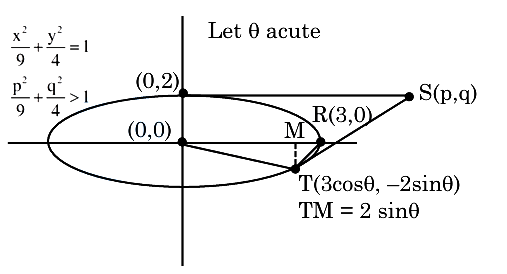
\(\operatorname{Ar}(\Delta \mathrm{ORT})=\frac{3}{2}\)
\(\left|\frac{1}{2} \times 3 \times 2 \sin \theta\right|=\frac{3}{2}\)
\(\sin \theta=\frac{1}{2} \Rightarrow \theta=\frac{11 \pi}{6}\) as point T is in third quadrant
\(\mathrm{T}\left(\frac{3 \sqrt{3}}{2},-1\right)\)
Tanget at \((0,2) \frac{x(0)}{9}+\frac{y(2)}{4}=1 \Rightarrow y=2...(1)\)
Tangent at \(\left(\frac{3 \sqrt{3}}{2},-1\right) \frac{x\left(\frac{3 \sqrt{3}}{2}\right)}{9}+\frac{y(-1)}{4}=1...(2)\)
\(\therefore\) By solving (1) & (2) \(\Rightarrow \mathrm{p}=3 \sqrt{3}, \mathrm{q}=2\)
\(\Rightarrow\) Option (1) is Correct.
See the Complete Solution
Get step-by-step explanations for this and 2.5 Lakh+ more JEE, NEET & CET questions.
- Unlock all solutions
- Practice the full chapter
- Track accuracy across PYQs
4.8 rated on Google Play · 14,000+ reviews
More questions from Mathematics
- Let \(L_1\) be the line of intersection of the planes given by the equation- \(2 x+3 y+z=4 \text { and } x+2 y+z=5 .\)
Let \(L_2\) be the line passing through the point \(P(2,-1,3)\) and parallel to \(L_1\). Let \(M\) denote the plane given by the equation- \(2 x+y-2 z=6\)
Suppose that the line \(L_2\) meets the plane \(M\) at the point \(Q\). Let \(R\) be the foot of the perpendicular drawn from \(P\) to the plane \(M\).
Then which of the following statements is (are) TRUE?JEE Advanced 2025 Hard - Let , for all and , for all . Let denote and denote . Then which of the following is (are) true?JEE Advanced 2015 Medium
- The common tangents to the circle and the parabola touch the circle at the points P, and Q the parabola at the points R, S. Then the area of the quadrilateral PQRS isJEE Advanced 2014 Easy
- Let be the origin and and for some If then which of the following statements is (are) TRUE?JEE Advanced 2021 Medium
- Let \(p(x)\) be a polynomial of degree 4 having extremum at \(x=1,2\) and \(\lim _{x \rightarrow 0}\left[1+\frac{p(x)}{x^2}\right]=2\). Then, the value of \(p(2)\) isJEE Advanced 2009 Medium
- Let \(z\) be a complex number such that the imaginary part of \(z\) is non-zero and \(a=z^{2}+z+1\) is real. Then a cannot take the valueJEE Advanced 2012 Hard
More PYQs from JEE Advanced
- A diatomic ideal gas is compressed adiabatically to \(\frac{1}{32}\) of its initial volume. If the initial temperature of the gas is \(T_i\) \(T_i\) (in kelvin) and the final temperature is \(a T_i\), the value of \(a\) isJEE Advanced 2010 Easy
- In a historical experiment to determine Planck's constant, a metal surface was irradiated with light of different wavelengths. The emitted photoelectron energies were measured by applying a stopping potential. The relevant data for the wavelength \((\lambda)\) of incident light and the corresponding stopping potential (\(V_0\)) are given below:
Given that \(c=3 \times 10^8 m s^{-1}\) and \(e=1.6 \times 10^{-19} C\), Planck's constant (in units of J s) found from such an experiment is :\(\lambda(\mu m)\) Volt 0.3 2.0 0.4 1.0 0.5 0.4 JEE Advanced 2016 Medium - Let \(\mathbb{N}\) denote the set of all natural numbers, and \(\mathbb{Z}\) denote the set of all integers. Consider the functions \(f: \mathbb{N} \rightarrow \mathbb{Z}\) and \(g: \mathbb{Z} \rightarrow \mathbb{N}\) defined by
\(f(n)= \begin{cases}(n+1) / 2 & \text { if } n \text { is odd } \\ (4-n) / 2 & \text { if } n \text { is even }\end{cases}\) And
\(g(n)=\left\{\begin{array}{cc}3+2 n & \text { if } n \geq 0 \\ -2 n & \text { if } n <0\end{array}\right.\)
Define \((g \circ f)(n)=g(f(n))\) for all \(n \in \mathbb{N}\), and \((f \circ g)(n)=f(g(n))\) for all \(n \in \mathbb{Z}\).
Then which of the following statements is (are) TRUE?JEE Advanced 2025 Hard - A large spherical mass is fixed at one position and two identical point masses are kept on a line passing through the centre of (see figure). The point masses are connected by a rigid massless rod of length and this assembly is free to move along the line connecting them. All three masses interact only through their mutual gravitational interaction. When the point mass nearer to is at a distance from , the tension in the rod is zero for . The value of is
 JEE Advanced 2015 Medium
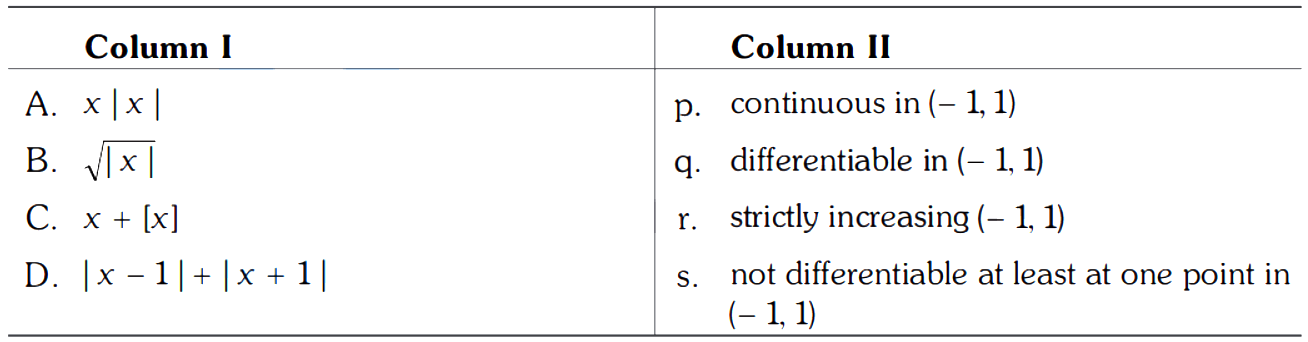
 - In the following \([x]\) denotes the greatest integer less than or equal to \(x\). Match the functions in Column I with the properties Column II.
 JEE Advanced 2007 Hard
 - An ideal gas is undergoing a cyclic thermodynamic process in different ways as shown in the corresponding P-V diagrams in column 3 of the table. Consider only the path from state 1 to state 2. W denotes the corresponding work done on the system. The equations and plots in the table have standard notations as used in thermodynamic process. Here is the ratio of heat capacities at constant pressure and constant volume. The number of moles in the gas in n.
Which one of the following options correctly represents a thermodynamic process that is used as a correction in the determination of the speed of sound in ideal gas?Column – 1 Column – 2 Column – 3 (I) \(W_{1 \rightarrow 2}=\) \(\frac{1}{\gamma-1}\left(P_2 V_2-P_1 V_1\right)\) (i) Isothermal (P) 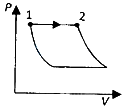
(II) \(W_{1 \rightarrow 2}=\) \(-P V_2+P V_1\) (ii) Isochoric (Q) 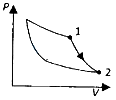
(III) \(W_{1 \rightarrow 2}=0\) (iii) Isobaric (R) 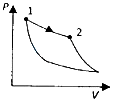
(IV) \(W_{1 \rightarrow 2}=\)\(-n R T \ln \left(\frac{V_2}{V_1}\right)\) (iv) Adiabatic (S) 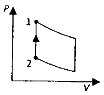 JEE Advanced 2017 Medium