


JEE Advanced · Chemistry · 13. GOC
Which of the given statement(s) about \(\mathbf{N}, \mathbf{O}, \mathbf{P}\) and \(\mathbf{Q}\) with respect to \(\mathbf{M}\) is (are) correct?
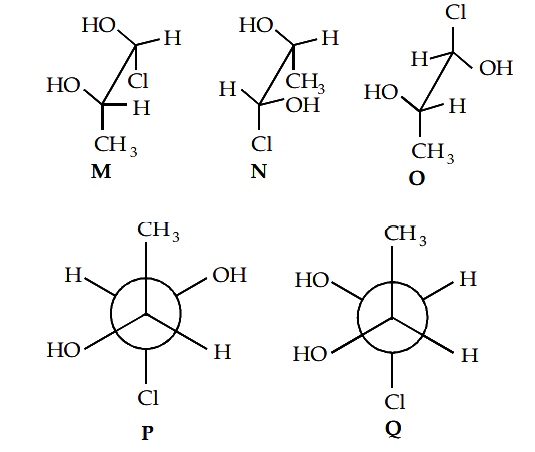
- A \(\mathbf{M}\) and \(\mathbf{N}\) are non-mirror image stereoisomers
- B \(\mathbf{M}\) and \(\mathbf{O}\) are identical
- C \(\mathbf{M}\) and \(\mathbf{P}\) are enantiomers
- D \(\mathbf{M}\) and \(\mathbf{Q}\) are identical
Answer & Solution
Correct Answer
(A) \(\mathbf{M}\) and \(\mathbf{N}\) are non-mirror image stereoisomers
Step-by-step Solution
Detailed explanation
The given conformation are of the following compound
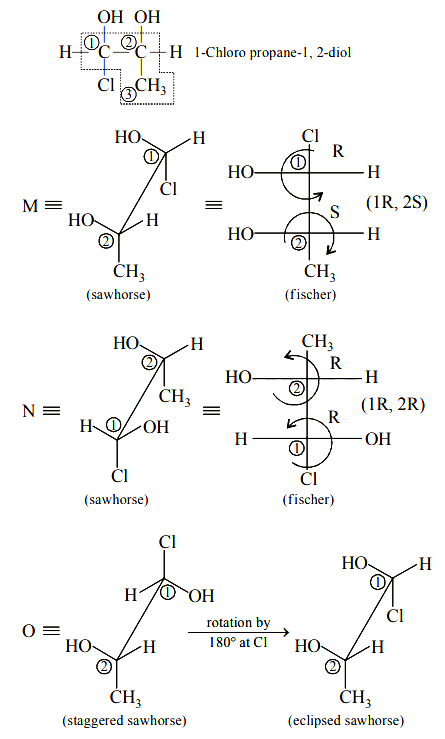
Note : Fisher conformation always show the eclipsed form of molecule. Thus, we have to convert the given staggered conformation of 'O' to an eclipsed conformation.
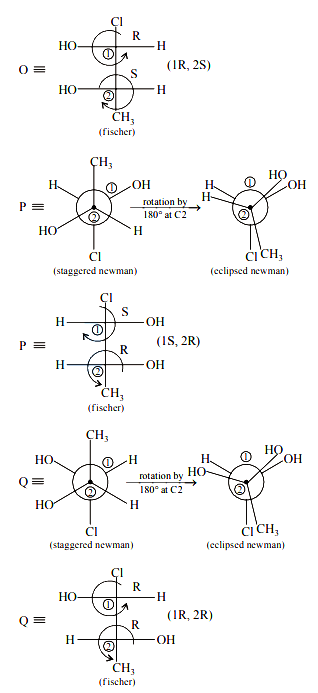
Based on the above structures, we can say that
(a) \(\mathrm{M}\) and \(\mathrm{N}\) are diastereomers or non-mirror image stereoisomers.
(b) \(\mathrm{M}\) and \(\mathrm{O}\) are identical.
(c) \(\mathrm{M}\) and \(\mathrm{P}\) are enantiomers.
(d) \(\mathrm{M}\) and \(\mathrm{Q}\) are diastereomers and therefore not identical.
Note : Fisher conformation always show the eclipsed form of molecule. Thus, we have to convert the given staggered conformation of 'O' to an eclipsed conformation.
Based on the above structures, we can say that
(a) \(\mathrm{M}\) and \(\mathrm{N}\) are diastereomers or non-mirror image stereoisomers.
(b) \(\mathrm{M}\) and \(\mathrm{O}\) are identical.
(c) \(\mathrm{M}\) and \(\mathrm{P}\) are enantiomers.
(d) \(\mathrm{M}\) and \(\mathrm{Q}\) are diastereomers and therefore not identical.
See the Complete Solution
Get step-by-step explanations for this and 2.5 Lakh+ more JEE, NEET & CET questions.
- Unlock all solutions
- Practice the full chapter
- Track accuracy across PYQs
4.8 rated on Google Play · 14,000+ reviews
More questions from Chemistry
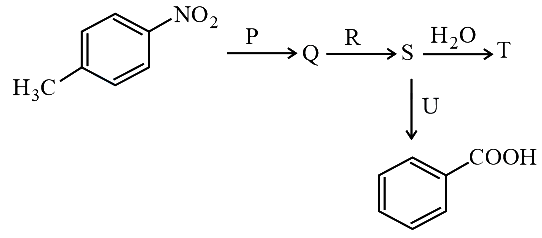
- Considering the following reaction sequence,
the correct option(s) is(are)JEE Advanced 2022 Hard - Oxidation states of the metal in the minerals haematite and magnetite, respectively, areJEE Advanced 2011 Easy
- Aqueous solution of \(\text{Na} _2\text S_2\text O _3\) on reaction with \(\text{Cl} _2\) givesJEE Advanced 2008 Medium
- The reagent(s) for the following conversion,

is/areJEE Advanced 2007 Easy - In the chemical reaction between stoichiometric quantities of in weakly basic solution, what is the number of moles of released for consumed?JEE Advanced 2020 Easy
- Match the following
Column I Column II (A) \(CH _3- CHBr - CD _3\) on treatment with alc. KOH gives \(CH _2= CH - CD _3\) as a major product. (P) E1 reaction (B) \(Ph - CHBr - CH _3\) reacts faster than \(Ph - CHBr - CD _3\) (Q) E2 reaction (C) \(Ph - CH _2- CH _2 Br\) on treatment with \(C _2 H _5 OD / C _2 H _5 O ^{-}\)gives \(Ph - CD = CH _2\) as the major product (R) El cb reaction (D) \(PhCH _2 CH _2 Br\) and \(PhCH _2 CH _2 Br\) react with same rate (S) First order reaction JEE Advanced 2006 Medium
More PYQs from JEE Advanced
- Paragraph
The key feature of Bohr's theory of spectrum of hydrogen atom is the quantization of angular momentum when an electron is revolving around a proton. We will extend this to a general rotational motion to find quantized rotational energy of a diatomic molecule assuming it to be rigid. The rule to be applied is Bohr's quantization condition.
Question:
It is found that the excitation frequency from ground to the first excited state of rotation for the \(\mathrm{CO}\) molecule is close to \(\frac{4}{\pi} \times 10^{11} \mathrm{~Hz}\). Then the moment of inertia of CO molecule about its centre of mass is close to (Take \(h=2 \pi \times 10^{-34} J-s\) )JEE Advanced 2010 Hard - The following carbohydrate is
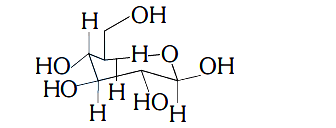 JEE Advanced 2011 Medium
 - Let \(f_{1}:(0, \infty) \rightarrow \mathbb{R}\) and \(f_{2}:(0, \infty) \rightarrow \mathbb{R}\) be defined by
\[
f_{1}(x)=\int_{0}^{x} \prod_{j=1}^{21}(t-j)^{j} d t, \quad x > 0
\(
and
\]
f_{2}(x)=98(x-1)^{50}-600(x-1)^{49}+2450, \quad x > 0
\)
where, for any positive integer \(n\) and real numbers \(a_{1}, a_{2}, \ldots, a_{n}, \prod_{i=1}^{n} a_{i}\) denotes the product of \(a_{1}, a_{2}, \ldots, a_{n} .\) Let \(m_{i}\) and \(n_{i}\), respectively, denote the number of points of local minima and the number of points of local maxima of function \(f_{i}, i=1,2\), in the interval \((0, \infty)\).
The value of is ____.JEE Advanced 2021 Medium - In a one-litre flask, moles of undergoes the reaction . The progress of product formation at two temperatures (in Kelvin), and , is shown in the figure:
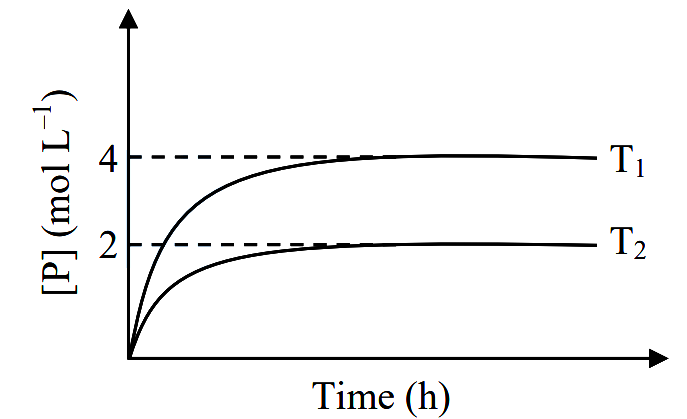 If and , then the value of is
[ and are standard Gibb's free energy change for the reaction at temperatures and , respectively.]JEE Advanced 2023 Medium - A colorless aqueous solution contains nitrates of two metals, and . When it was added to an aqueous solution of , a white precipitate was formed. This precipitate was found to be partly soluble in hot water to give a residue and a solution . The residue was soluble in aq. and also in excess sodium thiosulfate. The hot solution gave a yellow precipitate with . The metals and , respectively, areJEE Advanced 2020 Medium
- In a circuit shown in the figure, the capacitor is initially uncharged and the key is open. In this condition, a current of flows through the resistor. The key is closed at time . Which of the following statement(s) is(are) correct?
[Given : ]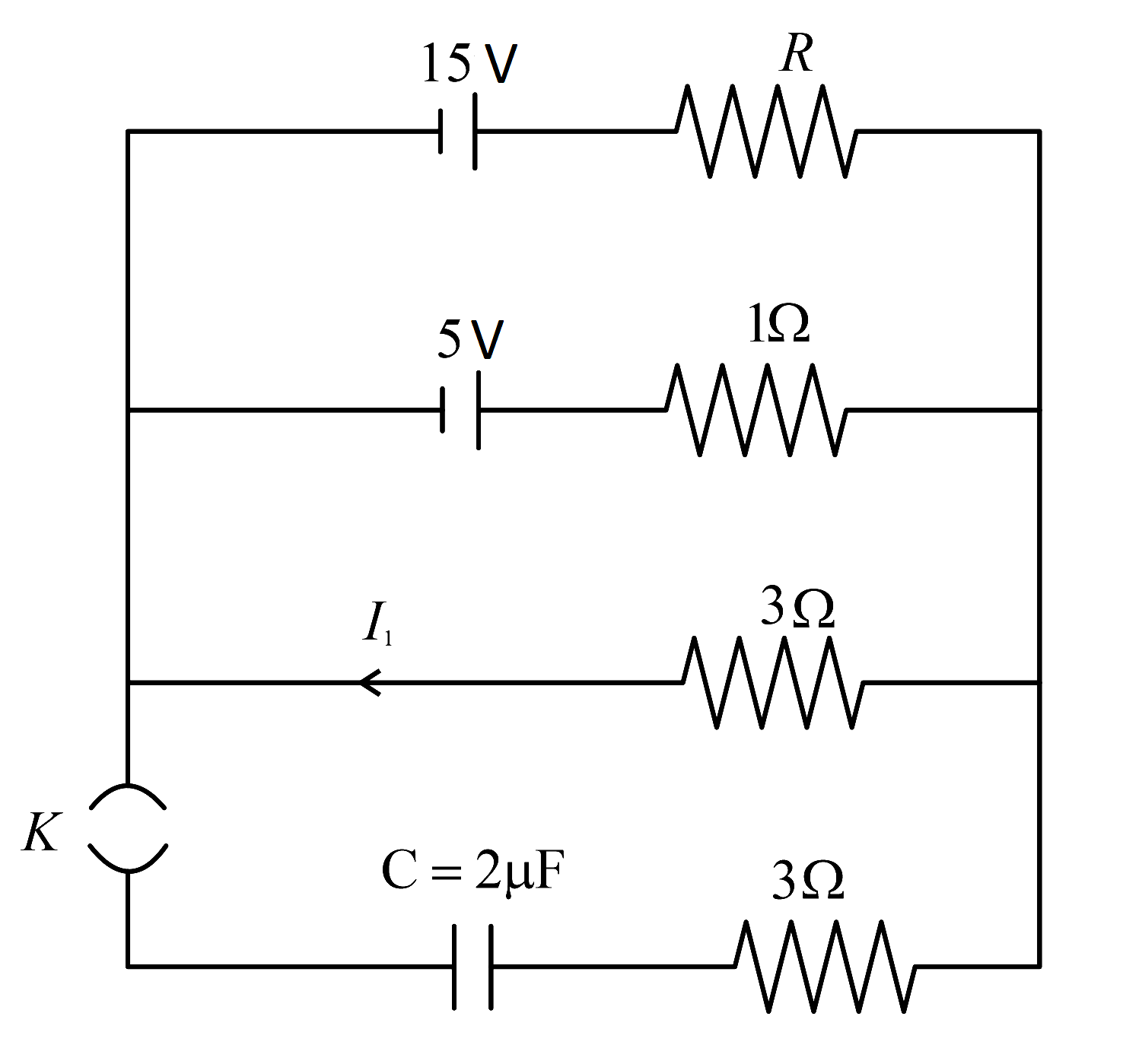 JEE Advanced 2023 Medium