


JEE Advanced · Chemistry · 24. Haloalkanes & Haloarenes
Match the following
| Column I | Column II |
| (A) \(CH _3- CHBr - CD _3\) on treatment with alc. KOH gives \(CH _2= CH - CD _3\) as a major product. | (P) E1 reaction |
| (B) \(Ph - CHBr - CH _3\) reacts faster than \(Ph - CHBr - CD _3\) | (Q) E2 reaction |
| (C) \(Ph - CH _2- CH _2 Br\) on treatment with \(C _2 H _5 OD / C _2 H _5 O ^{-}\)gives \(Ph - CD = CH _2\) as the major product | (R) El cb reaction |
| (D) \(PhCH _2 CH _2 Br\) and \(PhCH _2 CH _2 Br\) react with same rate | (S) First order reaction |
- A (A) Q, (B) P, (C) R,S, (D) Q,S
- B (A) S, (B) R, (C) R, (D) P,S
- C (A) R, (B) Q, (C) S, (D) Q,S
- D (A) Q, (B) Q, (C) R,S, (D) P,S
Answer & Solution
Correct Answer
(D) (A) Q, (B) Q, (C) R,S, (D) P,S
Step-by-step Solution
Detailed explanation
(A) Match with (Q)

The formation of \(\mathrm{CH}_2=\mathrm{CH}-\mathrm{CD}_3\) can be explained on the basis of the fact that \(\mathrm{C}-\mathrm{D}\) bond is much stronger than \(\mathrm{C}-\mathrm{H}\) bond.
(B) match with (Q)
Reactivity of \(\mathrm{PhCHBrCH}_3\) is greater than
\(\mathrm{Ph} \mathrm{CHBrCD}_3\) because \(\mathrm{C}-\mathrm{D}\) bond is more stronger than \(\mathrm{C}-\mathrm{H}\) bond.
(C) match with (R) and (S)

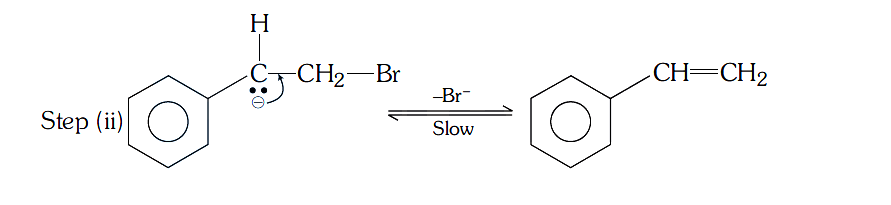
In the step (II), a slow unimolecular elimination occurs in the conjugate base of the reactant and hence this mechanism is called \(E_1 C B\) or carbanion mechanism. Since step (I) must be reversible, if ethanol containing \(\mathrm{C}_2 \mathrm{H}_5 \mathrm{OD}\) is used as solvent, it would be expected that the original bromide would incorporate deuterium (D).
\(\text { (D) Match with (P) and (S) }\)
Step I. \(\mathrm{PhCH}_2-\mathrm{CH}_2-\mathrm{Br} \stackrel{\text { Slow }}{\longrightarrow} \mathrm{PhCH}_2-\stackrel{+}{\mathrm{C}} \mathrm{H}_2+\mathrm{Br}^{-}\)
Step II. \(\mathrm{PhCH}_2-\stackrel{+}{\mathrm{C}_2} \mathrm{H}_2 \stackrel{\text { Fast }}{\longrightarrow} \mathrm{Ph}-\mathrm{CH}=\mathrm{CH}_2+\mathrm{H}^{-}\)
Rate \(\propto\left[\mathrm{PhCH}_2-\mathrm{CH}_2-\mathrm{Br}\right]\)
Similarly
Step II. \(\mathrm{PhCD}_2 \stackrel{+}{\mathrm{C}_2} \mathrm{H}_2 \stackrel{\text { Fast }}{\longrightarrow} \mathrm{PhCD}=\mathrm{CHD}+\mathrm{H}^{+}\)
Rate \(\propto\left[\mathrm{PhCD}_2-\mathrm{CH}_2 \mathrm{Br}\right]\)
Hence, \(E_1\) reaction and first order kinetics.
The formation of \(\mathrm{CH}_2=\mathrm{CH}-\mathrm{CD}_3\) can be explained on the basis of the fact that \(\mathrm{C}-\mathrm{D}\) bond is much stronger than \(\mathrm{C}-\mathrm{H}\) bond.
(B) match with (Q)
Reactivity of \(\mathrm{PhCHBrCH}_3\) is greater than
\(\mathrm{Ph} \mathrm{CHBrCD}_3\) because \(\mathrm{C}-\mathrm{D}\) bond is more stronger than \(\mathrm{C}-\mathrm{H}\) bond.
(C) match with (R) and (S)
In the step (II), a slow unimolecular elimination occurs in the conjugate base of the reactant and hence this mechanism is called \(E_1 C B\) or carbanion mechanism. Since step (I) must be reversible, if ethanol containing \(\mathrm{C}_2 \mathrm{H}_5 \mathrm{OD}\) is used as solvent, it would be expected that the original bromide would incorporate deuterium (D).
\(\text { (D) Match with (P) and (S) }\)
Step I. \(\mathrm{PhCH}_2-\mathrm{CH}_2-\mathrm{Br} \stackrel{\text { Slow }}{\longrightarrow} \mathrm{PhCH}_2-\stackrel{+}{\mathrm{C}} \mathrm{H}_2+\mathrm{Br}^{-}\)
Step II. \(\mathrm{PhCH}_2-\stackrel{+}{\mathrm{C}_2} \mathrm{H}_2 \stackrel{\text { Fast }}{\longrightarrow} \mathrm{Ph}-\mathrm{CH}=\mathrm{CH}_2+\mathrm{H}^{-}\)
Rate \(\propto\left[\mathrm{PhCH}_2-\mathrm{CH}_2-\mathrm{Br}\right]\)
Similarly
Step II. \(\mathrm{PhCD}_2 \stackrel{+}{\mathrm{C}_2} \mathrm{H}_2 \stackrel{\text { Fast }}{\longrightarrow} \mathrm{PhCD}=\mathrm{CHD}+\mathrm{H}^{+}\)
Rate \(\propto\left[\mathrm{PhCD}_2-\mathrm{CH}_2 \mathrm{Br}\right]\)
Hence, \(E_1\) reaction and first order kinetics.
See the Complete Solution
Get step-by-step explanations for this and 2.5 Lakh+ more JEE, NEET & CET questions.
- Unlock all solutions
- Practice the full chapter
- Track accuracy across PYQs
4.8 rated on Google Play · 14,000+ reviews
More questions from Chemistry
- When 100 mL of 1.0 M HCl was mixed with 100 mL of 1.0 M NaOH in an insulated beaker at constant pressure, a temperature increase of was measured for the beaker and its contents (Expt.1). Because the enthalpy of neutralization of a strong acid with a strong base is a constant , this experiment could be used to measure the calorimeter constant. In a second experiment (Expt. 2), 100 mL of 2.0 M acetic acid was mixed with 100 mL of 1.0 M NaOH (under identical conditions to Expt. 1) where a temperature rise of was measured. (Consider heat capacity of all solutions as and density of all solutions as )
The pH of the solution after Expt. 2 isJEE Advanced 2015 Medium - A decapeptide (molecular weight 796) on complete hydrolysis gives glycine (molecular weight 75), alanine and phenylalanine. Glycine contributes \(47.0 \%\) to the total weight of the hydrolysed products. The number of glycine units present in the decapeptide isJEE Advanced 2011 Hard
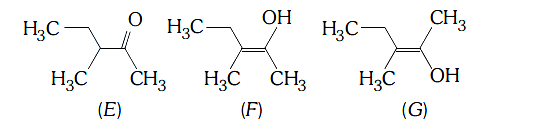
- The correct statement(s) concerning the structures E, F and G is are
 JEE Advanced 2008 Easy
 - Among the following metal carbonyls, the \(\mathrm{C}-\mathrm{O}\) bond order is lowest inJEE Advanced 2007 Easy
- Paragraph:
The hydrogen-like species \(\mathrm{Li}^{2+}\) is in a spherically symmetric state \(S_1\) with one radial node. Upon absorbing light the ion undergoes transition to a state \(S_2\). The state \(S_2\) has one radial node and its energy is equal to the ground state energy of the hydrogen atom.
Question:
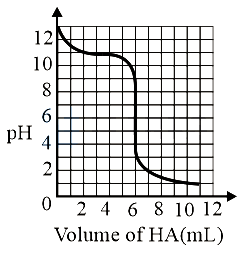
Energy of the state \(S_1\) in units of the hydrogen atom ground state energy isJEE Advanced 2010 Easy - A solution of weak base is titrated with of a strong acid . The variation of of the solution with the volume of added is shown in the figure below. What is the of the base? The neutralization reaction is given by.
 JEE Advanced 2020 Hard
More PYQs from JEE Advanced
- The coordination number of \(\mathrm{Al}\) in the crystalline state of \(\mathrm{AlCl}_3\) isJEE Advanced 2009 Easy
- Paragraph:
Chemical reactions involve interaction of atoms and molecules. A large number of atoms/molecules (approximately \(6.023 \times 10^{23}\) ) are present in a few grams of any chemical compound varying with their atomic/molecular masses. To handle such large numbers conveniently, the mole concept was introduced. This concept has implications in diverse areas such as analytical chemistry, biochemistry, electrochemistry and radiochemistry. The following example illustrates a typical case, involving chemical/electrochemical reaction, which requires a clear understanding of the mole concept.
A \(4.0\) molar aqueous solution of \(\mathrm{NaCl}\) is prepared and \(500 \mathrm{~mL}\) of this solution is electrolysed. This leads to the evolution of chlorine gas at one of electrodes (atomic mass: \(\mathrm{Na}=23, \mathrm{Hg}=200 ; 1\) faraday \(=96500\) coulombs).
Question:
The total number of moles of chlorine gas evolved isJEE Advanced 2007 Medium - The IUPAC name of \(\left[\mathrm{Ni}\left(\mathrm{NH}_3\right)_4\right]\left[\mathrm{NiCl}_4\right]\) isJEE Advanced 2008 Easy
- For , a transition takes place from the orbit of radius to the orbit of radius . The wavelength (in ) of the emitted photon during the transition is
Bohr radius,
Rydberg constant,
Planck's constant,
Speed of light, ]JEE Advanced 2023 Easy - A piece of wire is bent in the shape of a parabola \(y=k x^2\) (y-axis vertical) with a bead of mass \(m\) on it. The bead can slide on the wire without friction. It stays at the lowest point of the parabola when the wire is at rest. The wire is now accelerated parallel to the \(x\)-axis with the constant acceleration \(a\). The distance of the new equilibrium position of the bead, where the bead can stays at rest with respect to the wire, from the \(y\)-axis isJEE Advanced 2009 Medium
- Answer the following by appropriately matching the lists based on the information given in the paragraph.
In a thermodynamics process on an ideal monatomic gas, the infinitesimal heat absorbed by the gas is given by where is temperature of the system and is the infinitesimal change in a thermodynamic quantity of the system. For a mole of monatomic ideal gas Here, is gas constant, is volume of gas, and are constants.
The List-I below gives some quantities involved in a process and List-II gives some possible values of these quantities.Work done by the system in process Change in internal energy in process Heat absorbed by the system in process Heat absorbed by the system in process
If the process carried out on one mole of monatomic ideal gas is as shown in figure in the - -diagram with the correct match is,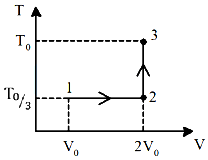 JEE Advanced 2019 Medium