


JEE Advanced · Chemistry · 18. Chemical Kinetics
For the first order reaction \(2 \mathrm{~N}_2 \mathrm{O}_5(\mathrm{~g}) \longrightarrow 4 \mathrm{NO}_2(g)+\mathrm{O}_2(g)\)
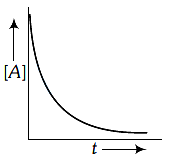
- A the concentration of the reactant decreases exponentially with time.
- B the half-life of the reaction decreases with increasing temperature
- C the half-life of the reaction depends on the initial concentration of the reactant.
- D the reaction proceeds of \(99.6 \%\) completion in eight half-life duration.
Answer & Solution
Correct Answer
(A) the concentration of the reactant decreases exponentially with time.
Step-by-step Solution
Detailed explanation
(a) For a first order reaction, the concentration of reactant remaining after time \(t\) is given by \([A]=[A]_0 e^{-k t}\) Therefore, concentration of reactant decreases exponentially with time.
(b) Rise in temperature increases rate constant \((k)\) and therefore decreases half-life \(\left(t_{1 / 2}\right)\) as
\(
t_{1 / 2}=\frac{\operatorname{In} 2}{k}
\)
(d) For a first order reaction, if 100 moles of reactant is taken initially, after \(n\) half-lives, reactant remaining is given by
\(\text {Percentage } A=100\left(\frac{1}{2}\right)^n=100\left(\frac{1}{2}\right)^8=0.3906 \)
\( \Rightarrow \text {A reacted }=100-0.3906=99.6 \%\)
(c) Half-life of first order reaction is independent of initial concentration.
(b) Rise in temperature increases rate constant \((k)\) and therefore decreases half-life \(\left(t_{1 / 2}\right)\) as
\(
t_{1 / 2}=\frac{\operatorname{In} 2}{k}
\)
(d) For a first order reaction, if 100 moles of reactant is taken initially, after \(n\) half-lives, reactant remaining is given by
\(\text {Percentage } A=100\left(\frac{1}{2}\right)^n=100\left(\frac{1}{2}\right)^8=0.3906 \)
\( \Rightarrow \text {A reacted }=100-0.3906=99.6 \%\)
(c) Half-life of first order reaction is independent of initial concentration.
See the Complete Solution
Get step-by-step explanations for this and 2.5 Lakh+ more JEE, NEET & CET questions.
- Unlock all solutions
- Practice the full chapter
- Track accuracy across PYQs
4.8 rated on Google Play · 14,000+ reviews
More questions from Chemistry
- Paragraph:
Properties such as boiling point, freezing point and vapour pressure of a pure solvent change when solute molecules are added to get homogeneous solution. These are called colligative properties. Applications of colligative properties are very useful in day-to-day life. One of its examples is the use of ethylene glycol and water mixture as anti-freezing liquid in the radiator automobiles.
A solution \(M\) is prepared by mixing ethanol and water. The mole fraction of ethanol in the mixtrue is \(0.9\)
Given Freezing point depression constant of water \(\left(k^{\text {water }}\right)=1.86 \mathrm{~K} \mathrm{~kg} \mathrm{~mol}^{-1}\)
Freezing point depression constant of ethanol \(\left(k_f^{\text {ethanol }}\right)=2.0 \mathrm{Kkg} \mathrm{mol}^{-1}\)
Boiling point elevation constant of water \(\left(k_b^{\text {water }}\right)=0.52 \mathrm{Kkg} \mathrm{mol}^{-1}\)
Boiling point elevation constant of ethanol \(\left(k_b^{\text {ethanol }}\right)=1.2 \mathrm{Kkg} \mathrm{mol}^{-1}\)
Standard freezing point of water \(=273 \mathrm{~K}\)
Standard freezing point of ethanol \(=155.7 \mathrm{~K}\)
Standard boiling point of water \(=373 \mathrm{~K}\)
Standard boiling point of ethanol \(=351.5 \mathrm{~K}\)
Vapour pressure of pure water \(=328 \mathrm{~mm}\) of \(\mathrm{Hg}\)
Vapour pressure of pure ethanol \(=40 \mathrm{~mm}\) of \(\mathrm{Hg}\)
Molecular weight of water \(=18 \mathrm{~g} \mathrm{~mol}^{-1}\)
Molecular weight of ethanol \(=46 \mathrm{~g} \mathrm{~mol}^{-1}\)
In answering the following questions, consider the solutions to be ideal dilute solutions and solutes to be non-volatile and non-dissociative.
Question:
The vapour pressure of the solution \(M\) isJEE Advanced 2008 Medium - Among the following compounds, the most acidic isJEE Advanced 2011 Medium
- A monoatomic ideal gas undergoes a process in which the ratio of \(P\) to \(V\) at any instant is constant and equals to 1 . What is the molar heat capacity of the gas?JEE Advanced 2006 Easy
- The dissociation constant of a substituted benzoic acid at \(25^{\circ} \mathrm{C}\) is \(1.0 \times 10^{-4}\). The \(\mathrm{pH}\) of \(0.01 \mathrm{M}\) solution of its sodium salt isJEE Advanced 2009 Medium
- A trinitro compound, -tris-(-nitrophenyl) benzene, on complete reaction with an excess of gives a major product, which on treatment with an excess of at provides as the product. , upon treatment with excess of at room temperature, gives the product . Bromination of in aqueous medium furnishes the product . The compound upon treatment with an excess of phenol under basic conditions gives the product . The molar mass difference between compounds and is and between compounds and is .
The number of heteroatoms present in one molecule of \(R\) is [Use: Molar mass (in \(\text{g mol} -1\) ): \(H =1,\) \(C =12, N=14, O =16,\) \(Br =80, Cl =35.5\) Atoms other than C and H are considered as heteroatoms]JEE Advanced 2023 Medium - The pair(s) of diamagnetic ions is(are)JEE Advanced 2025 Easy
More PYQs from JEE Advanced
- A cubical solid aluminum (bulk modulus \(=-\text V \frac{\text{dP}}{\text{dV}}=70\text{ GPa}\)) block has an edge length of 1 m on the surface of the earth. It is kept on the floor of a 5 km deep ocean. Taking the average density of water and the acceleration due to gravity to be \(10^3\text{ kg m} ^{-3}\) and \(10\text{ ms} ^{-2}\), respectively, the change in the edge length of the block in mm is _____________ .JEE Advanced 2020 Easy
- The Henry's law constant for the solubility of \(\mathrm{N}_2\) gas in water at \(298 \mathrm{~K}\) is \(1.0 \times 105 \mathrm{~atm}\). The mole fraction of \(\mathrm{N}_2\) in air is \(0.8\). The number of moles of \(\mathrm{N}_2\) from air dissolved in 10 moles of water of \(298 \mathrm{~K}\) and \(5 \mathrm{~atm}\) pressure isJEE Advanced 2009 Medium
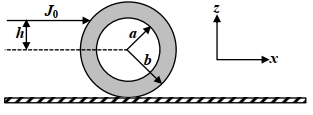
- An annular disk of mass , inner radius and outer radius is placed on a horizontal surface with coefficient of friction , as shown in the figure. At some time, an impulse is applied at a height above the center of the disk. If then the disk rolls without slipping along the -axis. Which of the following statement(s) is(are) correct?
 JEE Advanced 2023 Hard
 - In a high school, a committee has to be formed from a group of boys
and girls .
(i) Let be the total number of ways in which the committee can be formed such that the committee has members, having exactly boys and girls.
(ii) Let be the total number of ways in which the committee can be formed such that the committee has at least members, and having an equal number of boys and girls.
(iii) Let be the total number of ways in which the committee can be formed such that the committee has members, at least of them being girls.
(iv) Let be the total number of ways in which the committee can be formed such that the committee has members, having at least girls and such that both and are NOT in the committee together.
The correct option is:LIST-I LIST-II A. The value of is P. B. The value of is Q. C. The value of is R. D. The value of is S. T. U. JEE Advanced 2018 Medium - Let be a unit vector in and Given that there exists a vector in such that and Which of the following statement(s) is (are) correct ?JEE Advanced 2016 Medium
- Match each coordination compound in List-I with an appropriate pair of characteristics from List-II and select the correct answer using the code given below the lists
\(\left\{\right.\)en \(= H _2 NCH _2 CH _2 NH _2 ;\) atomic numbers \(\left.: T _{ i }=22, Cr =24 ; Co =27 ; Pt =78\right\}\)List – I List – II A. P. Paramagnetic and exhibits ionization isomerism B. Q. Diamagnetic and exhibits cis - trans isomerism C. R. Paramagnetic and exhibits cis - trans isomerism D. S. Diamagnetic and exhibits ionization isomerism JEE Advanced 2014 Medium