


JEE Advanced · Chemistry · 23. Coordination Compounds
Paragraph:
When a metal rod \(M\) is dipped into an aqueous colourless concentrated solution of compound \(\mathrm{N}\), the solution turns light blue. Addition of aqueous \(\mathrm{NaCl}\) to the blue solution gives a white precipitate \(\mathrm{O}\). Addition of aqueous \(\mathrm{NH}_3\) dissolves \(\mathrm{O}\) and gives an intense blue solution.
Question:
The final solution contains
- A \(\left[\mathrm{Pb}\left(\mathrm{NH}_3\right)_4\right]^{2+}\) and \(\left[\mathrm{CoCl}_4\right]^{2-}\)
- B \(\left[\mathrm{Al}\left(\mathrm{NH}_3\right)_4\right]^{3+}\) and \(\left[\mathrm{Cu}\left(\mathrm{NH}_3\right)_4\right]^{2+}\)
- C \(\left[\mathrm{Ag}\left(\mathrm{NH}_3\right)_2\right]^{+}\)and \(\left[\mathrm{Co}\left(\mathrm{NH}_3\right)_4\right]^{2+}\)
- D \(\left[\mathrm{Ag}\left(\mathrm{NH}_3\right)_2\right]^{+}\)and \(\left[\mathrm{Ni}\left(\mathrm{NH}_3\right)_6\right]^{2+}\)
Answer & Solution
Correct Answer
(C) \(\left[\mathrm{Ag}\left(\mathrm{NH}_3\right)_2\right]^{+}\)and \(\left[\mathrm{Co}\left(\mathrm{NH}_3\right)_4\right]^{2+}\)
Step-by-step Solution
Detailed explanation
Since in the beginning, concentrated \(\mathrm{AgNO}_3\) solution was taken, some \(\mathrm{AgNO}_3\) remain in solution which gives white precipitate of \(\mathrm{AgCl}\) on addition of \(\mathrm{NaCl}\). The precipitate finally dissolve in ammonia and \(\mathrm{Cu}^{2+}\) present in solution also forms complex with ammonia as
\(Cu \left( NO _3\right)_2+4 NH _3( aq ) \rightarrow \underset{\text { Blue }}{\left[ Cu \left( NH _3\right)_4\right]^{2+}}\) \(+~2 NO _3\)
\(AgCl (s)+2 NH _3(a q) \rightarrow\left[ Ag \left( NH _3\right)_2\right]^{+}+ Cl ^{-}\)
\(Cu \left( NO _3\right)_2+4 NH _3( aq ) \rightarrow \underset{\text { Blue }}{\left[ Cu \left( NH _3\right)_4\right]^{2+}}\) \(+~2 NO _3\)
\(AgCl (s)+2 NH _3(a q) \rightarrow\left[ Ag \left( NH _3\right)_2\right]^{+}+ Cl ^{-}\)
See the Complete Solution
Get step-by-step explanations for this and 2.5 Lakh+ more JEE, NEET & CET questions.
- Unlock all solutions
- Practice the full chapter
- Track accuracy across PYQs
4.8 rated on Google Play · 14,000+ reviews
More questions from Chemistry
- In an electrochemicalcell, dichromate ions in aqueous acidic medium are reduced to \(\mathrm{Cr}^{3+}\). The current (in amperes) that flows through the cell for 48.25 minutes to produce 1 mole of \(\mathrm{Cr}^{3+}\) is _____ .
Use: 1 Faraday \(=96500 \mathrm{C} \mathrm{mol}^{-1}\)JEE Advanced 2025 Easy - Match the chemical substance in Column I with type of polymers/type of bond in Column II. Indicate your answer by darkening the appropriate bubbles of \(4 \times 4\) matrix given in the ORS.
Column I Column II A. Cellulose p. Natural polymer B. Nylon-6,6 q. Synthetic polymer C. Protein r. Amide linkage D. Sucrose s. Glycoside linkage JEE Advanced 2007 Easy - Paragraph:
Carbon-14 is used to determine the age of organic material. The procedure is based on the formation of \({ }^{14} \mathrm{C}\) by neutron capture in the upper atmosphere.
\(
{ }_7^{14} \mathrm{~N}+{ }_0^1 n \longrightarrow{ }_6^{14} \mathrm{C}+{ }_1 n^1
\)
\({ }^{14} \mathrm{C}\) is absorbed by living organisms during photosynthesis. The \({ }^{14} \mathrm{C}\) content is constant in living organism once the plant or animal dies, the uptake of carbon dioxide by it ceases and the level of \({ }^{14} \mathrm{C}\) in the dead being, falls to the decay which \({ }^{14} \mathrm{C}\) undergoes.
\(
{ }_6^{14} \mathrm{C} \longrightarrow{ }_7^{14} \mathrm{~N}+\beta^{-}
\)
The half life period of \({ }^{14} \mathrm{C}\) is 5770 years. The decay constant \((\lambda)\) can be calculated by using the following formula \(\lambda=\frac{0.693}{t_{1 / 2}}\).
The comparison of the \(\beta^{-}\)activity of the dead matter with that of the carbon still in circulation enables measurement of the period of the isolation of the material from the living cycle. The method however, ceases to be accurate over periods longer than 30,000 years. The proportion of \({ }^{14} \mathrm{C}\) to \({ }^{12} \mathrm{C}\) in living matter is \(1: 10^{12}\).
Question:
What should be the age of fossil for meaningful determination of its age?JEE Advanced 2006 Easy - The correct statement about the following disaccharide is
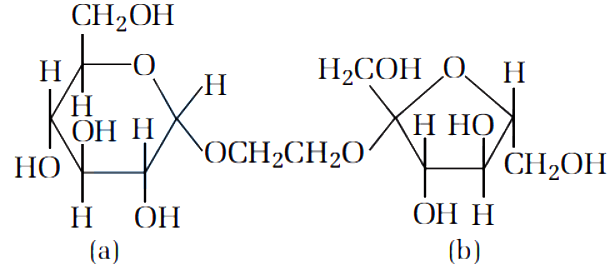 JEE Advanced 2010 Medium
 - The dilution processes of different aqueous solutions with water are given in LIST-I. The effects of dilution of the solutions on are given in LIST-II.
(Note: The degree of dissociation of a weak acid and a weak base is the degree of hydrolysis of salt is represents the concentration of ions)List - I List - II A) 10 mL of \(0.1\text{ M NaOH} +20\text{ mL}\) of 0.1 M acetic acid diluted to 60 mL . P) The value of \(\left[\text H ^{+}\right]\)does not change on dilution. B) 20 mL of \(0.1\text{ M NaOH} +20\text{ mL}\) of 0.1 M acetic acid diluted to 80 mL . Q) The value of \(\left[\text H ^{+}\right]\)changes to half of its initial value on dilution. C) 20 mL of \(0.1\text{ M HCl} +20\text{ mL}\) of 0.1 M ammonia solution diluted to 80 mL . R) The value of \(\left[\text H ^{+}\right]\)changes to two times its initial value on dilution. D) 10 mL saturated solution of \(\text{Ni} (\text{OH})_2\) in equilibrium with excess of solid \(\text{Ni} (\text{OH})_2\) is diluted to 20 mL (solid \(\text{Ni} (\text{OH})_2\) is still present after dilution). S) The value of \(\left[\text H ^{+}\right]\)changes to \(\sqrt{ }\) times its initial value on dilution. T) The value of \(\left[\text H ^{+}\right]\)changes to \(\sqrt{2}\) times its initial value on dilution.
Match each process given in LIST-I with one or more effect(s) in LIST-II. The correct option isJEE Advanced 2018 Hard - The IUPAC name of \(\left[\mathrm{Ni}\left(\mathrm{NH}_3\right)_4\right]\left[\mathrm{NiCl}_4\right]\) isJEE Advanced 2008 Easy
More PYQs from JEE Advanced
- For \(r=0,1, \ldots, 10\), let \(A_r, B_r\) and \(C_r\) denote, respectively, the coefficient of \(x^r\) in the expansions of \((1+x)^{10}\), \((1+x)^{20}\) and \((1+x)^{30}\). Then \(\sum_{r=1}^{10} A_r\left(B_{10} B_r-C_{10} A_r\right)\) is equal toJEE Advanced 2010 Medium
- Which one of the following options represents the magnetic field at due to the current flowing in the given wire segments lying on the plane?
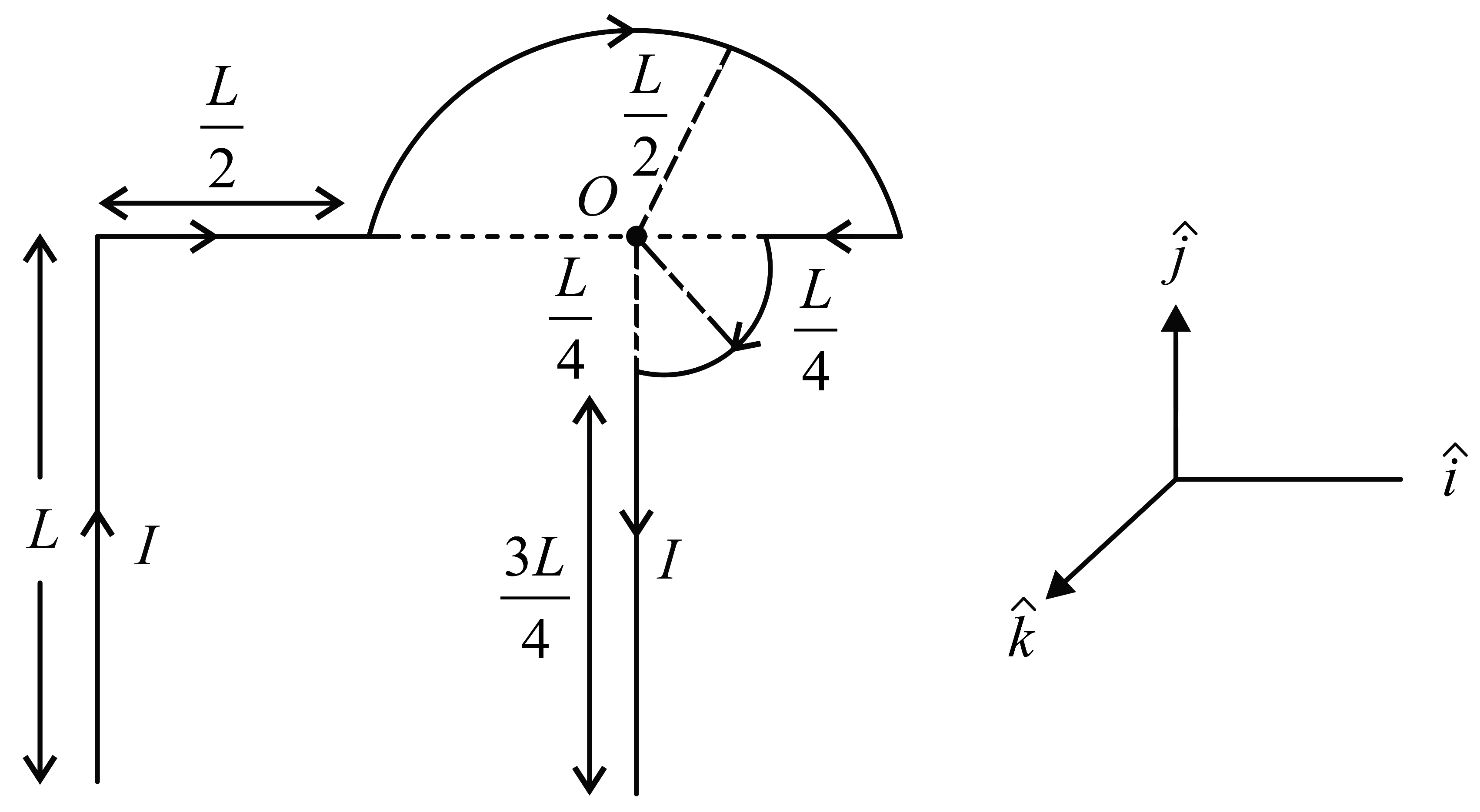 JEE Advanced 2022 Medium
 - For 'invert sugar', the correct statement(s) is (are)
(Given: specific rotations of sucrose, maltose, glucose and fructose in aqueous solution are and , respectively)JEE Advanced 2016 Easy - LIST- contains metal species and LIST- contains their properties.
List - I List - II (I) \(\left[ Cr ( CN )_6\right]^{4-}\) (P) \(t _{2 g}\) orbitals contain 4 electrons (II) \(\left[ RuCl _6\right]^{2-}\) (Q) \(\mu\) spin - only \(=4.9\) BM (III) \(\left[ Cr \left( H _2 O \right)_6\right]^{2+}\) (R) low spin complex ion (IV) \(\left[ Fe \left( H _2 O \right)_6\right]^{2+}\) (S) metal ion in 4 + oxidation state (T) \(d ^4\) species
[Given: Atomic number of ]
Match each metal species in LIST- with their properties in LIST-, and choose the correct optionJEE Advanced 2022 Hard - Two beams of red and violet colours are made to pass separately through a prism (angle of the prism is \(60^{\circ}\) ). In the position of minimum deviation, the angle of refraction will beJEE Advanced 2008 Easy
- Column I showns four systems, each of the same length \(L\), for producing standing waves. The lowest possible natural frequency of a system is called its fundamental frequency, whose wavelength is denoted as \(\lambda_f\). Match each system with statements given in Column II describing the nature and wave length of the standing waves.
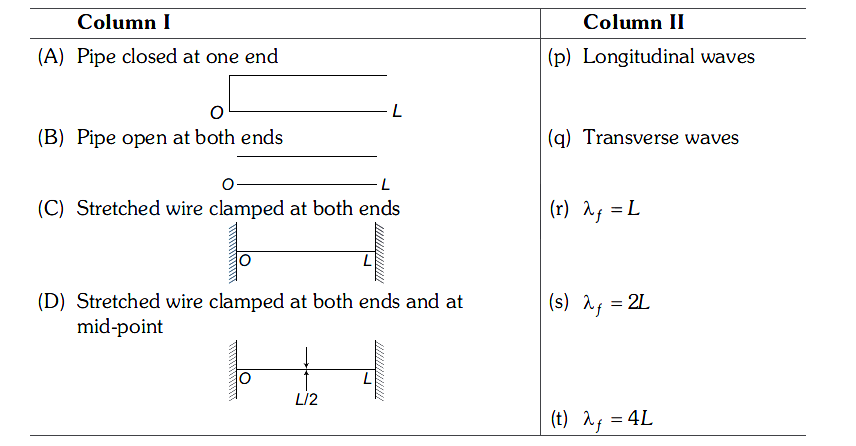 JEE Advanced 2011 Hard