


JEE Advanced · Chemistry · 29. Biomolecules
For a double strand DNA, one strand is given below:

The amount of energy required to split the double strand DNA into two single strands is _______ kcal \(\mathrm{mol}^{-1}.\)
[Given: Average energy per \(\mathrm{H}\)-bond for A-T base pair \(=1.0 \mathrm{kcal} \mathrm{mol}^{-1}, \mathrm{G}-\mathrm{C}\) base pair \(=1.5 \mathrm{kcal}\) \(\mathrm{mol}^{-1}\), and A-U base pair \(=1.25 \mathrm{kcal} \mathrm{mol}^{-1}.\) Ignore electrostatic repulsion between the phosphate groups.]
- A 30
- B 54
- C 19
- D 41
Answer & Solution
Correct Answer
(D) 41
Step-by-step Solution
Detailed explanation
\(\mathrm{A}=\mathrm{T} \quad 2 \mathrm{H}\)-bond
\(\mathrm{G} \equiv \mathrm{C} \quad 3 \mathrm{H}\)-bond
Number of \(\mathrm{A}=\mathrm{T}\) pair \(=7\)
Number of \(\mathrm{G} \equiv \mathrm{C}\) pair \(=6\)
Number of H-bond involve in \(\mathrm{A}=\mathrm{T}=7 \times 2=14\)
Number of \(\mathrm{H}\)-bond involve in \(\mathrm{G} \equiv \mathrm{C}=6 \times 3=18\)
Energy required for \(\mathrm{A}=\mathrm{T}=14 \times 1=14\)
Energy required for \(\mathrm{G} \equiv \mathrm{C}=18 \times 1.5=27\)
Total energy required \(14+27=41\)
\(\mathrm{G} \equiv \mathrm{C} \quad 3 \mathrm{H}\)-bond
Number of \(\mathrm{A}=\mathrm{T}\) pair \(=7\)
Number of \(\mathrm{G} \equiv \mathrm{C}\) pair \(=6\)
Number of H-bond involve in \(\mathrm{A}=\mathrm{T}=7 \times 2=14\)
Number of \(\mathrm{H}\)-bond involve in \(\mathrm{G} \equiv \mathrm{C}=6 \times 3=18\)
Energy required for \(\mathrm{A}=\mathrm{T}=14 \times 1=14\)
Energy required for \(\mathrm{G} \equiv \mathrm{C}=18 \times 1.5=27\)
Total energy required \(14+27=41\)
See the Complete Solution
Get step-by-step explanations for this and 2.5 Lakh+ more JEE, NEET & CET questions.
- Unlock all solutions
- Practice the full chapter
- Track accuracy across PYQs
4.8 rated on Google Play · 14,000+ reviews
More questions from Chemistry
- In the reaction scheme shown below, and are the major products.
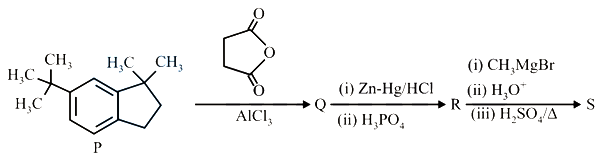
The correct structure ofJEE Advanced 2020 Hard - Paragraph:
The reaction of \(\mathrm{K}_{3}\left[\mathrm{Fe}(\mathrm{CN})_{6}\right]\) with freshly prepared \(\mathrm{FeSO}_{4}\) solution produces a dark blue precipitate called Turnbull's blue. Reaction of \(\mathrm{K}_{4}\left[\mathrm{Fe}(\mathrm{CN})_{6}\right]\) with the \(\mathrm{FeSO}_{4}\) solution in complete absence of air produces a white precipitate \(\mathbf{X}\), which turns blue in air. Mixing the \(\mathrm{FeSO}_{4}\) solution with \(\mathrm{NaNO}_{3}\), followed by a slow addition of concentrated \(\mathrm{H}_{2} \mathrm{SO}_{4}\) through the side of the test tube produces a brown ring.
Question:
Among the following, the brown ring is due to the formation ofJEE Advanced 2021 Easy - Some standard electrode potentials at are given below: To a solution containing of and of , the metal rods and are inserted at and connected by a conducting wire. This resulted in dissolution of . The correct combination(s) of and , respectively, is(are) (Given: Gas constant, , Faraday constant, )JEE Advanced 2021 Easy
- The compound(s) formed upon combustion of sodium metal in excess air is (are)JEE Advanced 2009 Easy
- Paragraph:
The reactions of \(\mathrm{Cl}_{2}\) gas with cold-dilute and hot-concentrated \(\mathrm{NaOH}\) in water give sodium salts of two (different) oxoacids of chlorine, \(\boldsymbol{P}\) and \(\boldsymbol{Q}\), respectively. The \(\mathrm{Cl}_{2}\) gas reacts with \(\mathrm{SO}_{2}\) gas, in presence of charcoal, to give a product \(\boldsymbol{R}\). \(\boldsymbol{R}\) reacts with white phosphorus to give a compound \(\boldsymbol{S}\). On hydrolysis, \(\boldsymbol{S}\) gives an oxoacid of phosphorus, \(\boldsymbol{T}\).
Question:
\(P\) and \(Q\), respectively, are the sodium salts ofJEE Advanced 2013 Medium - Which ordering of compounds is according to the decreasing order of the oxidation state of nitrogen?JEE Advanced 2012 Medium
More PYQs from JEE Advanced
- A metal is heated in a furnace where a sensor is kept above the metal surface to read the power radiated () by the metal. The sensor has a scale that displays , where is a constant. When the metal surface is at a temperature of , the sensor shows a value . Assume that the emissivity of the metallic surface remains constant. What is the value displayed by the sensor when the temperature of the metal surface is raised to ?JEE Advanced 2016 Hard
- A uniform rod of length \(L\) and mass \(M\) is pivoted at the centre. Its two ends are attached to two springs of equal spring constants \(k\). The springs are fixed to rigid supports as shown in the figure, and rod is free to oscillate in the horizontal plane. The rod is gently pushed through a small angle \(\theta\) in one direction and released. The frequency of oscillation is
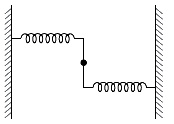 JEE Advanced 2009 Medium
 - If \(\mathbf{a}, \mathbf{b}, \mathbf{c}\) and \(\mathbf{d}\) are the unit vectors such that \((\mathbf{a} \times \mathbf{b}) \cdot(\mathbf{c} \times \mathbf{d})=1\) and \(\mathbf{a} \cdot \mathbf{c}=\frac{1}{2}\), thenJEE Advanced 2009 Hard
- Let us consider a system of units in which mass and angular momentum are dimensionless. If length has dimension of which of the following statement (s) is/are correct?JEE Advanced 2019 Easy
- A point source \(\mathrm{S}\) emits unpolarized light uniformly in all directions. At two points \(\mathrm{A}\) and \(\mathrm{B}\), the ratio \(r=I_A / I_B\) of the intensities of light is 2. If a set of two polaroids having \(45^{\circ}\) angle between their pass-axes is placed just before point \(\mathrm{B}\), then the new value of \(r\) will be ______JEE Advanced 2024 Easy
- The total number of carboxylic acid groups in the product P is
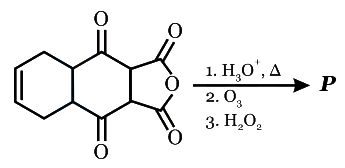 JEE Advanced 2013 Medium