


JEE Advanced · Chemistry · 13. GOC
The hyperconjugative stabilities of tert-butyl cation and 2-butene, respectively, due to
- A \(\sigma \rightarrow p\) (empty) and \(\sigma \rightarrow \pi^*\) electron delocalisations.
- B \(\sigma \rightarrow \sigma^*\) and \(\sigma \rightarrow \pi\) electron delocalisations.
- C \(\sigma \rightarrow p\) (filled) and \(\sigma \rightarrow \pi\) electron delocalisations.
- D p (filled) \(\rightarrow \sigma^*\) and \(\sigma \rightarrow \pi^*\) electron delocalisations.
Answer & Solution
Correct Answer
(A) \(\sigma \rightarrow p\) (empty) and \(\sigma \rightarrow \pi^*\) electron delocalisations.
Step-by-step Solution
Detailed explanation
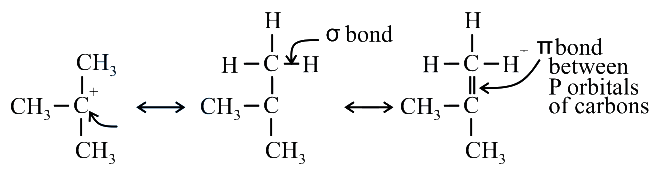
In tert-butyl cation, carbon bearing charge has one vacant p orbital hence it is (empty) conjugation or Hyperconjugation.

In 2-butene hyperconjugation between and bond.
See the Complete Solution
Get step-by-step explanations for this and 2.5 Lakh+ more JEE, NEET & CET questions.
- Unlock all solutions
- Practice the full chapter
- Track accuracy across PYQs
4.8 rated on Google Play · 14,000+ reviews
More questions from Chemistry
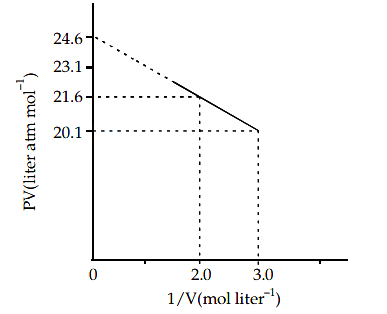
- For one mole of a van der Waal's gas when \(b=0\) and \(\mathrm{T}=300 \mathrm{~K}\), the PV vs, \(1 / \mathrm{V}\) plot is shown below. The value of the van der Waal's constant \(a\) (atm. liter \({ }^{2} \mathrm{~mol}^{-2}\) ) is :
 JEE Advanced 2012 Easy
 - Calamine, malachite, magnetite and cryolite, respectively are:JEE Advanced 2019 Easy
- At \(400 \mathrm{~K}\), the root mean square (rms) speed of a gas \(X\) (molecular weight \(=40\) ) is equal to the most probable speed of gas \(Y\) at \(60 \mathrm{~K}\). The molecular weight of the gas \(Y\) isJEE Advanced 2009 Easy
- The correct statement(s) about surface properties is(are)JEE Advanced 2017 Easy
- The species which by definition has zero standard molar enthalpy of formation at \(298 \mathrm{~K}\) isJEE Advanced 2010 Hard
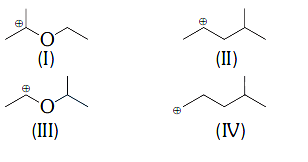
- The correct stability order for the following species is
 JEE Advanced 2008 Medium
More PYQs from JEE Advanced
- For , a transition takes place from the orbit of radius to the orbit of radius . The wavelength (in ) of the emitted photon during the transition is
Bohr radius,
Rydberg constant,
Planck's constant,
Speed of light, ]JEE Advanced 2023 Easy - For , the number of real roots of the equation isJEE Advanced 2021 Easy
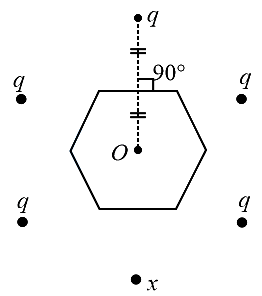
- Six charges are placed around a regular hexagon of side length as shown in the figure. Five of them have charge , and the remaining one has charge . The perpendicular from each charge to the nearest hexagon side passes through the center of the hexagon and is bisected by the side.
Which of the following statement(s) is(are) correct in SI units?JEE Advanced 2022 Easy - Paragraph :
The capacitor of capacitance \(C\) can be charged (with the help of a resistance \(R\) ) by a voltage source \(V\), by closing switch \(S_1\) while keeping switch \(S_2\) open. The capacitor can be connected in series with an inductor \(L\) by closing switch \(S_2\) and opening \(S_1\).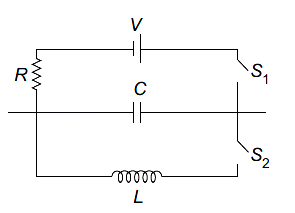
Question :
If the total charge stored in the \(L C\) circuit is \(Q_0\), then for \(t \geq 0\)JEE Advanced 2006 Hard - A particle of mass \(m\) is moving in a circular orbit under the influence of the central force \(F(r)=-k r\), corresponding to the potential energy \(V(r)=k r^2 / 2\), where \(k\) is a positive force constant and \(r\) is the radial distance from the origin. According to the Bohr's quantization rule, the angular momentum of the particle is given by \(L=n \hbar\), where \(\hbar=h /(2 \pi), h\) is the Planck's constant, and \(n\) a positive integer. If \(v\) and \(E\) are the speed and total energy of the particle, respectively, then which of the following expression(s) is(are) correct?JEE Advanced 2024 Medium
- Let \(z_k=\cos \left(\frac{2 k \pi}{10}\right)+i \sin \left(\frac{2 k \pi}{10}\right) ; k=1,2, \ldots, 9\)
List - I List - II (A) For each \(z_k\) there exists a \(z_j\) such \(z_k \cdot z_j=1\) (P) True (B) There exists a \(k \in\{1,2, \ldots, 9\}\) such that \(z_1 \cdot z=z_k\) has no solution z in the set of complex numbers (Q) False (C) \(\frac{\left|1-z_1\right|\left|1-z_2\right|\ldots\left|1-z_9\right|}{10}\) equals (R) 1 (D) \(1-\sum_{k=1}^9 \cos \left(\frac{2 k \pi}{10}\right)\) equals (S) 2 JEE Advanced 2014 Hard