


JEE Advanced · Chemistry · 31. Practical Chemistry
Paragraph:
An aqueous solution of metal ion \(\mathbf{M} 1\) reacts separately with reagents \(\mathbf{Q}\) and \(\mathbf{R}\) in excess to give tetrahedral and square planar complexes, respectively. An aqueous solution of another metal ion M2 always forms tetrahedral complexes with these reagents. Aqueous solution of \(\mathbf{M} 2\) on reaction with reagent \(\mathbf{S}\) gives white precipitate which dissolves in excess of \(\mathbf{S}\). The reactions are summarized in the scheme given below:
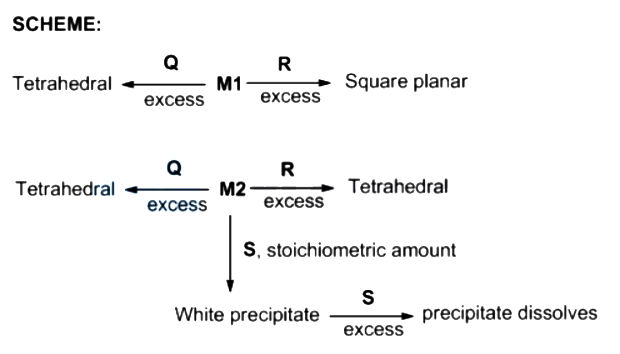
Question:
Reagent \(\mathbf{S}\) is
- A
- B
- C
- D
Answer & Solution
Correct Answer
(D)
Step-by-step Solution
Detailed explanation
See the Complete Solution
Get step-by-step explanations for this and 2.5 Lakh+ more JEE, NEET & CET questions.
- Unlock all solutions
- Practice the full chapter
- Track accuracy across PYQs
4.8 rated on Google Play · 14,000+ reviews
More questions from Chemistry
- The reagent(s) that can selectively precipitate from a mixture of and in aqueous solution is (are)JEE Advanced 2016 Medium
- With respect to graphite and diamond, which of the statement(s) given below is (are) correct?JEE Advanced 2012 Easy
- Paragraph:
Properties such as boiling point, freezing point and vapour pressure of a pure solvent change when solute molecules are added to get homogeneous solution. These are called colligative properties. Applications of colligative properties are very useful in day-to-day life. One of its examples is the use of ethylene glycol and water mixture as anti-freezing liquid in the radiator automobiles.
A solution \(M\) is prepared by mixing ethanol and water. The mole fraction of ethanol in the mixtrue is \(0.9\)
Given Freezing point depression constant of water \(\left(k^{\text {water }}\right)=1.86 \mathrm{~K} \mathrm{~kg} \mathrm{~mol}^{-1}\)
Freezing point depression constant of ethanol \(\left(k_f^{\text {ethanol }}\right)=2.0 \mathrm{Kkg} \mathrm{mol}^{-1}\)
Boiling point elevation constant of water \(\left(k_b^{\text {water }}\right)=0.52 \mathrm{Kkg} \mathrm{mol}^{-1}\)
Boiling point elevation constant of ethanol \(\left(k_b^{\text {ethanol }}\right)=1.2 \mathrm{Kkg} \mathrm{mol}^{-1}\)
Standard freezing point of water \(=273 \mathrm{~K}\)
Standard freezing point of ethanol \(=155.7 \mathrm{~K}\)
Standard boiling point of water \(=373 \mathrm{~K}\)
Standard boiling point of ethanol \(=351.5 \mathrm{~K}\)
Vapour pressure of pure water \(=328 \mathrm{~mm}\) of \(\mathrm{Hg}\)
Vapour pressure of pure ethanol \(=40 \mathrm{~mm}\) of \(\mathrm{Hg}\)
Molecular weight of water \(=18 \mathrm{~g} \mathrm{~mol}^{-1}\)
Molecular weight of ethanol \(=46 \mathrm{~g} \mathrm{~mol}^{-1}\)
In answering the following questions, consider the solutions to be ideal dilute solutions and solutes to be non-volatile and non-dissociative.
Question:
The freezing point of the solution \(M\) isJEE Advanced 2008 Medium - Consider the following complex ions, P, Qand R.

The correct order of the complex ions, according to their spin-only magnetic moment values (in B.M.) isJEE Advanced 2013 Medium - Atoms of metals and form face-centred cubic (fcc) unit cell of edge length , body-centred cubic (bcc) unit cell of edge length , and simple cubic unit cell of edge length , respectively. If and , then the correct statement(s) is(are)
[Given: , and are molar masses of metals , and , respectively. , and are atomic radii of metals , and , respectively.]JEE Advanced 2023 Medium - Paragraph:
A tertiary alcohol \(H\) upon acid catalysed dehydration gives a product \(I\). Ozonolysis of I leads to compounds \(\mathrm{J}\) and \(\mathrm{K}\). Compound \(\mathrm{J}\) upon reaction with
\(\mathrm{KOH}\) gives benzyl alcohol and a compound \(\mathrm{L}\), where \(\mathrm{K}\) on reaction with \(\mathrm{KOH}\) gives only \(M\).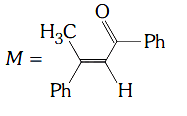
Question:
The structures of compounds \(J, K\) and \(L\), respectively, areJEE Advanced 2008 Medium
More PYQs from JEE Advanced
- Equation of the plane containing the straight line \(\frac{x}{2}=\frac{y}{3}=\frac{z}{4}\) and perpendicular to the plane containing the straight lines \(\frac{x}{3}=\frac{y}{4}=\frac{z}{2}\) and \(\frac{x}{4}=\frac{y}{2}=\frac{z}{3}\) isJEE Advanced 2010 Medium
- In the following reaction sequence, the major product \(\mathbf{P}\) is formed.
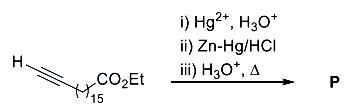
Glycerol reacts completely with excess \(\mathbf{P}\) in the presence of an acid catalyst to form \(\mathbf{Q}\). Reaction of \(\mathbf{Q}\) with excess \(\mathrm{NaOH}\) followed by the treatment with \(\mathrm{CaCl}_2\) yields Ca-soap \(\mathbf{R}\), quantitatively. Starting with one mole of \(\mathbf{Q}\), the amount of \(\mathbf{R}\) produced in gram is ________.
[Given, atomic weight: \(\mathrm{H}=1, \mathrm{C}=12,\) \(\mathrm{~N}=14, \mathrm{O}=16, \mathrm{Na}=23, \mathrm{Cl}=35,\) \(\mathrm{Ca}=40\)]JEE Advanced 2024 Easy - The reaction of \(P_2\) with \(X\) leads selectively to \(\mathrm{P}_4 \mathrm{O}_6\). The \(\mathrm{X}\) isJEE Advanced 2009 Easy
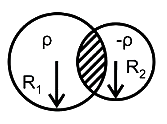
- Two non-conducting spheres of radii and and carrying uniform volume charge densities and , respectively, are placed such that they partially overlap, as shown in the figure. At all points in the overlapping region,
 JEE Advanced 2013 Hard
 - Match the complexes in Column I with their properties listed in Column II. Indicate your answer by darkening the appropriate bubbles of the \(4 \times 4\) matrix given in the ORS.
Column I Column II A. \(\text O _2^{-} \longrightarrow \text{O} _2\) \(+~\text O _2^{2-}\) P. Redox reaction B. \(\text{CrO} _4^{2-}+\text H ^{+} \longrightarrow\) Q. One of the products has trigonal planar structure C. \(\text{MnO} _4^{-}+ \text{NO} _2^{-}\) \(+~ \text H ^{+} \longrightarrow\) R. Dimeric bridged tetrahedral metal ion D. \(\text{NO} _3^{-}+ \text H _2 \text{SO} _4\) \(+~ \text{Fe} ^{2+} \longrightarrow\) S. Disproportionation JEE Advanced 2007 Hard - In dilute aqueous , the complex diaquodioxalatoferrate (II) is oxidized by . For this reaction, the ratio of the rate of change of to the rate of change of isJEE Advanced 2015 Easy