


JEE Advanced · Chemistry · 14. Hydrocarbons
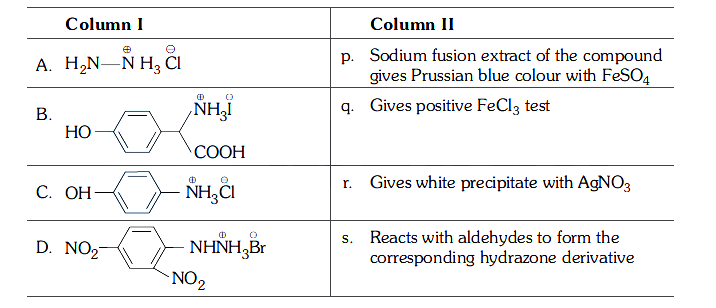
Match the compounds in Column I with their characteristic test(s)/reactions(s) given in Column II. Indicate your answer by darkening the appropriate bubbles of the \(4 \times 4\) matrix given in the ORS.
- A (A) r,s, (B) p,q, (C) p,q,r, (D) p
- B (A) r, (B) p,q,s, (C) p,q,s, (D) p,q
- C (A) s, (B) q,r,s, (C) p,q,r,s, (D) p,q
- D (A) r,s, (B) p,q,s, (C) p,q,r, (D) p
Answer & Solution
Correct Answer
(A) (A) r,s, (B) p,q, (C) p,q,r, (D) p
Step-by-step Solution
Detailed explanation
A-r; B-p, q; C- p, q, r; D-p
Sodium fusion extract gives Prussian blue when nitrogen is present alongwith carbon. Phenolic group and carboxylate gives positive \(\mathrm{FeCl}_3\) test - white precipitate comes with \(\mathrm{AgCl}\).
Hydrazone formation occurs effectively at \(\text{pH} \approx 4.5\). The reaction proceeds in that condition only when \(\mathrm{H}^{+}\)concentration is merely sufficient to activate. As \(\mathrm{H}^{+}\)concentration raises, sufficient molecule of hydrazone gets converted into hydrazonium which is not nucleophilic and reaction becomes impossible. Further, low concentration of \(\mathrm{H}^{+}\)(in the case of hydrolysis of 2, 4-dinitrophenyl hydrazonium bromide) is not effective to proceed elimination (rate determining step).
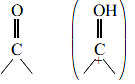
If it is assumed that the given hydrazonian bromiate is the result as salt main \(\mathrm{HBr}\) is used as acid catalyst. Remember! hydrazone formation involves first addition and then elimination (res). In the second step substitution dominates over elimination ( \(\mathrm{HBr}\) is not a dehydrating reagent mutually).
Sodium fusion extract gives Prussian blue when nitrogen is present alongwith carbon. Phenolic group and carboxylate gives positive \(\mathrm{FeCl}_3\) test - white precipitate comes with \(\mathrm{AgCl}\).
Hydrazone formation occurs effectively at \(\text{pH} \approx 4.5\). The reaction proceeds in that condition only when \(\mathrm{H}^{+}\)concentration is merely sufficient to activate. As \(\mathrm{H}^{+}\)concentration raises, sufficient molecule of hydrazone gets converted into hydrazonium which is not nucleophilic and reaction becomes impossible. Further, low concentration of \(\mathrm{H}^{+}\)(in the case of hydrolysis of 2, 4-dinitrophenyl hydrazonium bromide) is not effective to proceed elimination (rate determining step).
If it is assumed that the given hydrazonian bromiate is the result as salt main \(\mathrm{HBr}\) is used as acid catalyst. Remember! hydrazone formation involves first addition and then elimination (res). In the second step substitution dominates over elimination ( \(\mathrm{HBr}\) is not a dehydrating reagent mutually).
See the Complete Solution
Get step-by-step explanations for this and 2.5 Lakh+ more JEE, NEET & CET questions.
- Unlock all solutions
- Practice the full chapter
- Track accuracy across PYQs
4.8 rated on Google Play · 14,000+ reviews
More questions from Chemistry
- is ethylenediaminetetraacetate ion. The total number of N - Co - O bond angles in complex ion isJEE Advanced 2013 Hard
- Match the complexes in Column I with their properties listed in Column II. Indicate your answer by darkening the appropriate bubbles of the \(4 \times 4\) matrix given in the ORS.
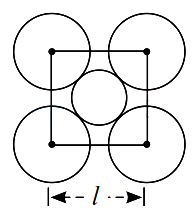
Column I Column II A. \(\text O _2^{-} \longrightarrow \text{O} _2\) \(+~\text O _2^{2-}\) P. Redox reaction B. \(\text{CrO} _4^{2-}+\text H ^{+} \longrightarrow\) Q. One of the products has trigonal planar structure C. \(\text{MnO} _4^{-}+ \text{NO} _2^{-}\) \(+~ \text H ^{+} \longrightarrow\) R. Dimeric bridged tetrahedral metal ion D. \(\text{NO} _3^{-}+ \text H _2 \text{SO} _4\) \(+~ \text{Fe} ^{2+} \longrightarrow\) S. Disproportionation JEE Advanced 2007 Hard - The packing efficiency of the two-dimensional square unit cell shown below is
 JEE Advanced 2010 Easy
 - Consider an ionic solid , with structure. Construct a new structure , whose unit cell is constructed from the unit cell of , following the sequential instructions given below. Neglect the charge balance.
Remove all the anions , except the central one.
Replace all the face centered cations , by anions .
Remove all the corner cations .
Replace the central anion , with cation .
The value of in is _____.JEE Advanced 2018 Hard - All the energy released from the reaction is used for oxidizing as
Under standard conditions, the number of moles of oxidized when one mole of X is converted to Y isJEE Advanced 2015 Hard - The geometries of the ammonia complexes of respectively, are :JEE Advanced 2016 Medium
More PYQs from JEE Advanced
- Let \(f\) be a real-valued function defined on the interval \((0, \infty)\), by \(f(x)=\ln x+\int_0^x \sqrt{1+\sin t} d t\). Then which of the following statement(s) is (are) true ?JEE Advanced 2010 Medium
- The major products obtained from the reactions in List-II are the reactants for the named reactions mentioned in List-I. Match List-I with List-II and choose the correct option.
List I List II Etard reaction Gattermann reaction Gattermann-Koch reaction Rosenmund reduction JEE Advanced 2023 Easy - Geometrical shapes of the complexes formed by the reaction of \(\mathrm{Ni}^{2+}\) with \(\mathrm{Cl}^{-}\), \(\mathrm{CN}^{-}\)and \(\mathrm{H}_2 \mathrm{O}\), respectively, areJEE Advanced 2011 Easy
- Among the following compounds, the most acidic isJEE Advanced 2011 Medium
- A current carrying wire heats a metal rod. The wire provides a constant power to the rod. The metal rod is enclosed in an insulated container. It is observed that the temperature in the metal rod changes with time as:
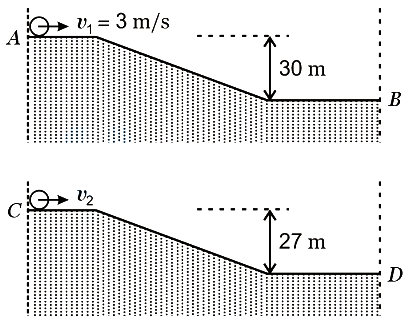
where is a constant with appropriate dimension while is a constant with dimension of temperature. The heat capacity of the metal is:JEE Advanced 2019 Hard - Two identical uniform discs roll without slipping on two different surfaces AB and CD (see figure) starting at A and C with linear speeds \(v_1\) and \(v_2\), respectively, and always remain in contact with the surfaces. If they reach B and D with the same linear speed and \(v_1=3 m / s\), then \(v_2\) in \(m / s\) is \(\left( g =10 \frac{m}{ s ^2}\right)\)
 JEE Advanced 2015 Medium