


JEE Advanced · Chemistry · 22. d & f Block
In the scheme given below, \(\text X\) and \(\text Y\), respectively, are
Metal halide \(\quad \xrightarrow{\text { aq. NaOH} } \quad\) White precipitate \((\text P )+\) Filtrate \((\text Q )\)
\(P \xrightarrow[\text { heat }]{\substack{\text { aq. } H _2 SO _4 \\ PbO _2 \text { (excess) }}}\text X\) (a coloured species in solution)
\(Q \xrightarrow[\text { warm }]{ MnO ( OH )_2, \text { Conc. } H _2 SO _4}\text Y\) (gives blue-coloration with KI-starch paper)
- A and
- B
- C
- D
Answer & Solution
Correct Answer
(C)
Step-by-step Solution
Detailed explanation
The metal halide can be manganese dichloride. It gives white precipitate of manganese hydroxide.
See the Complete Solution
Get step-by-step explanations for this and 2.5 Lakh+ more JEE, NEET & CET questions.
- Unlock all solutions
- Practice the full chapter
- Track accuracy across PYQs
4.8 rated on Google Play · 14,000+ reviews
More questions from Chemistry
- The correct statement(s) about and is (are)
[Atomic number of Cr = 24 and Mn = 25]JEE Advanced 2015 Easy - The correct statement(s) concerning the structures E, F and G is are
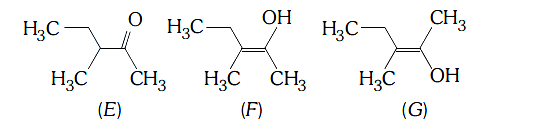 JEE Advanced 2008 Easy
 - The treatment of an aqueous solution of 3.74 g of \(\text{Cu} \left(\text{NO} _3\right)_2\) with excess KI results in a brown solution along with the formation of a precipitate. Passing \(\text{H} _2 \text{S}\) through this brown solution gives another precipitate X . The amount of X (in g ) is _____________ [Given: Atomic mass of \(\text{H} =1, \text{N}=14, \text{O} =16, \text{S}=32, \text{K}=39,\) \(\text{Cu} =63, \text{I} =127]\)JEE Advanced 2022 Easy
- Paragraph:
An aqueous solution of metal ion \(\mathbf{M} 1\) reacts separately with reagents \(\mathbf{Q}\) and \(\mathbf{R}\) in excess to give tetrahedral and square planar complexes, respectively. An aqueous solution of another metal ion M2 always forms tetrahedral complexes with these reagents. Aqueous solution of \(\mathbf{M} 2\) on reaction with reagent \(\mathbf{S}\) gives white precipitate which dissolves in excess of \(\mathbf{S}\). The reactions are summarized in the scheme given below: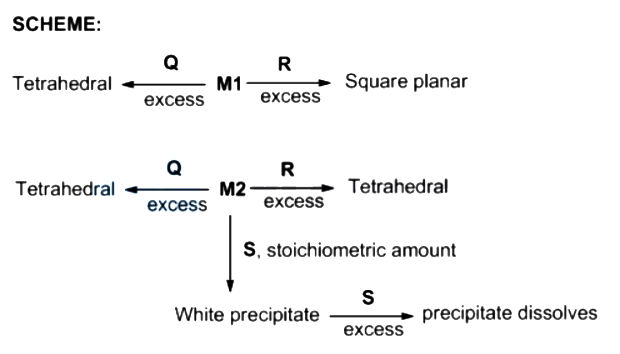
Question:
\(\mathbf{M} 1, \mathbf{Q}\) and \(\mathbf{R}\), respectively areJEE Advanced 2014 Easy - In the following reaction, the product(s) formed is/are:
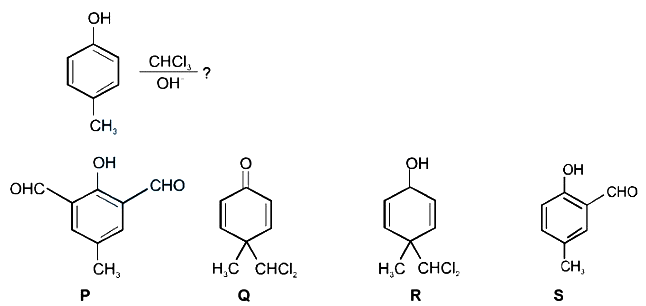 JEE Advanced 2013 Medium
 - In an atom, the total number of electrons having quantum numbers and isJEE Advanced 2014 Easy
More PYQs from JEE Advanced
- Match the reactions in List-I with the features of their products in List-II and choose the correct option.
List - I List - II (P) 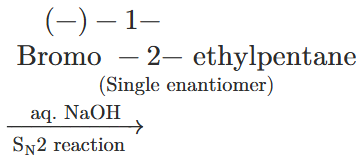
1. Inversion of configuration (Q) 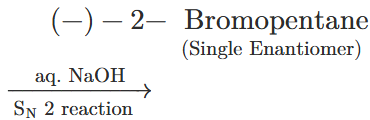
2. Retention of configuration (R) 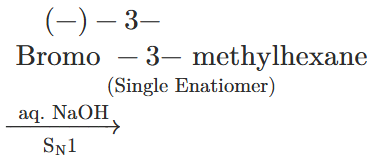
3. Mixture of enantiomers (S) 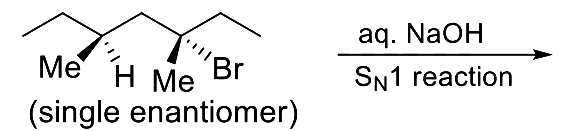
4. Mixture of structural isomers 5. Mixture of diastereomers JEE Advanced 2023 Hard - Starting at time from the origin with speed , a particle follows a two-dimensional trajectory in the plane so that its coordinates are related by the equation . The and components of its acceleration are denoted by and , respectively. ThenJEE Advanced 2020 Medium
- Paragraph:
Consider a simple \(R C\) circuit as shown in Figure \(1\).
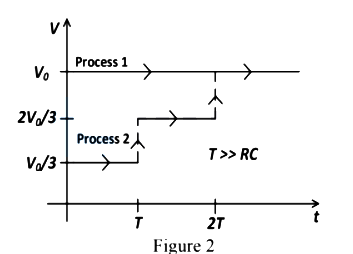
Process 1: In the circuit the switch \(S\) is closed at \(t=0\) and the capacitor is fully charged to voltage \(V_{0}\) (i.e., charging continues for time \(T>>R C\) ). In the process some dissipation \(\left(E_{D}\right)\) occurs across the resistance \(R\). The amount of energy finally stored in the fully charged capacitor is \(E_{C}\).
Process 2: In a different process the voltage is first set to \(\frac{V_{0}}{3}\) and maintained for a charging time \(T>>R C\). Then the voltage is raised to \(\frac{2 V_{0}}{3}\) without discharging the capacitor and again maintained for a time \(T>>R C\). The process is repeated one more time by raising the voltage to \(V_{0}\) and the capacitor is charged to the same final voltage \(V_{0}\) as in Process 1.
These two processes are depicted in Figure \(2 .\)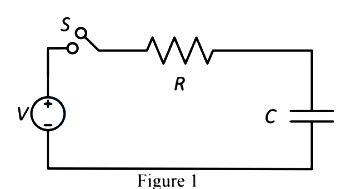
Question:
In Process 2, total energy dissipated across the resistance \(E_{D}\) is:JEE Advanced 2017 Medium - The total number of lone pairs of electrons in melamine isJEE Advanced 2013 Easy
- If where the inverse trigonometric functions take only the principal values, then the correct options(s) is(are)JEE Advanced 2015 Medium
- Liquids and form ideal solution for all compositions of and at . Two such solutions with and mole fractions of have the total vapor pressures of and bar, respectively. What is the vapor pressure of pure liquid in bar?JEE Advanced 2020 Medium