


JEE Advanced · Chemistry · 9. Redox Reactions
Paragraph :
Redox reaction play a pivotal role in chemistry and biology. The values of standard redox potential \(\left(E^{\circ}\right)\) of two half-cell reactions decide which way the reaction is expected to proceed. A simple example is a Daniel cell in which zinc goes into solution and copper gets deposited. Given below are a set of half-cell reactions (acidic medium) along with their \(E^{\circ}(V\) with respect to normal hydrogen electrode) values. Using this data obtain the correct explanations to Questions 14-19.
\(\mathrm{I}_2+2 e^{-} \longrightarrow 2 \mathrm{I}^{-} E^{\circ}=0.54 \)
\( \mathrm{Cl}_2+2 e^{-} \longrightarrow 2 \mathrm{Cl}^{-} E^{\circ}=1.36 \)
\( \mathrm{Mn}^{3+}+e^{-} \longrightarrow \mathrm{Mn}^{2+} E^{\circ}=1.50 \)
\( \mathrm{Fe}^{3+}+e^{-} \longrightarrow \mathrm{Fe}^{2+} E^{\circ}=0.77 \)
\( \mathrm{O}_2+4 \mathrm{H}^{+}+4 e^{-} \longrightarrow 2 \mathrm{H}_2 \mathrm{O} E^{\circ}=1.23\)
Question :
Sodium fusion extract, obtained from aniline, on treatment with iron (II) sulphate and \(\mathrm{H}_2 \mathrm{SO}_4\) in presence of air gives a prussian blue precipitate. The blue colour is due to the formation of
- A \(\mathrm{Fe}_4\left[\mathrm{Fe}(\mathrm{CN})_6\right]_3\)
- B \(\mathrm{Fe}_3\left[\mathrm{Fe}(\mathrm{CN})_6\right]_2\)
- C \(\mathrm{Fe}_4\left[\mathrm{Fe}(\mathrm{CN})_6\right]_2\)
- D \(\mathrm{Fe}_3\left[\mathrm{Fe}(\mathrm{CN})_6\right]_3\)
Answer & Solution
Correct Answer
(A) \(\mathrm{Fe}_4\left[\mathrm{Fe}(\mathrm{CN})_6\right]_3\)
Step-by-step Solution
Detailed explanation
\(\text{Na} +\text C +\text N \longrightarrow \underset{\text {Sodium extract}}{\text{NaCN}}\)
\(\text{Fe} ^{2+}+6 \text{CN} ^{-} \longrightarrow\left[\text{Fe} (\text{CN})_6\right]_2\)
\(4 \text{Fe} ^{3+}+3\left[\text{Fe} (\text{CN})_6\right]^{4-} \longrightarrow \underset{\text {Prussian blue ppt.}}{\text{Fe} _4\left[\text{Fe} (\text{CN})_6\right]_3}\)
\(\text{Fe} ^{2+}+6 \text{CN} ^{-} \longrightarrow\left[\text{Fe} (\text{CN})_6\right]_2\)
\(4 \text{Fe} ^{3+}+3\left[\text{Fe} (\text{CN})_6\right]^{4-} \longrightarrow \underset{\text {Prussian blue ppt.}}{\text{Fe} _4\left[\text{Fe} (\text{CN})_6\right]_3}\)
See the Complete Solution
Get step-by-step explanations for this and 2.5 Lakh+ more JEE, NEET & CET questions.
- Unlock all solutions
- Practice the full chapter
- Track accuracy across PYQs
4.8 rated on Google Play · 14,000+ reviews
More questions from Chemistry
- In \(1 \mathrm{~L}\) saturated solution of \(\mathrm{AgCl}\left[K_{\mathrm{sp}} \mathrm{AgCl}=1.6 \times 10^{-10}\right], 0.1\) mole of \(\mathrm{CuCl}\left[K_{\mathrm{sp}}(\mathrm{CuCl})=1.0 \times 10^{-6}\right]\) is added. The resultant concentration of \(\mathrm{Ag}^{+}\)in the solution is \(1.6 \times 10^{-x}\). The value of \(x\) isJEE Advanced 2011 Medium
- Paragraph: When potassium iodide is added to an aqueous solution of potassium ferricyanide, a reversible reaction is observed in which a complex \(\mathbf{P}\) is formed. In a strong acidic medium, the equilibrium shifts completely towards \(\mathbf{P}\). Addition of zinc chloride to \(\mathbf{P}\) in a slightly acidic medium results in a sparingly soluble complex Q.
Question: The number of zinc ions present in the molecular formula of \(\mathbf{Q}\) isJEE Advanced 2024 Medium - Based on VSEPR model, match the xenon compounds given in List-I with the corresponding geometries and the number of lone pairs on xenon given in List-II and choose the correct option.
List - I List - II (P) \(XeF _2\) (1) Trigonal bipyramidal and two lone pair of electrons (Q) \(XeF _4\) (2) Tetrahedral and one lone pair of electrons (R) \(XeO _3\) (3) Octahedral and two lone pair of electrons (S) \(XeO _3 F_2\) (4) Trigonal bipyramidal and no lone pair of electrons (5) Trigonal bipyramidal and three lone pair of electrons JEE Advanced 2024 Medium - The reaction of and gives a compound . The number of moles of produced by the complete hydrolysis of of is _____ .JEE Advanced 2022 Easy
- A closed vessel contains \(10 \mathrm{~g}\) of an ideal gas \(\mathbf{X}\) at \(300 \mathrm{~K}\), which exerts 2 atm pressure. At the same temperature, \(80 \mathrm{~g}\) of another ideal gas \(\mathbf{Y}\) is added to it and the pressure becomes \(6 \mathrm{~atm}\). The ratio of root mean square velocities of \(\mathbf{X}\) and \(\mathbf{Y}\) at \(300 \mathrm{~K}\) isJEE Advanced 2024 Medium
- A solution when diluted with \(\mathrm{H}_2 \mathrm{O}\) and boiled, it gives a white precipitate. On addition of excess \(\mathrm{NH}_4 \mathrm{Cl} / \mathrm{NH}_4 \mathrm{OH}\), the volume of precipitate decreases leaving behind a white gelatinous precipitate. Identify the precipitate which dissolves in \(\mathrm{NH}_4 \mathrm{OH} / \mathrm{NH}_4 \mathrm{Cl}\).JEE Advanced 2006 Hard
More PYQs from JEE Advanced
- The total number of ways in which 5 balls of different colours can be distributed among 3 persons so that each person gets at least one ball isJEE Advanced 2012 Hard
- In a particular system of units, a physical quantity can be expressed in terms of the electric charge , electron mass . Planck's constant , and Coulomb's constant , where is the permittivity of vacuum. In terms of these physical constants, the dimension of the magnetic field is . The value of is _______.JEE Advanced 2022 Medium
- Match the chemical substance in Column I with type of polymers/type of bond in Column II. Indicate your answer by darkening the appropriate bubbles of \(4 \times 4\) matrix given in the ORS.
Column I Column II A. Cellulose p. Natural polymer B. Nylon-6,6 q. Synthetic polymer C. Protein r. Amide linkage D. Sucrose s. Glycoside linkage JEE Advanced 2007 Easy - Paragraph:
Carbon-14 is used to determine the age of organic material. The procedure is based on the formation of \({ }^{14} \mathrm{C}\) by neutron capture in the upper atmosphere.
\(
{ }_7^{14} \mathrm{~N}+{ }_0^1 n \longrightarrow{ }_6^{14} \mathrm{C}+{ }_1 n^1
\)
\({ }^{14} \mathrm{C}\) is absorbed by living organisms during photosynthesis. The \({ }^{14} \mathrm{C}\) content is constant in living organism once the plant or animal dies, the uptake of carbon dioxide by it ceases and the level of \({ }^{14} \mathrm{C}\) in the dead being, falls to the decay which \({ }^{14} \mathrm{C}\) undergoes.
\(
{ }_6^{14} \mathrm{C} \longrightarrow{ }_7^{14} \mathrm{~N}+\beta^{-}
\)
The half life period of \({ }^{14} \mathrm{C}\) is 5770 years. The decay constant \((\lambda)\) can be calculated by using the following formula \(\lambda=\frac{0.693}{t_{1 / 2}}\).
The comparison of the \(\beta^{-}\)activity of the dead matter with that of the carbon still in circulation enables measurement of the period of the isolation of the material from the living cycle. The method however, ceases to be accurate over periods longer than 30,000 years. The proportion of \({ }^{14} \mathrm{C}\) to \({ }^{12} \mathrm{C}\) in living matter is \(1: 10^{12}\).
Question:
Which of the following option is correct?JEE Advanced 2006 Medium - Let \(a_{1}, a_{2}, a_{3}, \ldots . .\) be in harmonic progression with \(a_{1}=5\) and \(a_{20}=25\). The least positive integer \(n\) for which \(a_{n} < 0\) isJEE Advanced 2012 Medium
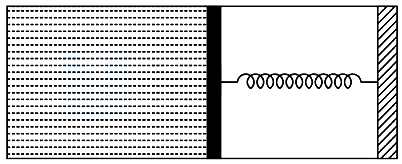
- An ideal monoatomic gas is confined in a horizontal cylinder by a spring loaded piston (as shown in the figure).Initially the gas is at temperature , pressure and volume and the spring is in its relaxed state. The gas is then heated very slowly to temperature , pressure and volume . During this process the piston moves out by a distance . Ignoring the friction between the piston the cylinder, the correct statement(s) is (are)
 JEE Advanced 2015 Medium