


JEE Advanced · Chemistry · 6. Thermodynamics (C)
For the reaction, \(2 \mathrm{CO}+\mathrm{O}_2 \rightarrow 2 \mathrm{CO}_2 ; \Delta H=-560 \mathrm{~kJ}\). Two moles of \(\mathrm{CO}\) and one mole of \(\mathrm{O}_2\) are taken in a container of volume \(1 \mathrm{~L}\). They completely form two moles of \(\mathrm{CO}_2\), the gases deviate appreciably from ideal behaviour. If the pressure in the vessel changes from 70 to \(40 \mathrm{~atm}\), find the magnitude (absolute value) of \(\Delta U\) at \(500 \mathrm{~K} .(1 \mathrm{~L}-\mathrm{atm}=0.1 \mathrm{~kJ})\)
- A -557
- B -667
- C -645
- D -145
Answer & Solution
Correct Answer
(A) -557
Step-by-step Solution
Detailed explanation
\(\because \Delta H=\Delta U+\Delta(P V) \)
\( \text {or } \Delta H=\Delta U+V \Delta P \)
\( \text {or } \Delta U=\Delta H-V \Delta P\)
Given that, \(\Delta H=-560 \mathrm{~kJ}\)
\(
\Delta P=40-70=-30 \mathrm{~atm}
\)
\(\therefore V \Delta P =1 \mathrm{~L} \times-30 \mathrm{~atm}=-30 \mathrm{~L} \text { atom } \)
\( 1 \mathrm{~L} \text {-atom } =0.1 \mathrm{~kJ} \)
\( \therefore V \Delta P =-30 \times 0.1 \mathrm{~kJ} \)
\( \therefore \Delta U =-560-(-30 \times 0.1)=-557 \mathrm{~kJ}\)
\( \text {or } \Delta H=\Delta U+V \Delta P \)
\( \text {or } \Delta U=\Delta H-V \Delta P\)
Given that, \(\Delta H=-560 \mathrm{~kJ}\)
\(
\Delta P=40-70=-30 \mathrm{~atm}
\)
\(\therefore V \Delta P =1 \mathrm{~L} \times-30 \mathrm{~atm}=-30 \mathrm{~L} \text { atom } \)
\( 1 \mathrm{~L} \text {-atom } =0.1 \mathrm{~kJ} \)
\( \therefore V \Delta P =-30 \times 0.1 \mathrm{~kJ} \)
\( \therefore \Delta U =-560-(-30 \times 0.1)=-557 \mathrm{~kJ}\)
See the Complete Solution
Get step-by-step explanations for this and 2.5 Lakh+ more JEE, NEET & CET questions.
- Unlock all solutions
- Practice the full chapter
- Track accuracy across PYQs
4.8 rated on Google Play · 14,000+ reviews
More questions from Chemistry
- Silver (atomic weight \(=108 \mathrm{~g} \mathrm{~mol}^{-1}\) ) has a density of \(10.5 \mathrm{~g} \mathrm{~cm}^{-3}\). The number of silver atoms on a surface of area \(10^{-12} \mathrm{~m}^2\) can be expressed in scientific notation as \(y \times 10^x\). The value of \(x\) isJEE Advanced 2010 Easy
- Among the following compounds, the most acidic isJEE Advanced 2011 Medium
- The order of the oxidation state of the phosphorus atom in and isJEE Advanced 2017 Easy
- The number of geometric isomers possible for the complex is
JEE Advanced 2016 Medium - Paragraph:
A fixed mass of a gas is subjected to transformation of states from to to to and back to as shown in the figure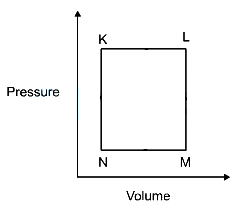
Question :
The pair of isochoric processes among the transformation of states isJEE Advanced 2013 Easy - An aqueous solution of X is added slowly to an aqueous solution of Y as shown in List I. The variation in conductivity of these reactions is given in List II. Match List I with List II and select the correct using answer the code given below the lists :
List - I List - II a. \(\underset{\quad\quad~~ X }{( C _2 H _5)_3 N}+\underset{ Y }{CH _3 COOH}\) p. Conductivity decreases and then increases b. \(\underset{\quad\quad~~ X }{KI (0.1 M )}+\underset{ Y }{AgNO _3(0.01 M )}\) q. Conductivity decreases and then does not change much c. \(\underset{\text X }{CH _3 COOH}+\underset{\text Y }{KOH}\) r. Conductivity increases and then
does not change muchd. \(\underset{\text X }{NaOH}+\underset{\text Y }{HI}\) s. Conductivity does not change much and
then increasesJEE Advanced 2013 Medium
More PYQs from JEE Advanced
- In the following reaction sequence, the major product \(\mathbf{P}\) is formed.
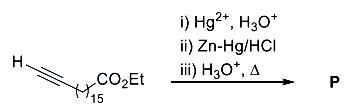
Glycerol reacts completely with excess \(\mathbf{P}\) in the presence of an acid catalyst to form \(\mathbf{Q}\). Reaction of \(\mathbf{Q}\) with excess \(\mathrm{NaOH}\) followed by the treatment with \(\mathrm{CaCl}_2\) yields Ca-soap \(\mathbf{R}\), quantitatively. Starting with one mole of \(\mathbf{Q}\), the amount of \(\mathbf{R}\) produced in gram is ________.
[Given, atomic weight: \(\mathrm{H}=1, \mathrm{C}=12,\) \(\mathrm{~N}=14, \mathrm{O}=16, \mathrm{Na}=23, \mathrm{Cl}=35,\) \(\mathrm{Ca}=40\)]JEE Advanced 2024 Easy - Paragraph:
Tangents are drawn from the point \(P(3,4)\) to the ellipse \(\frac{x^2}{9}+\frac{y^2}{4}=1\) touching the ellipse at points \(A\) and \(B\).Question:
The coordinates of \(A\) and \(B\) areJEE Advanced 2010 Medium - Paragraph:
Tollen's reagent is used for the detection of aldehyde when a solution of \(\mathrm{AgNO}_3\) is added to glucose with \(\mathrm{NH}_4 \mathrm{OH}\) then gluconic acid is formed
\(\mathrm{Ag}^{+}+e^{-} \rightarrow \mathrm{Ag} E_{\text {red }}^{\circ}=0.8 \mathrm{~V} \)
\( \mathrm{C}_6 \mathrm{H}_{12} \mathrm{O}_6+\mathrm{H}_2 \mathrm{O} \rightarrow \text { Gluconic acid }\left(\mathrm{C}_6 \mathrm{H}_{12} \mathrm{O}_7\right)\) \(+~2 \mathrm{H}^{+}+2 e^{-} ; -E_{\mathrm{red}}^{\circ}=-0.05 \mathrm{~V} \)
\( \mathrm{Ag}\left(\mathrm{NH}_3\right)_2^{+}+e^{-} \rightarrow \mathrm{Ag}(s)+2 \mathrm{NH}_3 ; E_{\mathrm{red}}^{\circ}\) \(=0.337 \mathrm{~V}\)
[Use \(2.303 \times \frac{R T}{F}=0.0592\) and \(\frac{F}{R T}=38.92\) at \(298 \mathrm{~K}\)]
Question:
\(2 \mathrm{Ag}^{+}+\mathrm{C}_6 \mathrm{H}_{12} \mathrm{O}_6+\mathrm{H}_2 \mathrm{O} \rightarrow 2 \mathrm{Ag}(\mathrm{s})\) \(+~\mathrm{C}_6 \mathrm{H}_{12} \mathrm{O}_4+2 \mathrm{H}^{+}\). Find \(\ln \mathrm{K}\) of this reaction.JEE Advanced 2006 Medium - A container has a base of and height , as shown in the figure. It has two parallel electrically conducting walls each of area . The remaining walls of the container are thin and non-conducting. The container is being filled with a liquid of dielectric constant at a uniform rate of . What is the value of the capacitance of the container after seconds?
[Given: Permittivity of free space , the effects of the non-conducting walls on the capacitance are negligible]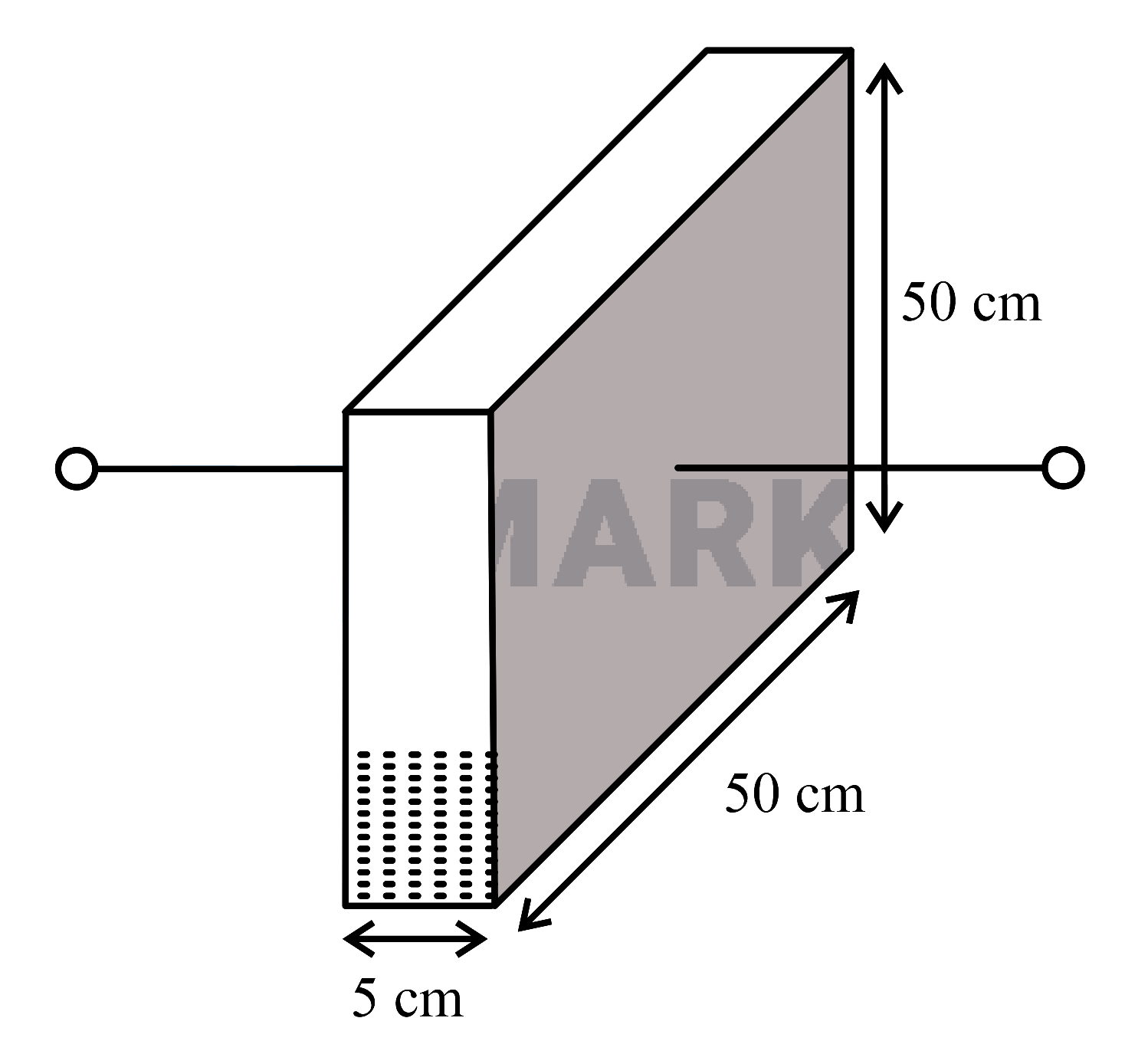 JEE Advanced 2023 Medium
 - Let \(E^c\) denotes the complement of an event \(E\). Let \(E, F, G\) be pairwise independent events with \(P(G)>0\) and \(P(E \cap F \cap G)=0\). Then, \(P\left(E^c \cap F^c \mid G\right)\) equalsJEE Advanced 2007 Medium
- Statement 1 There is a natural asymmetry between converting work to heat and converting heat to work.
Statement 2 No process is possible in which the sole result in the absorption of heat from a reservoir and its complete conversion into work.JEE Advanced 2008 Hard