


JEE Advanced · Mathematics · 32. Probability
Let \(E^c\) denotes the complement of an event \(E\). Let \(E, F, G\) be pairwise independent events with \(P(G)>0\) and \(P(E \cap F \cap G)=0\). Then, \(P\left(E^c \cap F^c \mid G\right)\) equals
- A
\(P\left(E^c\right)+P\left(F^c\right)\)
- B
\(P\left(E^c\right)-P\left(F^c\right)\)
- C
\(P\left(E^c\right)-P(F)\)
- D
\(P(E)-P\left(F^c\right)\)
Answer & Solution
Correct Answer
(C)
\(P\left(E^c\right)-P(F)\)
Step-by-step Solution
Detailed explanation
\[
\text { } \begin{aligned}
P\left(\frac{E^c \cap F^c}{G}\right) & =\frac{P\left(E^c \cap F^c \cap G\right)}{P(G)} \\
& =\frac{P(G)-P(E \cap G)-P(G \cap F)}{P(G)} \\
& =\frac{P(G)[1-P(E)-P(F)]}{P(G)} \\
& =1-P(E)-P(F) \\
& =P\left(E^c\right)-P(F) .
\end{aligned}
\]
\text { } \begin{aligned}
P\left(\frac{E^c \cap F^c}{G}\right) & =\frac{P\left(E^c \cap F^c \cap G\right)}{P(G)} \\
& =\frac{P(G)-P(E \cap G)-P(G \cap F)}{P(G)} \\
& =\frac{P(G)[1-P(E)-P(F)]}{P(G)} \\
& =1-P(E)-P(F) \\
& =P\left(E^c\right)-P(F) .
\end{aligned}
\]
See the Complete Solution
Get step-by-step explanations for this and 2.5 Lakh+ more JEE, NEET & CET questions.
- Unlock all solutions
- Practice the full chapter
- Track accuracy across PYQs
4.8 rated on Google Play · 14,000+ reviews
More questions from Mathematics
- Let \(\vec{w}=\hat{i}+\hat{j}-2 \hat{k}\), and \(\overrightarrow{\mathrm{u}}\) and \(\overrightarrow{\mathrm{v}}\) be two vectors such that \(\vec{u} \times \vec{v}=\vec{w}\) and \(\vec{v} \times \vec{w}=\vec{u}\). Let \(\alpha, \beta, \gamma\) and \(t\) be real numbers such that \(\vec{u}=\alpha \hat{i}+\beta \hat{j}+\gamma \hat{k},-t \alpha+\beta+\gamma=0, \alpha-t \beta+\gamma=0\), and \(\alpha+\beta-t \gamma=0\).
Match each entry in List-I to the correct entry in List-II and choose the correct option.
LIST - I LIST - II (P) \(|\vec{v}|^2\) is equal to (1) 0 (Q) If \(\alpha=\sqrt{3}\),then \(\gamma^2\) is equal to (2) 1 (R) If \(\alpha=\sqrt{3}\),then \((\beta+\gamma)^2\) is equal to (3) 2 (S) If \(\alpha=\sqrt{2}\),then \(t+3\) is equal to (4) 3 (5) 5 JEE Advanced 2025 Hard - If the function is defined by , then which of the following statements is TRUE?JEE Advanced 2020 Easy
- A signal which can be green or red with probability \(\frac{4}{5}\) and \(\frac{1}{5}\) respectively, is received by station \(A\) and then transmitted to station B. The probability of each station receiving the signal correctly is \(\frac{3}{4}\). If the signal received at station \(B\) is green, then the probability that the original signal green isJEE Advanced 2010 Hard
- Let \(S_1=\{(i, j, k): i, j, k \in\{1,2, \ldots, 10\}\}\)
\(S_2=\{(i, j): 1 \leq i < j+2 \leq 10, i, j\) \(\in\{1,2, \ldots, 10\}\} \)
\(S_3=\{(i, j, k, l): 1 \leq i < j < k < l, i,\) \(j, k, l \in\{1,2, \ldots . ., 10\}\}\)
and \(S_4=\{(i, j, k, l): i, j, k\) and \(l\) are distint elements in \(\{1,2, \ldots, 10\}\}\) If the total number of elements in the set \(S_r\) is \(n_r, r=1,2,3,4\) then which of the following statements is (are) TRUE?JEE Advanced 2021 Medium - Four persons independently solve a certain problem correctly with probabilities . Then the probability that the problem is solved correctly by at least one of them isJEE Advanced 2013 Medium
- Let . If contains exactly one positive integer , then the value of isJEE Advanced 2023 Easy
More PYQs from JEE Advanced
- Based on VSEPR model, match the xenon compounds given in List-I with the corresponding geometries and the number of lone pairs on xenon given in List-II and choose the correct option.
List - I List - II (P) \(XeF _2\) (1) Trigonal bipyramidal and two lone pair of electrons (Q) \(XeF _4\) (2) Tetrahedral and one lone pair of electrons (R) \(XeO _3\) (3) Octahedral and two lone pair of electrons (S) \(XeO _3 F_2\) (4) Trigonal bipyramidal and no lone pair of electrons (5) Trigonal bipyramidal and three lone pair of electrons JEE Advanced 2024 Medium - Consider an experiment of tossing a coin repeatedly until the outcomes of two consecutive tosses are same. If the probability of a random toss resulting in head is , then the probability that the experiment stops with head isJEE Advanced 2023 Medium
- The value of is_____.JEE Advanced 2018 Easy
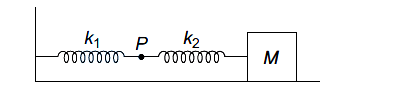
- The mass \(M\) shown in the figure oscillates in simple harmonic motion with amplitude \(A\). The amplitude of the point \(P\) is
 JEE Advanced 2009 Easy
 - A positive point charge of \(10^{-8} \mathrm{C}\) is kept at a distance of 20 cm from the center of a neutral conducting sphere of radius 10 cm . The sphere is then grounded and the charge on the sphere is measured. The grounding is then removed and subsequently the point charge is moved by a distance of 10 cm further away from the center of the sphere along the radial direction. Taking \(\frac{1}{4 \pi \epsilon_0}=9 \times 10^9 \mathrm{Nm}^2 / \mathrm{C}^2\) (where \(\epsilon_0\) is the permittivity of free space), which of the following
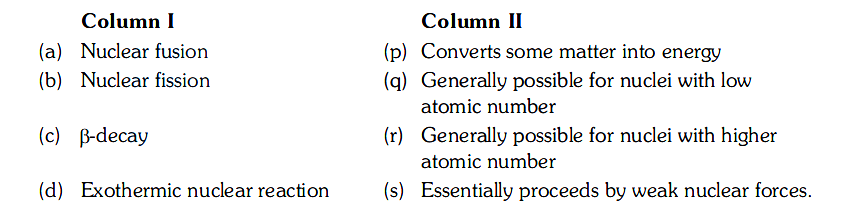
statements is/are correct: :JEE Advanced 2025 Medium - Match the following columns
 JEE Advanced 2006 Medium