


JEE Advanced · Chemistry · 12. p Block (G13-14)
All the compounds listed in Column I react with water. Match the result of the respective reactions with the appropriate options listed in Column II.
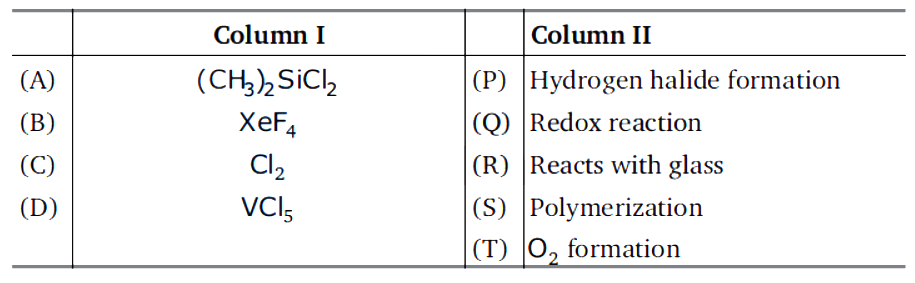
- A (A) P,Q, (B) P,Q,R,T, (C) P,Q,T, (D) P
- B (A) P,Q, (B) P,Q,T, (C) P,Q,R,T, (D) Q
- C (A) P,S, (B) P,Q,R,T, (C) P,Q,T, (D) P
- D (A) P,S, (B) P,Q,T, (C) P,Q,R,T, (D) Q
Answer & Solution
Correct Answer
(C) (A) P,S, (B) P,Q,R,T, (C) P,Q,T, (D) P
Step-by-step Solution
Detailed explanation

\(3 \mathrm{XeF}_4+6 \mathrm{H}_2 \mathrm{O} \longrightarrow \mathrm{XeO}_3+2 \mathrm{Xe}+\frac{3}{2} \mathrm{O}_2\) \(+~12 \mathrm{HF} \)
\(\mathrm{Cl}_2+\mathrm{H}_2 \mathrm{O} \longrightarrow 2 \mathrm{HCl}+\frac{1}{2} \mathrm{O}_2 \)
\(\mathrm{VCl}_5+\mathrm{H}_2 \mathrm{O} \longrightarrow \mathrm{VOCl}_3+2 \mathrm{HCl} \)
\(\text {Representative elements} \)
\(\text {Factual} \)
\(\text {III}\)}
See the Complete Solution
Get step-by-step explanations for this and 2.5 Lakh+ more JEE, NEET & CET questions.
- Unlock all solutions
- Practice the full chapter
- Track accuracy across PYQs
4.8 rated on Google Play · 14,000+ reviews
More questions from Chemistry
- An electrochemical cell is fueled by the combustion of butane at 1 bar and 298 K . Its cell potential is \(\frac{\boldsymbol{X}}{\boldsymbol{F}} \times 10^3\) volts, where \(\boldsymbol{F}\) is the Faraday constant. The value of \(\boldsymbol{X}\) is \(\qquad\) .
Use : Standard Gibbs energies of formation at 298 K are : \(\Delta_f G_{\mathrm{CO}_2}^{\circ}=-394 \mathrm{~kJ} \mathrm{~mol}^{-1}\);
\(\Delta_f G_{\text {water }}^{\circ}=-237 \mathrm{~kJ} \mathrm{~mol}^{-1} ; \Delta_f G_{\text {butane }}^{\circ}\) \(=-18 \mathrm{~kJ} \mathrm{~mol}^{-1}\)JEE Advanced 2025 Hard - Match the thermodynamic processes given under Column I with the expressions given under Column II.
Column I Column II A. Freezing of water at 273 K and 1 atm P. B. Expansion of 1 mol of an ideal gas into a vacuum under isolated conditions Q. C. Mixing of equal volumes of two ideal gases at constant temperature and pressure in an isolated container R. D. Reversible heating of at 1 atm from 300 K to 600 K, followed by reversible cooling to 300 K at 1 atm S. T. JEE Advanced 2015 Hard - Consider the following statements related to colloids.
(I) Lyophobic colloids are not formed by simple mixing of dispersed phase and dispersion medium.
(II) For emulsions, both the dispersed phase and the dispersion medium are liquid.
(III) Micelles are produced by dissolving a surfactant in any solvent at any temperature.
(IV) Tyndall effect can be observed from a colloidal solution with dispersed phase having the same refractive index as that of the dispersion medium.
The option with the correct set of statements isJEE Advanced 2023 Medium - Match the anionic species given in Column I that are present in the ores(s) given in Column II.
Column I Column II A. Carbonate P. Siderite B. Sulphide Q. Malachite C. Hydroxide R. Bauxite D. Oxide S. Calamine T. Argentite JEE Advanced 2015 Easy - The correct option(s) regarding the complex :-
(en ) is (are)JEE Advanced 2018 Medium - The reaction of and gives a compound . The number of moles of produced by the complete hydrolysis of of is _____ .JEE Advanced 2022 Easy
More PYQs from JEE Advanced
- A heavy nucleus of half-life minutes undergoes alpha-decay with probability of and beta-decay with probability of . Initially, the number of nuclei is . The number of alpha-decays of in the first one hour is:JEE Advanced 2021 Easy
- Paragraph:
Reimer-Tiemann reaction introduces an aldehyde group, on to the aromatic ring of phenol, ortho to the hydroxyl group. This reaction involves electrophilic aromatic substitution. This is a general method for the synthesis of substituted salicylaldehydes as depicted below.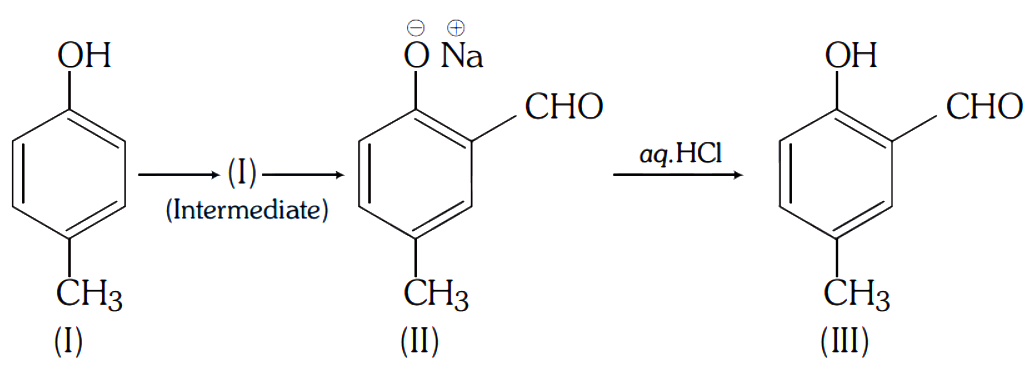
Question:
Which one of the following reagents is used the above reaction?JEE Advanced 2007 Medium - A ray of light travelling in water is incident on its surface open to air. The angle of incidence is \(\theta\), which is less than the critical angle. Then there will beJEE Advanced 2007 Medium
- Consider a spherical gaseous cloud of mass density in free space where is the radial distance from its center. The gaseous cloud is made of particles of equal mass m moving in circular orbits about the common center with the same kinetic energy . The force acting on the particles is their mutual gravitational force. If is constant in time, the particle number density is: [ is universal gravitational constant]JEE Advanced 2019 Hard
- Paragraph:
The reaction of compound \(\mathbf{P}\) with \(\mathrm{CH}_{3} \mathrm{MgBr}\) (excess) in \(\left(\mathrm{C}_{2} \mathrm{H}_{5}\right)_{2} \mathrm{O}\) followed by addition of \(\mathrm{H}_{2} \mathrm{O}\) gives \(\mathbf{Q}\). The compound \(\mathbf{Q}\) on treatment with \(\mathrm{H}_{2} \mathrm{SO}_{4}\) at \(0^{\circ} \mathrm{C}\) gives \(\mathbf{R}\). The reaction of \(\mathbf{R}\) with \(\mathrm{CH}_{3} \mathrm{COCl}\) in the presence of anhydrous \(\mathrm{AlCl}_{3}\) in \(\mathrm{CH}_{2} \mathrm{Cl}_{2}\) followed by treatment with \(\mathrm{H}_{2} \mathrm{O}\) produces compound \(\mathbf{S}\). [Et in compound \(\mathbf{P}\) is ethyl group]
Question :
The reactions, \(\mathbf{Q}\) to \(\mathbf{R}\) and \(\mathbf{R}\) to \(\mathbf{S}\), areJEE Advanced 2017 Hard - Paragraph:
An acylic hydrocarbon \(P\), having molecular formula \(\mathrm{C}_6 \mathrm{H}_{10}\), gave acetone as the only organic product through the following sequence of reactions, in which \(Q\) is an intermediate organic compounds.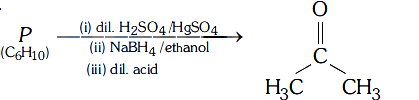
Question:
The structure of compound P isJEE Advanced 2011 Medium