


JEE Advanced · Chemistry · 21. p Block (G15-18)
The reaction of and gives a compound . The number of moles of produced by the complete hydrolysis of of is _____ .
- A 2
- B 4
- C 6
- D 8
Answer & Solution
Correct Answer
(B) 4
Step-by-step Solution
Detailed explanation
\(\underset{(\text P )}{6\text{ XeF} _4}+12\text H _2\text O \longrightarrow 4 \text{Xe} +2\text{ XeO} _3+24 \text{HF}\) \(+~3\text O _2\)
Number of moles of formed by complete hydrolysis of mole of
See the Complete Solution
Get step-by-step explanations for this and 2.5 Lakh+ more JEE, NEET & CET questions.
- Unlock all solutions
- Practice the full chapter
- Track accuracy across PYQs
4.8 rated on Google Play · 14,000+ reviews
More questions from Chemistry
- The pair(s) of complexes wherein both exhibit tetrahedral geometry is(are)
(Note: pyridine Given: Atomic numbers of and are and , respectively)JEE Advanced 2021 Medium - Paragraph:
The amount of energy required to break a bond is same as the amount of energy released when the same bond is formed. In gaseous state, the energy required for homolytic cleavage of a bond is called Bond Dissociation Energy (BDE) or Bond Strength. BDE is affected by \(s\)-character of the bond and the stability of the radicals formed. Shorter bonds are typically stronger bonds. BDEs for some bonds are given below:



Question:
Correct match of the \(\mathbf{C}-\mathbf{H}\) bonds (shown in bold) in Column \(\mathbf{J}\) with their BDE in Column \(\mathbf{K}\) is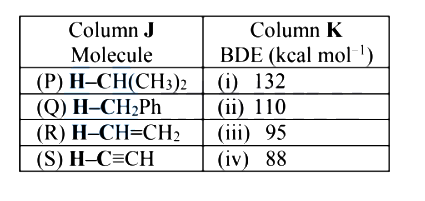 JEE Advanced 2021 Medium
 - Not considering the electronic spin, the degeneracy of the second excited state (n = ) of H atom is , while the degeneracy of the second excited state of is :JEE Advanced 2015 Medium
- On dissolving of a non-volatile non-ionic solute to of benzene, its vapor pressure decreases from to The depression of freezing point of benzene (in ) upon addition of the solute is _______
(Given data: Molar mass and the molal freezing point depression constant of benzene are and respectively)JEE Advanced 2019 Hard - Hydrogen peroxide in its reaction with KIO4 and NH2OH respectively, is acting as aJEE Advanced 2014 Medium
- Match the reactions (in the given stoichiometry of the reactants) in List-I with one of their products given in List-II and choose the correct option.
List - I List - II (P) \(P _2 O _3\) \(+~3 H _2 O \rightarrow\) (1) \(P ( O )\left( OCH _3\right)\) \(Cl _2\) (Q) \(P _4+3 NaOH\) \(+~3 H _2 O \rightarrow\) (2) \(H _3 PO _3\) (R) \(PCl _5+ CH _3\) \(COOH \rightarrow\) (3) \(PH _3\) (S) \(H _3 PO _2\) \(+~2 H _2 O ~+\) \(4 AgNO _3 \rightarrow\) (4) \(POCL _3\) (5) \(H _3 PO _4\) JEE Advanced 2023 Medium
More PYQs from JEE Advanced
- On complete hydrogenation, natural rubber producesJEE Advanced 2016 Easy
- Paragraph:
Let \(A_1, G_1, H_1\) denote the arithmetic, geometric and harmonic means respectively, of two distinct positive numbers. For \(n \geq 2\), let \(A_{n-1}\) and \(H_{n-1}\) has arithmetic, geometric and harmonic means as \(A_n, G_n, H_n\), respectively.
Question:
Which of the following statements is correct?JEE Advanced 2007 Hard - The number of all possible values of \(\theta\), where \(0 < \theta < \pi\), for which the system of equations
\((y+z) \cos 3 \theta=(x y z) \sin 3 \theta \) \( x \sin 3 \theta=\frac{2 \cos 3 \theta}{y}+\frac{2 \sin 3 \theta}{z}\) and \((x y z) \sin 3 \theta=(y+2 z) \cos 3 \theta\) \(+y \sin 3 \theta\) have a solution \(\left(x_0, y_0, z_0\right)\) with \(\quad y_0 z_0 \neq 0\), isJEE Advanced 2010 Medium - A hot air balloon is carrying some passengers, and a few sandbags of mass each so that its total mass is . Its effective volume giving the balloon its buoyancy is . The balloon is floating at an equilibrium height of . When number of sandbags are thrown out, the balloon rises to a new equilibrium height close to with its volume remain unchanged. If the variation of the density of air with height from the ground is where and the value of is _________.JEE Advanced 2020 Hard
- Let be the set of all complex numbers satisfying If the complex number is such that is the maximum of the set then the principal argument of isJEE Advanced 2019 Medium
- Let \(p(x)\) be a real polynomial of least degree which has a local maximum at \(x=1\) and a local minimum at \(x=3\). If \(p(1)=6\) and \(p(3)=2\), then \(p^{\prime}(0)\) isJEE Advanced 2012 Medium