


AP EAMCET · PHYSICS · Oscillations
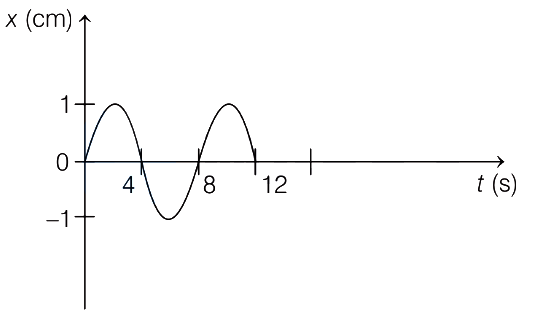
For a particle executing simple harmonic motion, the displacement-time \((x-t)\) graph is as shown in the figure. The acceleration of the particle at \(t=\frac{4}{3} \mathrm{~s}\) is
- A \(-\frac{\sqrt{3}}{32} \pi^2 \mathrm{~cm} \mathrm{~s}^{-2}\)
- B \(\frac{32}{\sqrt{3}} \pi^2 \mathrm{~cm} \mathrm{~s}^{-2}\)
- C \(+\frac{\sqrt{3}}{32} \pi \mathrm{cm} \mathrm{s}^{-2}\)
- D \(+\frac{32}{\sqrt{3}} \pi \mathrm{cm} \mathrm{s}^{-2}\)
Answer & Solution
Correct Answer
(A) \(-\frac{\sqrt{3}}{32} \pi^2 \mathrm{~cm} \mathrm{~s}^{-2}\)
Step-by-step Solution
Detailed explanation
The displacement-time graph shown in the figure is a sine wave, so the equation of displacement, \(x=1 \sin \omega t\) Here, \(\quad T=8 \mathrm{~s}\) (for a complete cycle) Hence, \(\omega=\frac{2 \pi}{T}=\frac{2 \pi}{8}=\frac{\pi}{4} \mathrm{rad} / \mathrm{s}\) and…
See the Complete Solution
Get step-by-step explanations for this and 2.5 Lakh+ more JEE, NEET & CET questions.
- Unlock all solutions
- Practice the full chapter
- Track accuracy across PYQs
4.8 rated on Google Play · 14,000+ reviews
More questions from PHYSICS
- Assertion (A) Propagation of light through an optical fibre is due to total internal reflection taking place at the core-clad interface.
Reason (R) Refractive index of the material of the core of the optical fibre is greater than that of air.AP EAMCET 2005 Easy - If a gaseous mixture consists of 3 moles of oxygen and 4 moles of argon at an absolute temperature T, then the total internal energy of the mixture is (neglect vibrational modes and R - Universal gas constant)AP EAMCET 2025 Medium
- A man who is running has half the kinetic energy of a boy of half his mass. The man speeds up by \(1 \mathrm{~ms}^{-1}\) and then has the same kinetic energy as the boy. The initial speed of the boy isAP EAMCET 2019 Easy
- A charged particle moving along a straight line path enters a uniform magnetic field of 4 mT at right angles to the direction of the magnetic field. If the specific charge of the charged particle is \(8 \times 10^7 \mathrm{C} \mathrm{kg}^{-1}\), the angular velocity of the particle in the magnetic field isAP EAMCET 2024 Easy
- A wall has two layers \(A\) and \(B\), each made of different materials. Both layers are of same thickness. But, the thermal conductivity of material \(A\) is twice that of \(B\). If in the steady state, the temperature difference across the wall is \(24^{\circ} \mathrm{C}\), then the temperature difference across the layer \(B\) isAP EAMCET 2021 Medium
- A block of mass \(m\) is placed on a smooth wedge of inclination \(\theta\). The whole system is accelerated horizontally so that the block does not slip on the wedge. The force exerted by the wedge on the block ( \(g\) is acceleration due to gravity) will beAP EAMCET 2020 Hard
More PYQs from AP EAMCET
- Which of the following conditions are not suitable for a spontaneous reaction?AP EAMCET 2022 Easy
- A four member committee is to be formed from a group containing 9 men and 5 women. If a committee is formed randomly, then the probability that it contains atleast one woman isAP EAMCET 2025 Medium
- The acceleration due to gravity at a height of \((\sqrt{2}-1) \mathrm{R}\) from the surface of the earth is
(Acceleration due to gravity on the surface of the earth \(=10 \mathrm{~m} \mathrm{~s}^{-2}\) and R is radius of the earth)AP EAMCET 2025 Medium - The value of for the equilibrium reaction:
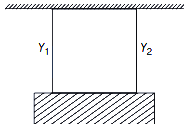
at is If the equilibrium concentration of is the concentration of in isAP EAMCET 2019 Easy - Two wires of equal length and equal cross sectional areas are suspended as shown in the figure. Their Young's modulii are \(Y_1\) and \(Y_2\), respectively. The equivalent Young's modulus is
 AP EAMCET 2019 Medium
 - Which statements among the following are correct about Helium?
(i) Liquid helium is used to sustain powerful superconducting magnets.
(ii) Liquid helium is useful to carry low temperature experiments.
(iii) It is a heavy gas.
(iv) It is a flammable gas.AP EAMCET 2021 Easy