


AP EAMCET · Maths · Pair of Lines
The point of intersection of the pair of lines \(x^2+x y+2 y^2-3 x+2 y+4=0\) is
- A \((1,2)\)
- B \((-1,2)\)
- C \((-2,1)\)
- D \((2,-1)\)
Answer & Solution
Correct Answer
(D) \((2,-1)\)
Step-by-step Solution
Detailed explanation
The point of intersection of the pair of lines \(f(x, y) \equiv x^2+x y+2 y^2-3 x+2 y+4=0\) is same as the intersection of curve obtaining after partial differentiating of the curve w.r.t. \(x\) and \(y\) respectively.…
See the Complete Solution
Get step-by-step explanations for this and 2.5 Lakh+ more JEE, NEET & CET questions.
- Unlock all solutions
- Practice the full chapter
- Track accuracy across PYQs
4.8 rated on Google Play · 14,000+ reviews
More questions from Maths
- Let be a function defined by . what is the value of ?AP EAMCET 2021 Easy
- \(f: R \rightarrow R\) is a function such that \(f(0)=1\) and for all \(x, y \in R f(x y+1)=f(x) f(y)-f(y)\), \(-x+2\), then \(\frac{d f}{d x}\) at \(x=e\) isAP EAMCET 2018 Medium
- The number of ways of arranging 2 red. 3 white and 5 yellow roses of different sizes into a garland such that no two yellow roses come together isAP EAMCET 2024 Easy
- A question paper contains 4 questions each having 4 alternative answers. The number of ways that a candidate can answer one or more questions isAP EAMCET 2017 Medium
- If \(\sin (2 x)=\frac{\sqrt{5}-1}{4}\) then \(x=\frac{n}{2} \pi+(-1)^n(m)\), \(n \in \mathbf{Z}\), find \(m\).AP EAMCET 2020 Easy
- The line \(x+y=1\) meets the lines represented by the equation \(y^3-6 x y^2+11 x^2 y-6 x^3=0\) at the points \(P, Q, R\). If \(O\) is the origin, then \((O P)^2+(O Q)^2+(O R)^2=\)AP EAMCET 2020 Medium
More PYQs from AP EAMCET
- If and thenAP EAMCET 2020 Medium
- The partial fraction of \(\frac{x^2}{x^2+3 x-4}\) isAP EAMCET 2021 Easy
- The major product \((\mathrm{X})\) formed in the given reaction is an example of
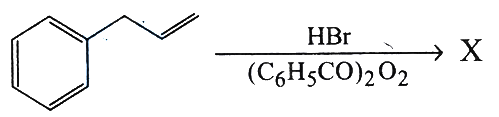 AP EAMCET 2024 Hard
 - Which of the following contain \(\alpha\)-D-glucose units ?
a) cane sugar
b) milk sugar
c) cellulose
d) amyloseAP EAMCET 2025 Medium - Which of the following statements are correct?
(i) \(\mathrm{NaH}(s)\) reacts violently with water to form \(\mathrm{NaOH}\) and \(\mathrm{H}_2\)
(ii) An example for electron rich hydride is \(\mathrm{NH}_3\)
(iii) Nickel forms saline hydrideAP EAMCET 2018 Easy - \((\mathbf{a}+\mathbf{b}) \cdot(\mathbf{b}+\mathbf{c}) \times(\mathbf{a}+\mathbf{b}+\mathbf{c})\) is equal toAP EAMCET 2002 Easy