


AP EAMCET · Maths · Application of Derivatives
If the function \(f(x)=x^3+b x^2+c x-6\) satisfies all the conditions of Rolle's theorem in \([1,3]\) and \(f^{\prime}\left(\frac{2 \sqrt{3}+1}{\sqrt{3}}\right)=0\), then \(b c=\)
- A \(18\)
- B \(-66\)
- C \(38\)
- D \(-46\)
Answer & Solution
Correct Answer
(B) \(-66\)
Step-by-step Solution
Detailed explanation
\(f(1)=f(3)\) \(1^3+b(1)^2+c(1)-6 = 3^3+b(3)^2+c(3)-6\) \(1+b+c-6 = 27+9b+3c-6\) \(b+c-5 = 9b+3c+21\) \(8b+2c = -26 \implies 4b+c=-13 \quad (1)\) \(f'(x) = 3x^2+2bx+c\) Let \(x_0 = \frac{2\sqrt{3}+1}{\sqrt{3}} = 2+\frac{1}{\sqrt{3}}\).…
See the Complete Solution
Get step-by-step explanations for this and 2.5 Lakh+ more JEE, NEET & CET questions.
- Unlock all solutions
- Practice the full chapter
- Track accuracy across PYQs
4.8 rated on Google Play · 14,000+ reviews
More questions from Maths
- For real number \(x\), if the minimum value of \(f(x)=x^2+2 b x+2 c^2\) is greater than the maximum value of \(g(x)=-x^2-2 c x+b^2\), thenAP EAMCET 2018 Easy
- If \(a x^2+2 h x y-2 a y^2+3 x+15 y-9=0\) represents a pair of lines intersecting at \((1,1)\), then ah \(=\)AP EAMCET 2025 Medium
- \(\frac{1}{\sin 1^{\circ} \sin 2^{\circ}}+\frac{1}{\sin 2^{\circ} \sin 3^{\circ}}+\ldots\)
\(+\frac{1}{\sin 89^{\circ}+\sin 90^{\circ}}=\)AP EAMCET 2022 Medium - The point on the curve \(y=x^2+4 x+3\) which is closest to the line \(y=3 x+2\) isAP EAMCET 2022 Medium
- If \(\frac{x^2+x+1}{x^2+2 x+1}=A+\frac{B}{x+1}+\frac{C}{(x+1)^2}\), then \(A-B\) is equal toAP EAMCET 2008 Medium
- The solution of the differential equation \(2 \frac{d y}{d x}-\frac{y}{x}=\frac{y^2}{x^2}\), given that \(y=2\) when \(x=1\), isAP EAMCET 2017 Medium
More PYQs from AP EAMCET
- If one ticket is selected at random from 30 tickets each with a distinct number from 1 to 30 , then the probability that the number on the selected ticket is a multiple of 3 or 5 isAP EAMCET 2023 Easy
- Which of the following, in general, is a slow process?AP EAMCET 2021 Easy
- If the vectors \(2 \overline{\mathrm{i}}-\overline{\mathrm{j}}+3 \overline{\mathrm{k}}, \overline{\mathrm{i}}+4 \overline{\mathrm{j}}+\overline{\mathrm{k}}, 4 \overline{\mathrm{i}}+\mathrm{p} \overline{\mathrm{j}}+\overline{\mathrm{k}}\) are coplanar, then \(\mathrm{p}=\)AP EAMCET 2025 Medium
- The molecular formula of potash alum isAP EAMCET 2004 Easy
- \(E_1\) and \(E_2\) are two independent events of a random experiment such that \(P\left(E_1\right)=\frac{1}{2}\) and \(P\left(E_1 \cup E_2\right)=\frac{2}{3}\).
Then match the items of List-I with the items of List-II.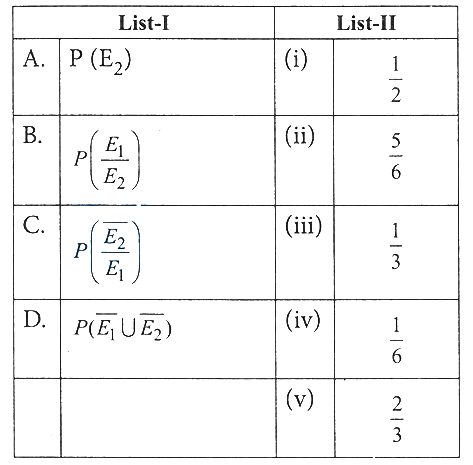
The correct match isAP EAMCET 2024 Easy - The circles \(x^2+y^2-2 x-4 y-4=0\) and \(x^2+y^2+2 x+4 y-11=0\)AP EAMCET 2025 Medium