


AP EAMCET · Maths · Binomial Theorem
If \(\left(1+2 x+3 x^2\right)^{10}\) \(=a_0+a_1 x+a_2 x^2+\ldots+a_{20} x^{20}\)
then \(\frac{a_2}{a_1}\) is equal to
- A 10.5
- B 21
- C 10
- D 5.5
Answer & Solution
Correct Answer
(A) 10.5
Step-by-step Solution
Detailed explanation
\(\left(1+2 x+3 x^2\right)^{10}\) \(=a_0+a_1 x+a_2 x^2+\ldots+a_{20} x^{20}\) \(=\{1+x(2+3 x)\}^{10}\) Then by binomial expansion \(={ }^{10} C_0+{ }^{10} C_1 x(2+3 x)+{ }^{10} C_2 x^2(2+3 x)^2+\ldots\) Now, the coefficient of \(x\) in this expansion \(=2 \cdot{ }^{10} C_1\)…
See the Complete Solution
Get step-by-step explanations for this and 2.5 Lakh+ more JEE, NEET & CET questions.
- Unlock all solutions
- Practice the full chapter
- Track accuracy across PYQs
4.8 rated on Google Play · 14,000+ reviews
More questions from Maths
- If thenAP EAMCET 2021 Medium
- Let \(a\gt1\) and \(0 \lt b \lt 1\). If \(f: \mathbf{R} \rightarrow[0,1]\) is defined by
\(f(x)=\left\{\begin{array}{l}a^x,-\infty \lt x \lt 0 \\ b^x, 0 \leq x \lt \infty\end{array}\right.\) then \(f(x)\) isAP EAMCET 2024 Medium - The area (in square units) of the triangle formed by the lines \(6 x^2+13 x y+6 y^2=0\) and \(x+2 y+3=0\) isAP EAMCET 2024 Medium
- If \(X\) is a binomial variate with the range \(\{0,1,2,3,4,5,6\}\) and \(P(X=2)=4 P(X=4)\), then the parameter \(p\) of \(X\) isAP EAMCET 2009 Easy
- If \(z=x+i y\) and \(z^2=(i \bar{z})^2\), thenAP EAMCET 2018 Easy
- The circumference of a circle is measured as \(56 \mathrm{~cm}\) with an error \(0.02 \mathrm{~cm}\). The percentage error in its area isAP EAMCET 2007 Easy
More PYQs from AP EAMCET
- Which of the following pair of ions have same paramagnetic moment?AP EAMCET 2004 Easy
- As shown in the figure, two infinitely long straight parallel wires \(P\) and \(Q\) carrying equal currents in opposite directions are arranged parallel to \(\mathrm{Y}\)-axis. If the magnetic field due to wire \(\mathrm{P}\) at the origin ' \(\mathrm{O}\) ' of the co-ordinate system is B, then match the resultant magnetic fields at various points given in column \(A\) with the points given in column \(B\).
\(\begin{array}{ll}
\text{Column A} & \text{Column B} \\
\text{A)} \frac{B}{4} & \text{i)} (0,0) \\
\text{B)} \frac{B}{2} & \text{ii)} (a, 0) \\
\text{C)} \frac{2 \mathrm{~B}}{3} & \text{iii)} (2a, 0) \\
\text{D)} 2 \mathrm{~B} & \text{iv)} (3 \mathrm{a}, 0) \\
\end{array}\)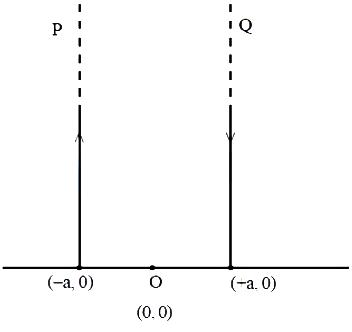
The correct answer isAP EAMCET 2017 Easy - If \(\tan \left(\frac{\pi}{4}+\alpha\right)=\tan ^3\left(\frac{\pi}{4}+\beta\right)\), then \(\tan (\alpha+\beta) \cot (\alpha-\beta)=\)AP EAMCET 2025 Medium
- Kepler's second law (law of areas) is nothing but a statement ofAP EAMCET 2020 Easy
- If two unbiased six-faced dice are thrown simultaneously until a sum of either or occurs, then the probability that comes before isAP EAMCET 2019 Easy
- The radius of orbit of an electron and the speed of electron in the ground state of hydrogen atom are \(5.5 \times 10^{-11} \mathrm{~m}\) and \(4 \times 10^6 \mathrm{~ms}^{-1}\) respectively. Then, the orbital period of this electron in the first excited state will be
......... .AP EAMCET 2017 Easy