


AP EAMCET · Chemistry · d and f Block Elements
Which of the following pair of ions have same paramagnetic moment?
- A \(\mathrm{Cu}^{2+}, \mathrm{Ti}^{3+}\)
- B \(\mathrm{Mn}^{2+}, \mathrm{Cu}^{2+}\)
- C \(\mathrm{Ti}^{4+}, \mathrm{Cu}^{2+}\)
- D \(\mathrm{Ti}^{3+}, \mathrm{Ni}^{2+}\)
Answer & Solution
Correct Answer
(A) \(\mathrm{Cu}^{2+}, \mathrm{Ti}^{3+}\)
Step-by-step Solution
Detailed explanation
\({ }_{29} \mathrm{Cu}=[\mathrm{Ar}] 3 d^{10} 4 s^1\) Both of these ions have one unpaired electron, hence these have same paramagnetic moment.
See the Complete Solution
Get step-by-step explanations for this and 2.5 Lakh+ more JEE, NEET & CET questions.
- Unlock all solutions
- Practice the full chapter
- Track accuracy across PYQs
4.8 rated on Google Play · 14,000+ reviews
More questions from Chemistry
- Given \(k_p\) for the reaction
\(\frac{1}{2} C(g) \rightleftharpoons \frac{1}{2} A(g)+\frac{1}{2} B(g)\) at a fixed temperature is \(0.25 \mathrm{~atm}^{-2}\). Find the \(K_p\) for the reaction
\(A(g)+B(g) \rightleftharpoons C(g)\) at the same temperature.AP EAMCET 2021 Easy - A reaction, \(3 \mathrm{X}(\mathrm{g}) \rightarrow 2 \mathrm{Y}(\mathrm{g})+\mathrm{Z}(\mathrm{g})\) takes place in a closed vessel. What is the rate of formation of \(Y\) (in \(\mathrm{mol} \mathrm{L}^{-1}\) ) if the rate of disappearance of \(\mathrm{X}\) is \(7.2 \times 10^{-3} \mathrm{~mol} \mathrm{~L}^{-1} \mathrm{~s}^{-1}\) ?AP EAMCET 2020 Easy
- Which among the following is most common in alkyl halides?AP EAMCET 2020 Medium
- Calculate the amount of \(\mathrm{CO}_2\) gas produced, when \(32 \mathrm{~g}\) moles of \(\mathrm{CH}_4\) is burned with sufficient amount of oxygen. (Given, atomic weights of \(\mathrm{C}=12, \mathrm{O}=16, \mathrm{H}=1\))AP EAMCET 2020 Easy
- Consider the following equilibrium reaction in gaseous state at \(\mathrm{T}(\mathrm{K})\).
\(\mathrm{A}+2 \mathrm{~B} \rightleftharpoons 2 \mathrm{C}+\mathrm{D}\)
The initial concentration of \(B\) is 1.5 times that of \(A\). At equilibrium, the concentrations of A and B are equal. The equilibrium constant for the reaction isAP EAMCET 2025 Medium - Observe the following equilibrium at \(\mathrm{T}(\mathrm{K})\)
\(\mathrm{H}_2(\mathrm{~g})+\mathrm{I}_2(\mathrm{~g}) \rightleftharpoons 2 \mathrm{HI}(\mathrm{g})\)
Which one of the following does not disturb the above equilibrium?AP EAMCET 2023 Easy
More PYQs from AP EAMCET
- If the number of diagonals of a regular polygon is 35, then the number of sides of the polygon isAP EAMCET 2025 Medium
- The approximate value of \(\int_1^3 \frac{d x}{2+3 x}\) using Simpson's rule and dividing the interval \([1,3]\) into two equal parts isAP EAMCET 2013 Hard
- A message signal of frequency \(14 \mathrm{kHz}\) is used to modulate a carrier of frequency \(900 \mathrm{kHz}\), then the frequencies of side bands areAP EAMCET 2023 Easy
- Five equal resistances each ' 2 R ' are connected as shown in figure. A battery of ' \(V\) ' volts connected between \(A\) and B. Then current through FC is
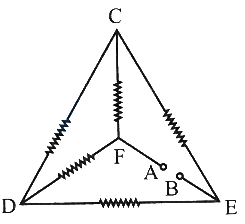 AP EAMCET 2024 Hard
 - A tension of \(20 \mathrm{~N}\) is applied to a copper wire of cross sectional area \(0.01 \mathrm{~cm}^2\), Young's modulus of copper is \(1.1 \times 10^{11} \mathrm{~N} / \mathrm{m}^2\) and Poisson's ratio is 0.32 . The decrease in cross sectional area of the wire isAP EAMCET 2013 Medium
- A micelle formed during the cleansing action by soap isAP EAMCET 2010 Easy