


AP EAMCET · Maths · Functions
Let \(a\gt1\) and \(0 \lt b \lt 1\). If \(f: \mathbf{R} \rightarrow[0,1]\) is defined by
\(f(x)=\left\{\begin{array}{l}a^x,-\infty \lt x \lt 0 \\ b^x, 0 \leq x \lt \infty\end{array}\right.\) then \(f(x)\) is
- A A bijection
- B One-one but not onto
- C Onto but not one-one-
- D Neither one-one nor onto
Answer & Solution
Correct Answer
(D) Neither one-one nor onto
Step-by-step Solution
Detailed explanation
\(f(x)= \begin{cases}a^x, & -\infty \lt x \lt 0 \\ b^x, & 0 \leq x \lt \infty\end{cases}\) \(a\gt1\) and \(0 \lt b \lt 1\) So by the graph Clearly, every horizontal line cuts \(f(x)\) at 2 points. Also, for \(f(x)=0\) There is no \(x \in \mathbb{R}\) So, \(f(x)\) is neither…
See the Complete Solution
Get step-by-step explanations for this and 2.5 Lakh+ more JEE, NEET & CET questions.
- Unlock all solutions
- Practice the full chapter
- Track accuracy across PYQs
4.8 rated on Google Play · 14,000+ reviews
More questions from Maths
- Maximum area of the rectangle inscribed in a circle of radius \(10 \mathrm{cms}\) isAP EAMCET 2022 Medium
- \(\tan 9^{\circ}-\tan 27^{\circ}-\tan 63^{\circ}+\tan 81^{\circ}=\)AP EAMCET 2020 Easy
- The lengths of the intercepts made by a circle \(\mathrm{S}\) on \(\mathrm{X}\) and \(\mathrm{Y}\) - axes are \(\frac{2 \sqrt{13}}{3}\) and \(\frac{2 \sqrt{22}}{3}\) respectively. If the radius of the circle \(\mathrm{S}\) is \(\frac{\sqrt{38}}{3}\) and its centre \(\mathrm{C}\) lies in the second quadrant, then \(\mathrm{C}=\)AP EAMCET 2023 Medium
- If \(\left[\begin{array}{ccc}1 & -1 & x \\ 1 & x & 1 \\ x & -1 & 1\end{array}\right]\) has no inverse, then the real value of \(x\) isAP EAMCET 2020 Easy
- If the normal drawn at the point \(P\left(\frac{\pi}{4}\right)\) on the ellipse \(x^2+4 y^2-4=0\) meets the ellipse again at \(\mathrm{Q}(\alpha, \beta)\), then \(\alpha=\)AP EAMCET 2025 Medium
- If \(x=\frac{2}{5}+\frac{1 \cdot 3}{2 !}\left(\frac{2}{5}\right)^2+\frac{1 \cdot 3 \cdot 5}{3 !}\left(\frac{2}{5}\right)^3+\ldots\), then \(x+\frac{1}{x}=\)AP EAMCET 2019 Medium
More PYQs from AP EAMCET
- Let \(\mathrm{V}_1\) be the potential at the center of the square of side \(1 \mathrm{~m}\) when the charges at the 4 corners are \(2 \mathrm{C}\) each. If the same charges are placed at the corners of a square of side \(2 \mathrm{~m}\), then the potential at the centre of this square is \(\mathrm{V}_2\). The value of \(\frac{V_2}{V_1}\) isAP EAMCET 2022 Medium
- Two blocks of masses ' \(M\) ' and ' \(m\) ' are placed on one another on a smooth horizontal surface as shown in the figure.
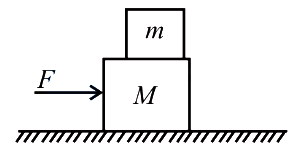
The force ' \(F\) ' is acting on the mass ' \(M\) ' horizontally during time interval ' \(t\) '. Assuming no relative sliding between the blocks, the work done by friction on the blocks is .......... .AP EAMCET 2017 Easy - The coefficient of \(x^k\) in the expansion of \(\frac{1-2 x-x^2}{e^{-x}}\) isAP EAMCET 2007 Hard
- If two of the lines represented by \(2 x^3+x^2 y+y^3=0\) are mutually perpendicular, then the slope of the third line isAP EAMCET 2017 Easy
- The plates of a parallel plate capacitor are charged upto 200 volts. A dielectirc slab of thickness \(4 \mathrm{~mm}\) is inserted between its plates. Then, to maintain the same potential difference between the plates of the capacitor, the distance between the plates is increased by \(3.2 \mathrm{~mm}\). The dielectric constant of the dielectric slab isAP EAMCET 2004 Medium
- \[
\int_0^{\pi^2 / 4}(2 \sin \sqrt{x}+\sqrt{x} \cos \sqrt{x}) d x=
\]AP EAMCET 2022 Medium