


WBJEE · Physics · Nuclear Physics
Two radionctive substances \(A\) and \(B\) have decay constants \(5 \lambda\) and \(\lambda\) respectively. At \(t=0,\) they have the same number of nuclei. The ratio of number of nuclei of \(A\) to that of \(B\) will be \((1 / e)^{2}\)
after a time interval of
- A \(\frac{1}{\lambda}\)
- B \(\frac{1}{2 \lambda}\)
- C \(\frac{1}{3 \lambda}\)
- D \(\frac{1}{4 \lambda}\)
Answer & Solution
Correct Answer
(B) \(\frac{1}{2 \lambda}\)
Step-by-step Solution
Detailed explanation
We know that \(N=N_{0} e^{-\lambda t}\) For \(A\), \(N_{A}=N_{0} e^{-5 \lambda_{L}}\) For \(B\), \(N_{B}=N_{0} e^{-\lambda t}\) Given, \(\begin{aligned} \frac{N_{A}}{N_{B}} &=\frac{1}{e^{2}} \\ \frac{N}{N_{B}} &=\frac{1}{e^{4 \lambda t}} \\ t &=\frac{1}{2 \lambda} \end{aligned}\)
See the Complete Solution
Get step-by-step explanations for this and 2.5 Lakh+ more JEE, NEET & CET questions.
- Unlock all solutions
- Practice the full chapter
- Track accuracy across PYQs
4.8 rated on Google Play · 14,000+ reviews
More questions from Physics
- If a person can throw a stone to maximum height of \(\mathrm{h}\) metre vertically, then the maximum distance through which it can be thrown horizontally by the same person isWBJEE 2011 Medium
- A wooden block is floating on water kept in a beaker. \(40 \%\) of the block is above the water surface. Now the beaker is kept inside a lift that starts going upward with acceleration equal to \(g / 2\). The block will thenWBJEE 2014 Medium
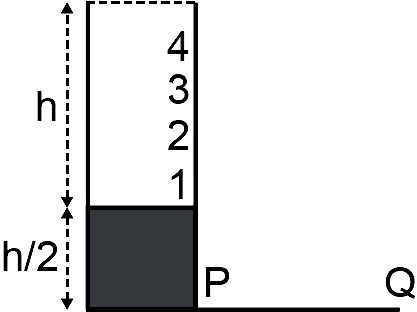
- A cylinder of height his filled with wator and is kept on a block of height \(h / 2\) The level of water in the cylinder is kept constant. Four holes numbered 1,2,3 and 4 are at the side of the cylinder and at heights \(0, h / 4, h / 2\) and \(3 h / 4,\) respectively. When all four holes are openned together, the hole from which water will reach farthest distance on the plane \(P Q\) is the hole number.
 WBJEE 2015 Medium
 - A point source is placed at coordinates (0,1) in \(x y\) -plane. A ray of light from the source is reflected on a plane mirror placed along the
\(X\) -axis and perpendicular to the \(x y\) -plane. The reflected ray passes through the point \((3,3) .\) What is the path length of the ray from (0,1) to (3,3)\(?\)WBJEE 2018 Easy - If \(n\) denotes a positive integer, \(h\) the Planck constant, \(q\) the charge and \(B\) the magnetic field, then the quantity \(\left[\frac{n h}{2 \pi q B}\right]\) has theWBJEE 2014 Easy
- The intensity of a sound appears to an observer to be periodic. Which of the following can be the cause of it?WBJEE 2018 Easy
More PYQs from WBJEE
- If four distinct points \((2 k, 3 k),(2,0),(0,3)\) (0,0) lie on a circle, thenWBJEE 2012 Medium
- A negative charge is placed at the midpoint between two fixed equal positive charges, separated by a distance \(2 d\). If the negative charge is given a small displacement \(x(x< < a)\) perpendicular to the line joining the positive charges, how the force \((F)\) developed on it will approximately depend on \(x ?\)WBJEE 2019 Easy
- The general value of the real angle \(\theta\), which satisfies the equation. \((\cos \theta+i \sin \theta)(\cos 2 \theta+i \sin 2 \theta) \ldots(\cos n \theta+t \sin n \theta)=1\) is given by, (assuming \(k\) is an integer)WBJEE 2019 Medium
- Four capacitors of equal capacitance have an equivalent capacitance \(\mathrm{C}_1\) when connected in series and an equivalent capacitance \(\mathrm{C}_2\) when connected in parallel. The ratio \(\frac{\mathrm{C}_1}{\mathrm{C}_2}\) is:WBJEE 2009 Easy
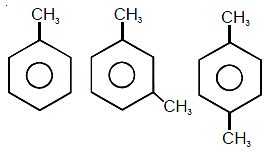
- The ease of Nitration of the following three hydrocarbons follows the order
 WBJEE 2011 Medium
 - Which of the following is present in maximum amount in 'acid rain'?WBJEE 2018 Easy