


WBJEE · Physics · Laws of Motion
To determine the coefficient of friction between a rough surface and a block, the surface is kept inclined at \(45^{\circ}\) and the block is released from rest. The block takes a time \(t\) in moving a distance \(d\). The rough surface is then replaced by a smooth surface and the same experiment is repeated. The block now takes a time \(t / 2\) in moving down the same distance d. The coefficient of friction is
- A \(3 / 4\)
- B \(5 / 4\)
- C \(1 / 2\)
- D \(1 / \sqrt{2}\)
Answer & Solution
Correct Answer
(A) \(3 / 4\)
Step-by-step Solution
Detailed explanation
If the same wedge is made rough then time taken by it to come down becomes \(n\) times more. The coefficient of friction…
See the Complete Solution
Get step-by-step explanations for this and 2.5 Lakh+ more JEE, NEET & CET questions.
- Unlock all solutions
- Practice the full chapter
- Track accuracy across PYQs
4.8 rated on Google Play · 14,000+ reviews
More questions from Physics
- An object is placed \(30 \mathrm{cm}\) away from a convex lens of focal length \(10 \mathrm{cm}\) and a sharp image is formed on a screen. Now a concave lens is placed in contact with the convex lens. The screen now has to be moved by \(45 \mathrm{cm}\) to get \(\underline{a}\) sharp image again. The magnitude of focal length of the concave lens is (in \(\mathrm{cm}\) )WBJEE 2014 Medium
- Two charges, each equal to \(-q\) are kept at \((-a, 0)\) and \((a, 0)\). A charge \(q\) is placed at the origin. If \(q\) is given a small displacement along y direction, the force acting on q is proportional toWBJEE 2022 Easy
- A biconvex lens of focal length \(f\) and radii of curvature of both the surfaces \(R\) is made of a material of refractive index \(n_{1}\). This lens is placed in a liquid of refractive index \(n_{2}\). Now this lens will behave likeWBJEE 2013 Easy
- A particle of mass \(M\) and charge \(q\), initially at rest, is accelerated by a uniform electric field \(E\) through a distance \(D\) and is then allowed to approach a fixed static charge \(Q\) of the same sign. The distance of the closest approach of the charge \(q\) will then beWBJEE 2013 Medium
- A particle with charge \(q\) moves with a velocity \(v\) in a direction perpendicular to the directions of uniform clectric and magnetic ficlds, \(E\) and \(B\) respectively, which are mutually perpendicular to each other. Which one of the following gives the condition for which the particle moves undeflected in its original trajectory?
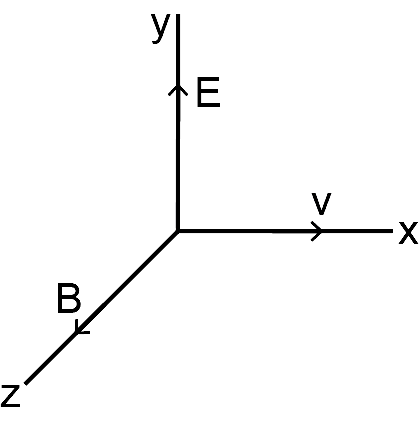 WBJEE 2019 Easy
 - Let \(v_{n}\) and \(E_{n}\) be the respective speed and energy of an electron in the \(n\) th orbit of radius \(r_{n}\), in a hydrogen atom, as predicted by Bohr's model. Then.WBJEE 2017 Medium
More PYQs from WBJEE
- The RMS velocity of CO gas molecules at \(27^{\circ} \mathrm{C}\) is approximately \(1000 \mathrm{m} / \mathrm{s}\). For molecules at \(600 \mathrm{K}\), the RMS velocity is approximatelyWBJEE 2015 Medium
- The area bounded by \(y=x+1\) and \(y=\cos x\) and the \(X\) -axis, isWBJEE 2019 Easy
- Amongst the following compounds, the one which would not respond to iodoform test isWBJEE 2016 Medium
- Let the foci of the ellipse \(\frac{x^{2}}{9}+y^{2}=1\) subtend a right angle at a point \(P\). Then, the locus of \(P\) isWBJEE 2012 Medium
- The reagent with which the following reaction is best accomplished is
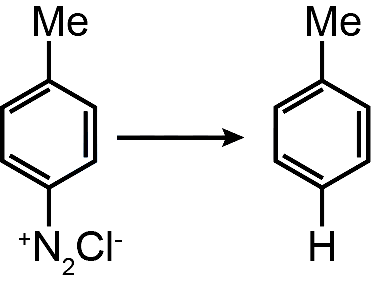 WBJEE 2014 Easy
 - The solution of the differential equation \(y \frac{d y}{d x}=x\left[\frac{y^{2}}{x^{2}}+\frac{\phi\left(\frac{y^{2}}{x^{2}}\right)}{\phi^{\prime}\left(\frac{y^{2}}{x^{2}}\right)}\right]\) is (where, \(c\) is a constant)WBJEE 2014 Hard