


WBJEE · Physics · Ray Optics
Three identical convex lenses each of focal length \(f\) are placed in a straight line separated by a distance \(f\) from each other. An object is located at \(\mathrm{f} / 2\) in front of the leftmost lens. Then,
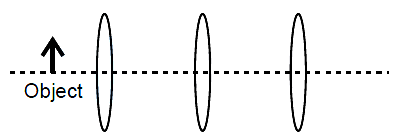
- A Final image will be at \(f / 2\) behind the rightmost lens and its magnification will be -1 .
- B Final image will be at \(f / 2\) behind the rightmost lens and its magnification will be +1 .
- C Final image will be at \(f\) behind the rightmost lens and its magnification will be -1 .
- D Final image will be at \(f\) behind the rightmost lens and its magnification will be +1 .
Answer & Solution
Correct Answer
(A) Final image will be at \(f / 2\) behind the rightmost lens and its magnification will be -1 .
Step-by-step Solution
Detailed explanation
Hint : For first lens…
See the Complete Solution
Get step-by-step explanations for this and 2.5 Lakh+ more JEE, NEET & CET questions.
- Unlock all solutions
- Practice the full chapter
- Track accuracy across PYQs
4.8 rated on Google Play · 14,000+ reviews
More questions from Physics
- A cricket ball thrown across a field is at heights \(h_{1}\) and \(h_{2}\) from the point of projection at times \(t_{1}\) and \(t_{2}\) respectively after the throw. The ball is caught by a fielder at the same height as that of projection. The time of flight of the ball in this journey isWBJEE 2014 Hard
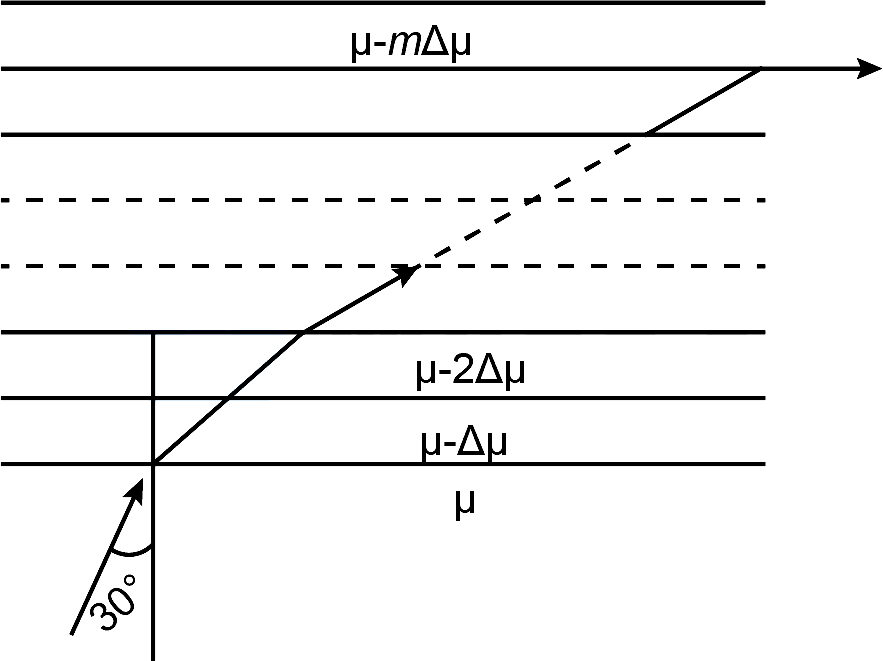
- A glass slab consists of thin uniform layers of progressively decreasing refractive indices RI (see figure) such that the RI of any layer is \(\mu-m \Delta \mu\). Here, \(\mu\) and \(\Delta \mu\) denote the \(\mathrm{RI}\) of 0 th layer and the difference in RI between any two consecutive layers, respectively. The integer \(m=0,1,2,3, \ldots\) denotes the numbers of the successive layers. A ray of light from the oth layer enters the 1st layer at an angle of incidence of \(30^{\circ}\). After undergoing the mth refraction, the ray emerges parallel to the interface. If \(\mu=1.5\) and \(\Delta \mu=0.015,\) the value of \(m\) is
 WBJEE 2014 Medium
 - One mole of a monoatomic ideal gas undergoes a quasistatic process, which is depicted by a straight line joining points \(\left(V_{0}, T_{0}\right)\) and \(\left(2 V_{0}, 3 T_{0}\right)\) in a \({V} \cdot T\) diagram. What is the value of the heat capacity of the gas at the point \(\left(V_{0}, T_{0}\right) ?\)WBJEE 2018 Medium
- A box of mass \(2 \mathrm{kg}\) is placed on the roof of a car. The box would remain stationary until the car attains a maximum acceleration. Coefficient of static friction between the box and the roof of the car is 0.2 and \(g=10 \mathrm{ms}^{-2}\) This maximum acceleration of the car, for the box to remain stationary, isWBJEE 2012 Medium
- The density of the material of a cube can be estimated by measuring its mass and the length of one of its sides. If the maximum error in the measurement of mass and length are \(0.3 \%\) and \(0.2 \%\) respectively, the maximum error in the estimation of the density of the cube is approximately.WBJEE 2019 Medium
- An electron of charge \(e\) and mass \(m\) is moving in a circular of radius \(r\) with a uniform angular speed \(\omega .\) Then which of the following statements are correct?WBJEE 2013 Easy
More PYQs from WBJEE
- The area bounded by the parabolas \(y=4 x^{2}, y=\frac{x^{2}}{9}\) and the straight line \(y=2\) isWBJEE 2021 Medium
- The dispersed phase and dispersion medium of fog respectively areWBJEE 2015 Easy
- At a certain temperature the time required for the complete diffusion of \(200 \mathrm{mL}\) of \(\mathrm{H}_{2}\) gas is 30 min. The time required for the complete diffusion of \(50 \mathrm{mL}\) of \(\mathrm{O}_{2}\) gas at the same temperature will beWBJEE 2014 Easy
- If from a point \(\mathrm{P}(\mathrm{a}, \mathrm{b}, \mathrm{c})\), perpendiculars \(\mathrm{PA}\) and \(\mathrm{PB}\) are drawn to \(\mathrm{YZ}\) and \(\mathrm{ZX}\) planes respectively, then the equation of the plane \(\mathrm{OAB}\) isWBJEE 2021 Easy
- Lines \(x+y=1\) and \(3 y=x+3\) intersect the ellipse \(x^{2}+9 y^{2}=9\) at the points \(P, Q\) and \(R\). The area of the \(\triangle P Q R\) isWBJEE 2013 Hard
- A galvanometer having internal resistance \(10 \Omega\) requires 0.01 A for a full scale deflection. To convert this galvanometer to a voltmeter of full-scale deflection at \(120 \mathrm{V}\), we need to connect a resistance ofWBJEE 2014 Easy