


WBJEE · Physics · Mathematics in Physics
The vectors are given by \(\dot{\mathbf{A}}=\hat{\mathbf{i}}+2 \hat{\mathbf{j}}+2 \hat{\mathbf{k}}\) and \(\mathbf{B}=3 \hat{\mathbf{i}}+6 \hat{\mathbf{j}}+2 \mathbf{k}\). Another vector \(\mathbf{C}\) has the same magnitude as \(\mathbf{B}\) but has the same direction as A. Then which of the following vectors represents C?
- A \(\frac{7}{3}(\hat{\mathrm{i}}+2 \hat{\mathrm{j}}+2 \hat{\mathrm{k}})\)
- B \(\frac{3}{7}(i-2 \hat{j}+2 \hat{k})\)
- C \(\frac{7}{9}(i-2 \hat{j}+2 \hat{k})\)
- D \(\frac{9}{7}(\vec{i}+2 \hat{j}+2 \hat{k})\)
Answer & Solution
Correct Answer
(A) \(\frac{7}{3}(\hat{\mathrm{i}}+2 \hat{\mathrm{j}}+2 \hat{\mathrm{k}})\)
Step-by-step Solution
Detailed explanation
(a) Given, \(A=i+2 j+2 \hat{k}\) and \(B=3 \hat{i}+6 j+2 \hat{k}\) So, \(\quad C=\frac{\hat{i}+2 \hat{j}+2 \hat{k}}{\sqrt{1+4+4}} \times \sqrt{3^{2}+6^{2}+2^{2}}\) \(=\frac{\hat{i}+2 \hat{j}+2 \hat{k}}{3} \times \sqrt{49}=\frac{7}{3}(\hat{i}+2 \hat{j}+2 \hat{\mathbf{k}})\)
See the Complete Solution
Get step-by-step explanations for this and 2.5 Lakh+ more JEE, NEET & CET questions.
- Unlock all solutions
- Practice the full chapter
- Track accuracy across PYQs
4.8 rated on Google Play · 14,000+ reviews
More questions from Physics
- The figure represents two equipotential lines in \(\mathrm{x}-\mathrm{y}\) plane for an electric field. The \(\mathrm{x}\)-component \(\mathrm{E}_{\mathrm{x}}\) of the electric field in space between these equipotential lines is,
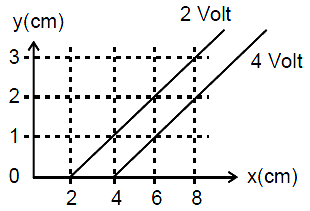 WBJEE 2023 Easy
 - Two point charges \(+\mathrm{q}_{1}\) and \(+\mathrm{q}_{2}\) are placed a finite distance ' \(\mathrm{d}\) ' apart. It is desired to put a third charge \(\mathrm{q}_{3}\) in between these two charges so that \(\mathrm{q}_{3}\) is in equilibrium. This isWBJEE 2021 Easy
- Which type of Gate the following truth table represents?
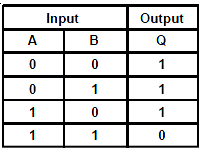 WBJEE 2011 Easy
 -
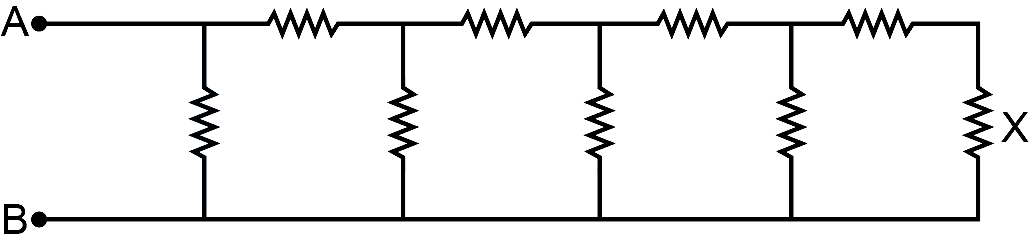 Consider the circuit shown in the figure where all the resistances are of magnitude \(1 \mathrm{k} \Omega\). If the current in the extreme right resistance \(X\) is \(1 \mathrm{mA},\) the potential difference between \(A\) and \(B\) isWBJEE 2017 Medium
 - Which of the following statements(s) is/are true? "Internal energy of an ideal gas ..........."WBJEE 2018 Easy
- To which of the following quantities, the radius of the circular path of a charged particle moving at right angles to a uniform magnetic field is directly proportional?WBJEE 2019 Medium
More PYQs from WBJEE
- Chords AB & CD of a circle intersect at right angle at the point P. If the length of AP, PB, CP, PD are 2, 6, 3, 4 units respectively, then the radius of the circle isWBJEE 2024 Easy
- Let \(f(x)=\frac{\sqrt{x+3}}{x+1}\) then the value of \(\underset{x \rightarrow-3-0}{\operatorname{Lt}} f(x)\) isWBJEE 2009 Easy
- Let \(d_{1}\) and \(d_{2}\) be the lengths of the perpendiculars drawn from any point of the line \(7 x-9 y+10=0\) upon the lines \(3 x+4 y=5\) and \(12 x+5 y=7,\) respectively. Then,WBJEE 2017 Medium
- The equivalent capacitance of a combination of connected capacitors shown in the figure between the points P and N
is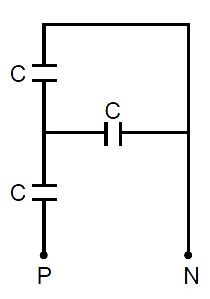 WBJEE 2024 Easy
 - The co-ordinates of the point on the curve \(y=x^2-3 x+2\) where the tangent is perpendicular to the straight line \(y=x\) areWBJEE 2010 Easy
- In which of the following mixed aqueous solutions, \(\mathrm{pH}=\mathrm{p} K_{a}\) at equilibrium?
(1) \(100 \mathrm{mL}\) of \(0.1 \mathrm{M} \mathrm{CH}_{3} \mathrm{COOH}+100 \mathrm{mL}\) of \(0.1 \mathrm{MCH}_{3} \mathrm{COONa}\)
(2) \(100 \mathrm{mL}\) of \(0.1 \mathrm{MCH}_{3} \mathrm{COOH}+50 \mathrm{mL}\) of 0.1 \(\mathrm{M} \mathrm{NaOH}\)
(3) \(100 \mathrm{mL}\) of \(0.1 \mathrm{M} \mathrm{CH}_{3} \mathrm{COOH}+100 \mathrm{mL}\) of \(0.1 \mathrm{M} \mathrm{NaOH}\)
(4) \(100 \mathrm{mL}\) of \(0.1 \mathrm{M} \mathrm{CH}_{3} \mathrm{COOH}+100 \mathrm{mL}\) of \(0.1 \mathrm{M} \mathrm{NH}_{3}\)WBJEE 2016 Hard