


WBJEE · Maths · Complex Number
The equation \(z \bar{z}+(2-3 i) z+(2+3 i) \bar{z}+4=0\) represents a circle of radius
- A 2 unit
- B 3 unit
- C 4 unit
- D 6 unit
Answer & Solution
Correct Answer
(B) 3 unit
Step-by-step Solution
Detailed explanation
Hint: Centre and radius of \(z \bar{z}+\bar{a} z+a \bar{z}+b=0\) are \(-a\) and \(\sqrt{|a|^{2}-b} \therefore\) radius \(=\sqrt{13-4}=3\)
See the Complete Solution
Get step-by-step explanations for this and 2.5 Lakh+ more JEE, NEET & CET questions.
- Unlock all solutions
- Practice the full chapter
- Track accuracy across PYQs
4.8 rated on Google Play · 14,000+ reviews
More questions from Maths
- Let \(f(x)\) be continuous on \([0,5]\) and differentiable in \((0,5)\). If \(f(0)=0\) and \(\left|f^{\prime}(x)\right| \leq \frac{1}{5}\) for all \(x\) in \((0,5)\), then \(\forall x\) in \([0,5]\).WBJEE 2025 Medium
- The number of distinct real roots of \(\left|\begin{array}{lll}\sin x & \cos x & \cos x \\ \cos x & \sin x & \cos x \\ \cos x & \cos x & \sin x\end{array}\right|=0\) in the interval \(-\frac{\pi}{4} \leq x \leq \frac{\pi}{4}\) isWBJEE 2015 Medium
- The solution of the differential equation \(\frac{d y}{d x}+\frac{y}{x \log _{e} x}=\frac{1}{x}\) under the condition \(y=1\) when \(x=e\) isWBJEE 2014 Medium
- The chord of the curve \(y=x^{2}+2 a x+b\) joining the points where \(x=\alpha\) and \(x=\beta,\) is parallel to the tangent to the curve at abscissa \(x\) is equal toWBJEE 2017 Medium
- If \(\alpha\) and \(\beta\) are the roots of the equation \(x^2+x+1=0\), then the equation whose roots are \(\alpha^{19}\) and \(\beta^7\) isWBJEE 2011 Hard
- The plane \(2 x-y+3 z+5=0\) is rotated through \(90^{\circ}\) about its line of intersection with the plane \(x+y+z=1\). The equation of the plane in new position isWBJEE 2024 Hard
More PYQs from WBJEE
- What amount of clectricity can deposit
I mole of Al metal at cathode when passed through molten \(\mathrm{AlCl}_{3} ?\)WBJEE 2018 Easy - The molar conductances of \(\mathrm{Ba}(\mathrm{OH})_2, \mathrm{BaCl}_2\) and \(\mathrm{NH}_4 \mathrm{Cl}\) at infinite dilution are \(523.28,280.0\) and \(129.8 \mathrm{~S} \mathrm{~cm}^2 \mathrm{~mol}^{-1}\) respectively. The molar conductance of \(\mathrm{NH}_4 \mathrm{OH}\) at infinite dilution will beWBJEE 2025 Medium
- The value of \((1+\cos \pi / 6)(1+\cos \pi / 3)(1+\cos 2 \pi / 3)(1+\cos 7 \pi / 6)\) isWBJEE 2009 Easy
- A line passing through the point of intersection of \(x+y=4\) and \(x-y=2\) makes an angle \(\tan ^{-1}\left(\frac{3}{4}\right)\) with the \(x\) -axis. It intersects the parabola \(y^{2}=4(x-3)\) at points \(\left(x_{1}, y_{1}\right)\) and \(\left(x_{2}, y_{2}\right)\) respectively. Then, \(\left|x_{1}-x_{2}\right|\) is equal toWBJEE 2013 Hard
-
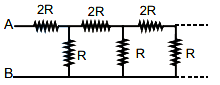
What will be the equivalent resistance between the terminals A and B of the infinite resistive network shown in the figure?WBJEE 2020 Hard - Let \(a_n\) denote the term independent of \(x\) in the expansion of \(\left[x+\frac{\sin (1 / n)}{x^2}\right]^{3 n}\), then \(\lim _{n \rightarrow \infty} \frac{\left(a_n\right) n!}{{ }^{3 n} P_n}\) equalsWBJEE 2025 Hard